
Tags
cherokee-indians, native-americans, New Seneca, northeast-alabama-history, trail-of-tears, turkeytown
First, a look at what Historian Mrs. Margaret Stewart, in her Cherokee County History Volume 1 (published 1958), stated on page 204. This is about where Chief Little Turkey lived.
What do the Cherokee people say? What do the people who interacted with the Cherokee people in Dah-noo-wey-ye (Turkey’s Place) say about the location?
“Turkey Town named for noted Chief “The Turkey” and located in the bend of the Coosa River opposite to and one mile south of the town of Centre. It was founded about 1770, and was considerable size and importance. It is marked on the Royce’s Map (1884) opposite the influx of Terrapin Creek. Chief Turkey lived on the east side of Turkey Creek on what later became the Sims farm. By some Indian agents and traders, the town was called New Seneca.”
We need to handle this Sims farm and the statements about this before we get to the Cherokee people. It adds too much to the confusion.
Where is this Sims’ farm? You will not find a Sims farm on the West side of the Coosa River opposite Centre Alabama. No Turkey Creek as well. Mrs. Stewart’s reference to the Sim’s farm is a newspaper article from the Gadsden Daily Times News dated 10 October 1899.
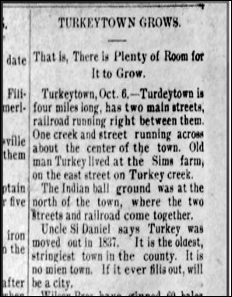
Gadsden, Alabama • Tue, Oct 10, 1899 Page 1
The location of this farm is in Etowah County, Alabama. The Sims’ farm is Richard G. Sims. In 1875, R. G. Sims purchased the property from Dr. Walter Baskin. Dr. Baskin had purchased the farm from the estate of Abraham Whorton. Abraham Whorton purchased it in November of 1840. Sims paid taxes on 152 acres in Section 16 of Township 11 & Range 7. This included the Eastern half of the NE and SE quarters. He paid these taxes through 1895. Richard Sims died on August 8, 1893. His wife, Catherine Sevilla Sims, and son, Robert B. Sims, sold this farm to Erastus Darrow in 1903. Mr. Darrow gifts this farm to Amanda McMahan. This is on Coats’ Bend Road, the south side of Turkeytown Creek. The border is Coats’ Bend Road to the Coosa River. The Northern border is Turkeytown Creek.1 2 (A map is at the end of this post.) Uncle Si Daniel is Josiah M. Daniel. He was Sheriff of Cherokee County from 1863-1869. (Coosa River News, page 3, 15 January 1892.) He lived in Leesburg, Cherokee County, Alabama.
It seems that Mrs. Stewart is contradicting herself. Is Turkey’s Town one mile south of Centre, Alabama? Or is it in Etowah County, Alabama at Turkeytown Creek on the Sims’ Farm?
What do the Cherokee people say?
A more precise location of Turkey’s Town is noted by Chief Charles R. Hicks. He is Chief Pathkiller’s second. A second is like the Vice-President of the Cherokee Nation.
After the Creek Indian War of 1813-1814, the Cherokee people sought compensation. They filed for reimbursement from the United States for their losses during the war. From 1814 War Claims;
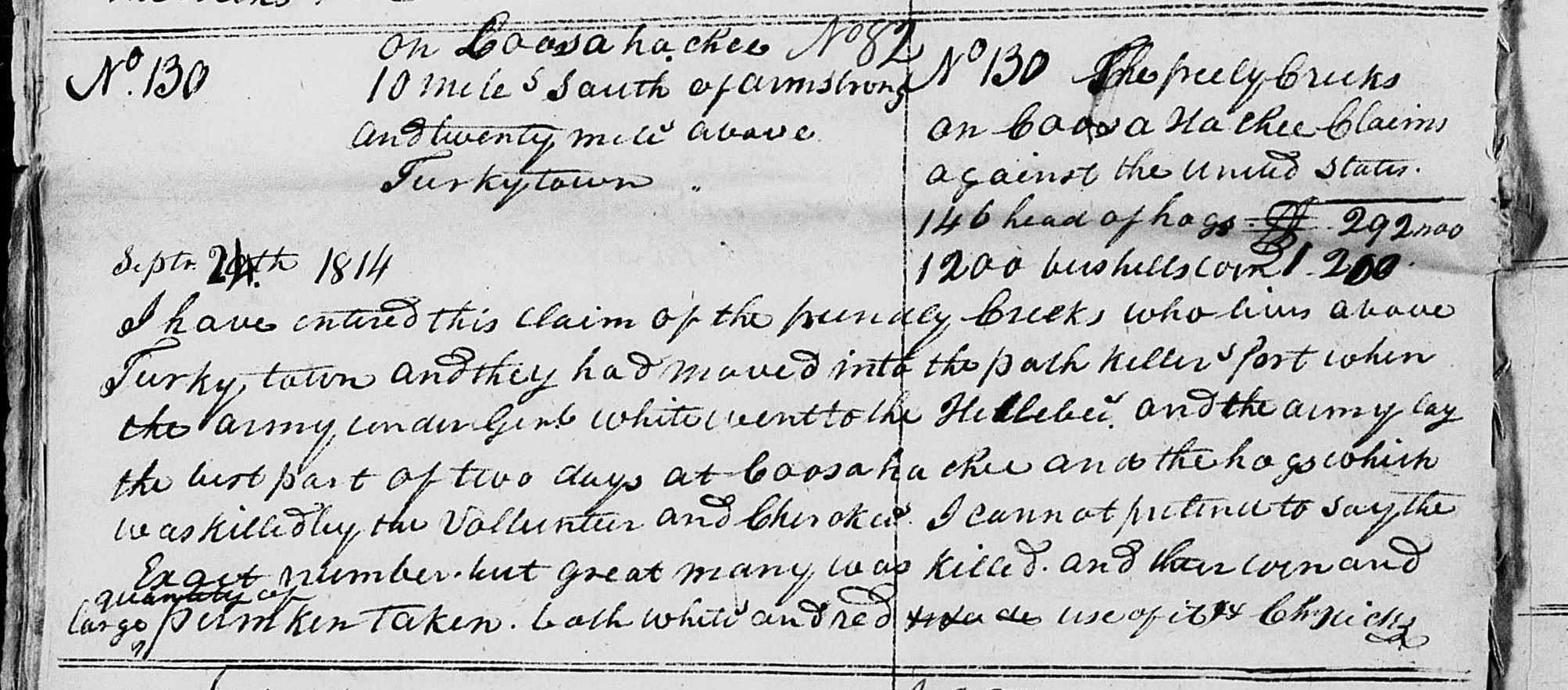
Sept 29th 1814 I have entered this claim of the friendly Creeks who live above Turkey town and they had moved into the Path Killers fort when the army under Genl White went to the Hillibees and the army lay the best part of two days at Coosahatchee and the hogs which was killed by the vollunteers and Cherokees I cannot pretend to say the exact number but great many was killed and there corn and large quantities of pumkin taken. both white and red made use of it. Ch Hicks. On the Coosahatchee No. 82 10 miles South of (Fort) Armstrong and 20 miles above Turkey’s Town. 3
Chief Hicks noted Coosahatchee location that is 10 miles South of Fort Armstrong. It is also 20 miles North (above) of Turkey town. The location of Fort Armstrong was located by archaeologists in 2017. This location is on Alabama Power Company property. Today, this would be on “Pruitt’s Island, Cherokee County, Alabama. This is the location of Fort Armstrong’s Ferry, which became Sewell’s Ferry. Today, this is mostly under the water of Weiss Lake. Travel ten miles South using the original roads you come to Coosahatchee. These roads are plotted on the original survey maps of 1838. This will place you at “Coloma” on Terrapin Creek. The below 1917 Cherokee County Road Map. It shows wagon roads and trails. I have plotted Armstrong’s ferry. Each numbered square is a 1-mile square. You can see where “10 miles South of Armstrong” would be.
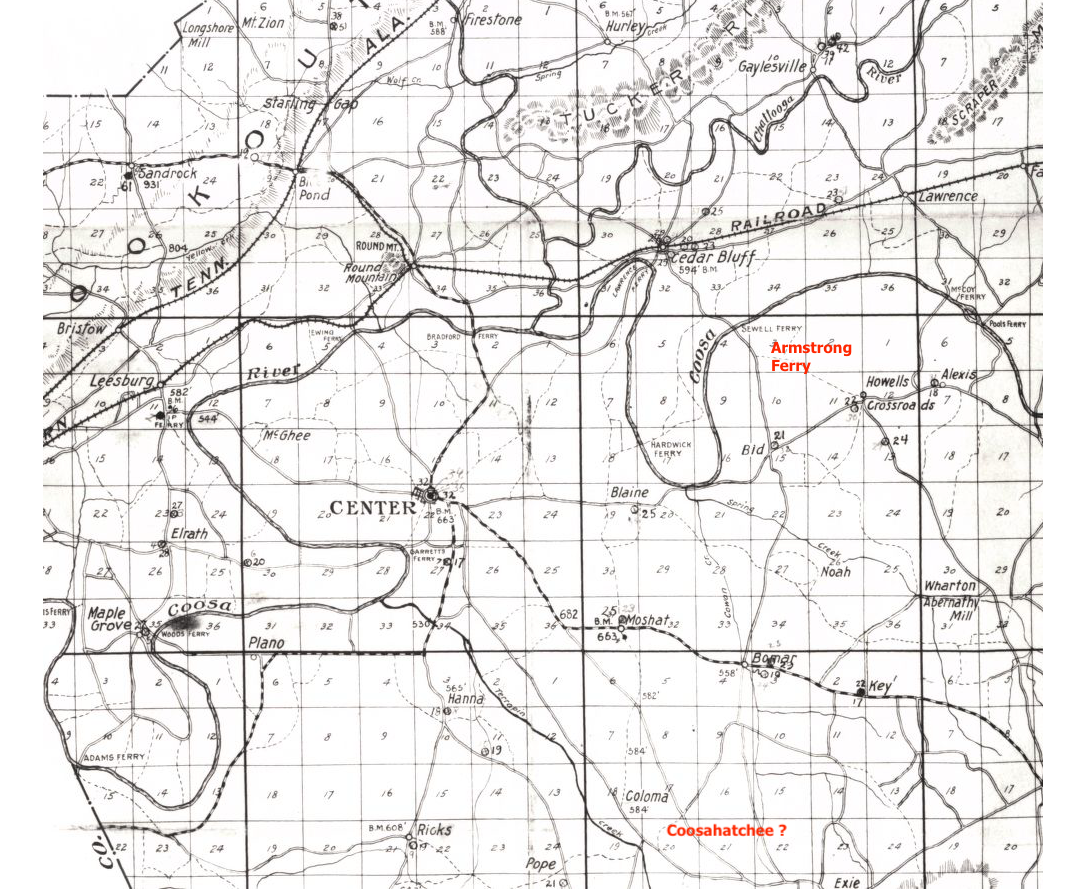
Traveling Southwest/west on original roads will place you at today’s Fitts Ferry (Kay’s Ferry), Coosa River, in Etowah County, Alabama. This is the site of Pathkiller’s residence and fort.
John LaTourette’s 1835 Map of Alabama titled An Accurate Map of the State of Alabama and West Florida, published in Mobile Alabama 1838. http://cartweb.geography.ua.edu/lizardtech/iserv/calcrgn?cat=North%20America%20and%20United%20States&item=States/Alabama/LatouretteSheet02.sid&wid=1000&hei=900&props=item(Name,Description),cat(Name,Description)&style=simple/view-dhtml.xsl
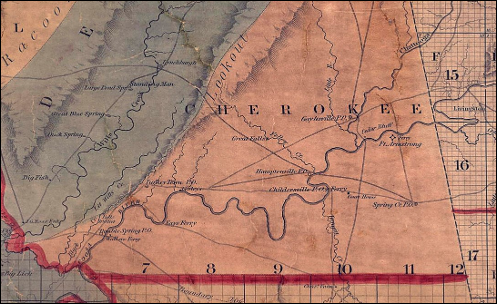
Chief Hicks’ location does not agree with James Mooney or Charles Royce. Turkey’s Town has to be 20 miles south of Centre, Alabama. On the above map, Centre, Alabama, is Childersville Ferry and the plot of “Court House.” This is a large distance from Childerville Ferry (Garrett’s Ferry). This notation of Chief Hick’s also would eliminate the tri-river location, as Don Naylor and Bob Minnix noted in 1993. See the earlier post on the traditional location. The Chattooga, Little River, and Coosa Rivers intersections are North and West of Fort Armstrong. This can not be Turkey’s Town.
Chief Hicks has stated that Turkey’s Town is much further South of Centre, Alabama, than what the Historians have stated. Did you review John Coffee’s and Royce’s maps? Just a note on General Coffee’s map: Terrapin Creek is listed as Rocky R.
Mission Teacher/Preacher, 1822, Tells Us the Location
A person deeply connected to the Cherokee people in Wills’ Town and Turkey’s Town is Reverend Daniel Butrick.
Reverend Daniel Butrick was the mission pastor and teacher. He was assigned to Willstown Mission. His assignment came from the Brainerd Mission (Presbyterian Church, American Board of Commissioners for Foreign Missions).
Rev. Daniel Sabin Butrick (or Buttrick) (August 25, 1789 – June 8, 1851) was commissioned in 1817 as a minister of the Word of God, in the service of the American Board of Commissioners for Foreign Missions (ABCFM). His subsequent 25 years were marked with personal failure and relational conflict as he sought to realize his mission to the Cherokee Nation, although his recorded observations concerning the Cherokee removal crisis and Trail of Tears established a legacy. His decision to champion Christian salvation over political advocacy resulted in the creation of an invaluable resource on Indian culture. (From Wikipedia, the free encyclopedia)
In Butrick’s report to the American Board of Commissioners for Foreign Missions, Thirteenth Annual Meeting in 1822, page 44;
From the journal, which Mr. Butrick kept, a few extracts will be made, and a summary will be given at the close. “19. Rode to the Boot’s, in Turkey-town, twenty-five miles. [This place is the residence of Path-killer, the king, or first beloved man, of the Cherokee nation. Mr. Hicks is the second beloved man.] 4
The information can be expounded on by what he wrote in his personal journal in January 1822. Assisting him was John Arch a converted Cherokee to Christianity, Butrick’s interpreter.
Set off for Wa-sa-si’s, but hearing he was not at home returned [to Browns], took our leave & rode to br. Brister’s 16 miles. 18 Jan 1822
Rode to the Boots in Turkey Town 25 miles. This man I believe is some like a prince regent. He attends to business when the king is absent or in ill health, and is his Creek interpreter. 19 Jan 18225
Brown is John Brown, a Pastor and Teacher with the ABCFM at Creek Path, which is now Guntersville, Alabama. Brister’s refers to Warwick Bristow. He settled in a valley that was given the name of Bristow’s Cove. Etowah County, Alabama, has a road named Bristow Cove Road and a stream by the same name. This is now the Aurora Community of Northwest Etowah County on Etowah County road 179. 1829, a post office was established under the name Brister’s Cove at Brister’s store. In 1830, the Brister’s Cove Post Office became the Aurora Post Office.6 If you travel on today’s roads, the distance is 26 miles. It is from Aurora at Bristow Cove Creek to Turkeytown Creek on Old US 411.
After spending most of the day with the Boot and his wife Rev. Daniel Butrick states in his journal on January 23rd, 1822, page 145;
Road 28-30 miles to the Widow Broom’s near Tas-ty-gi Creek.7
We can plot the Widow Broom’s location from the journal of L. V. Bierce; Travels in the South Land 1822-1823, pages 91-93.
April 3. Struck our tents and went two miles to Widow Broomes, a half bread who keeps a tavern. One mile from Broomes crossed the Chatooga, a narrow but deep stream over which is a very good Indian ferry. Eight miles from the ferry we crossed the Ecwomisteba or Little River, five miles from which we crossed yellow River. About a mile from the road up the latter river a natural curiosity worthy of notice. It is a perpendicular rock near two hundred feet high, in appearance having windows, doors and other appendages of a castle of the “lands of aulden time”. Viewed from the road, and time forbid a closer inspection, it is subline. The river falls nighty feet perpendicular over rock. It is on Mount lookout, the main branch of the Apalachian Chain. Five miles from Yellow Creek we encamped. 21m8
Bierce has described Yellow Creek Falls in Cherokee County, Alabama, on County Road 273. Start at today’s Yellow Creek and Yellow Creek Falls. Travel along Cherokee County Road 273 till it ends. Then head south on US 411. The route leads to Turkeytown Creek in Etowah County. If you use the old roads as much as they exist, it is 16 miles by automobile. You should add the 13 miles from the Widow Broomes to Yellow Creek, as stated by Bierce. This makes a total of 29 miles. “Road 28-30 miles to the Widow Broom’s“
This again places Turkey’s Town in Etowah County, Alabama.
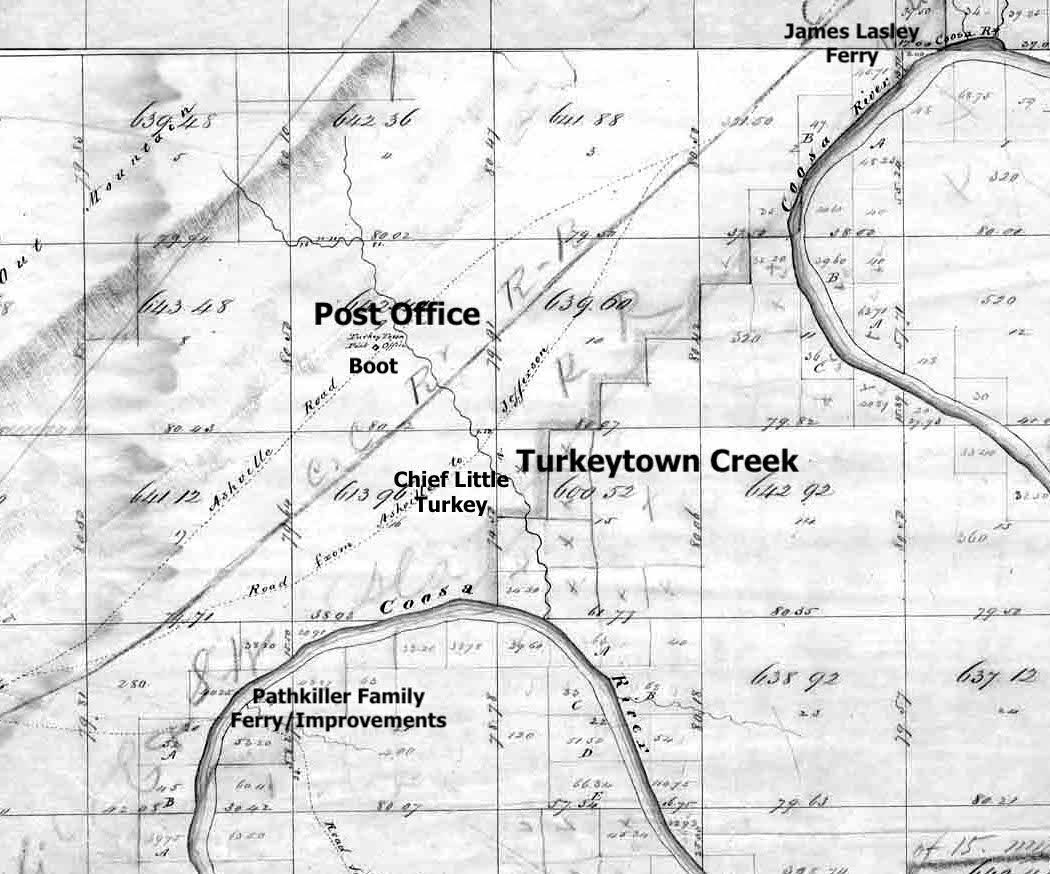
In both directions, you place Boot and family at today’s Turkeytown Creek. The heart of Turkey’s Town is on Turkeytown Creek. If the historians are correct, Chief Little Turkey lived on the east road (Coats’ Bend Road). Statement by Uncle Si Daniel in the 1899 Gadsden paper noted above. The Boot lived on the west road (Old US 411) at Turkeytown Creek.
Another note made by Rev Butrick is the Council House was one mile from the Boot. It is one mile in distance between Coats’ Bend Road and Old US 411. This would place the Council House on Coats’ Bend Road.
We accompanied our two fathers the Path Killer i.e. the king, and the Boot, to the council house about one mile distant. The council house consists of three roofs supported by crotches, each roof perhaps 30 feet long, built in this order viz; (drawing inserted) with a fire in the middle of the yard, and one immediately before each house. Here we found perhaps 100 dear immortals, precious sons and daughters of the forest. Perfect order and decency were maintained in every part of this assembly as far as we could judge.9

Did they place the council house near the Chief? Did Chief Little Turkey live near the Council House? Chief Little Turkey was not at home when he died. He died in March 1802 in Will’s Town. He is buried there.
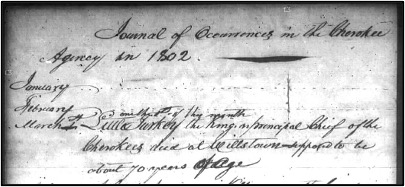
Conclusion
Chief Little Turkey lived on the East Road (Coats’ Bend Rd) near the Council House and Turkeytown Creek. The Boot lived on the West Road (Old US 411) near Turkeytown Creek. The heart of Turkey’s Town is along this creek.
Uncle Si appears to be correct. “Turkeytown is four miles long, has two main streets, railroad running right between them. One street and creek running across about the center of the town. October 1899.
These accounts are provided by the People of Turkey’s Town.
Location, By Chief Pathkiller’s family, is the next post in Uncovering the History of Turkeytown.
Pathkiller’s family has lots to say about this. They will confirm the original site of Turkey’s Town, Pathkiller’s residence and fort. They will reveal that Pathkiller had two different ferries. He lived in the above-plotted area with his family. He left when he moved north around 1819. He also took a new wife at that time. By doing this, Peggy, his former wife, will take possession of the improvements at his first ferry. The next post is significant to Uncovering the History of Turkeytown.
- Etowah County Land Plat records, Historic Plats, Etowah County Commission web site, https://etowahcounty.org/historic-plats/ Etowah County Abstract Company, 314 Chestnut Street, Gadsden, Alabama, ledger book information of said property ↩︎
- Will of Richard G. Sims from probate records of Etowah County Alabama 1893 found at FamilySearch.com https://www.familysearch.org/ark:/61903/3:1:33S7-9RRL-S34L?wc=MXRW-ZP6%3A314244401%2C317480301%26cc%3D1978117&cc=1978117&i=18 ↩︎
- Cherokee Claims War of 1812, List #82 Frame 121, Pathkiller Claim; NARA Microfilm M574 [Special Files of the Bureau of Indian Affairs]. Roll 17, Special File 104 [Claims for losses suffered by Cherokee Indians, particularly during the War of 1812]. https://www.familysearch.org/ark:/61903/3:1:3Q9M-CS5F-17GB-L?i=6&cat=362686 Digital image 129. ↩︎
- Report of the American Board of Commissioners for Foreign Missions, Thirteenth Annual Meeting 1822, page 44, Daniel Butrick, Yale University, https://findit.library.yale.edu/catalog/digcoll:445026. ↩︎
- Report of the American Board of Commissioners for Foreign Missions, Thirteenth Annual Meeting 1822, page 47, Daniel Butrick, Yale University, https://findit.library.yale.edu/catalog/digcoll:445026 ↩︎
- U. S. Appointments of Postmasters 1832-1971, ancestry.com. ↩︎
- Mission Among Us, the Cherokee Journal, February – August, 1823, by Reverend Daniel Butrick, The Missionary Herald, January, 1824, University of North Carolina, Chapel Hill. https://archive.org/details/missionamongcher00butr. ↩︎
- “Travels in the South Land 1822-1823”, pages 91-93. The Journal of Lucius Verus Bierce. Gadsden Public Library. ↩︎
- Mission Among Us, the Cherokee Journal, February – August, 1823, by Reverend Daniel Butrick, The Missionary Herald, January, 1824, University of North Carolina, Chapel Hill. https://archive.org/details/missionamongcher00butr. Pages 143-144. ↩︎
- Survey of Township 11 South of Range 7 East, of the Huntsville (AL) Meridian, Section 9. Plat certified April 20, 1840, by James W. Weakley, Surveyor General of the public lands in Alabama. Samuel Bigham, Deputy Surveyor.http://www.glorecords.blm.gov/SurveySearch/. ↩︎
- U. S. Appointments of Postmasters 1832-1971, ancestry.com ↩︎
Trust in the Lord with all your heart, and do not rely on your own understanding;
in all your ways know him, and he will make your paths straight. Proverbs 3; 5-6 CSV
 New Seneca Turkey's Town