
Tags
cherokee-indians, native-american, New Seneca, northeast-alabama-history, trail-of-tears, turkeytown
We have discovered that the actual location of Turkey’s Town is in Etowah County, Alabama. It is not one mile south of Centre, Alabama. This was revealed in the last post. Chief Charles R. Hicks and Reverend Daniel Butrick have given that information. How did the location in Centre, Alabama, come to be, and why is there conflicting information? Where did Chief Pathkiller live and where was his fort?
In this post, Chief Pathkiller and and his family explain where they lived. In the next post, we will examine the Centre, Alabama location. Hopefully, you will see the confusion come to an understanding.
The past Historians must not have had access to the family’s disputes. These disputes were between Pathkiller’s family over ownership of improvements. We learn a lot about Pathkiller’s family and uncover the history of Turkeytown.
The treaty of 1830 established the “Indian Removal Act.” The 1835 treaty resulted in the Trail of Tears, the forced removal of the Cherokee people. The Cherokee people filed claims for payment with the United States for what they left behind. They are referred to as Validation/Spoliation Claims. The people would be paid for houses, furniture, crops, and other miscellaneous items. This leads to misunderstandings within families. Chief Pathkiller’s grandchildren got into one of these disputes. Fortunately, this provides us with information on the location of Turkey’s Town. Bonus info is Pathkiller’s family history.
Pathkiller’s Grandchildren Dispute 1837
12 of September 1837 Personally, comes before me James Lasley being duly sworn that he does live in the neighborhood of the contested improvements. . . The grandfather of this claimant Anna Pathkiller being the person who made the first improvement and kept it and held it legally as his according to the Law and usage til about the year 1815 he made his children stay there to mine his stock and use it as a stock keeping place Tis true Dragging Canoe one of the old mans children did stay on the place for the purpose of keeping the stock as above and for no other purpose and under the direction and consent of the old man this grandfather as above nor did the old man give it or convey it to any one but his wife Peggy he died and left this in possession of the said place . . .this Peggy was the Legally possessed of it Before Peggy died a short time she made a will and left it Nelly her daughter who is the mother of Anna the present claimant and this Nelly told this despondent that she had given this said improvement to this same claimant Anna Pathkiller1
Above is a statement from an affidavit in part of James Lasley to Wilson Lumpkin. Lumpkin is the US Commissioner to the Cherokee Indians (1836-1837). He became Georgia’s Governor 1837-1841. He recorded several of the affidavits. The affidavit concerns the dispute of ownership of improvements on Chief Pathkiller and Peggy’s estate in 1837. This estate is today’s Alford’s Bend, Etowah County, Alabama.
Several affidavits were collected. They aimed to settle a dispute between Anna Pathkiller Hampton and Dragging Canoe’s son, daughter, and widow. The disagreement was over the improvements on the East side of the Coosa River at Peggy Pathkiller’s ferry.
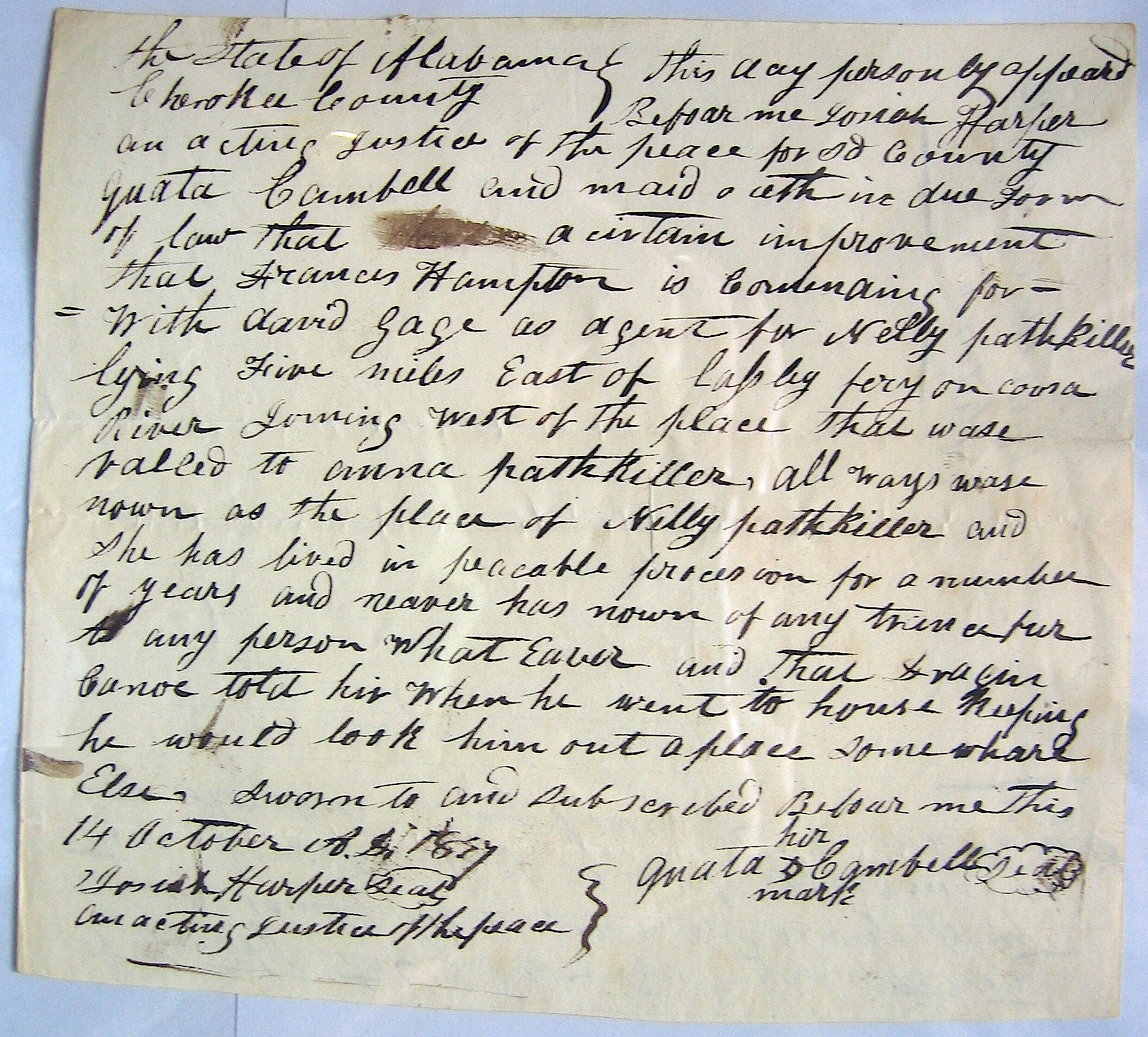
Dragging Canoe (not the Chickamauga war Chief) is the son of Pathkiller and Peggy. Sky-ah-too-ka is Dragging Canoe’s son. Dragging Canoe’s wife is Watty, and his daughter is Martha. David Gage, their representative, argues for them about ownership of the improvements. These improvements are on the “East side of the Coosa River five miles below Lasley’s ferry.” Lasley’s ferry is the today’s Croft ferry, Etowah County, Alabama. (James Lasley is a post of its own later.)
Anna Pathkiller is married to Frances Hampton. Anna is Nelly Pathkiller’s daughter. Nelly is the daughter of Peggy and Chief Pathkiller. Nelly is listed in Peggy’s will. Quata is Chief Pathkiller and Peggy’s daughter, married to George Campbell. She is the sister to Dragging Canoe and Nelly. She is listed in Peggy’s will. Dragging Canoe is not listed in Peggy’s will, she only takes care of the female side of the family. This was Cherokee custom.
There are several other affidavits about this dispute. Money Hunter has similar statements. Richard Ratliff has very similar statements. He is the husband of Charwahyooca (also known as Peggy Pathkiller Jr.). She is daughter of Pathkiller and Peggy and listed in Peggy’s will. Michael Wren collected the affidavits from Miscellaneous Claims Papers, 1836-1839. They are listed to the First Board of Cherokee Commissioners, Entry 236. They originate from the Records of the Bureau of Indian Affairs. This is Record Group 75, at the National Archives Building in Washington DC.
This is a lot of information just to say; “The grandfather of this claimant Anna Pathkiller being the person who made the first improvement and kept it and held it legally as his according to the Law and usage til about the year 1815.“ This does confirm that Pathkiller’s residence was 5 miles below Lasley’s on the east side of the Coosa. Also, the location of the pickled fort and ferry.
Note on Pathkiller’s Fort. Return J. Meigs to Nathan Lawson Pay Master General, 22 Jan 1820. “Also a number of members of the Cherokee warriors who were stationed at Turkey Town for one month only, in the time of the Creek War 1813-1814. This post camp had no officer to command them they were in a pickeled fort surrounding the resident of the King or Head Chief Pathkiller.“3 This was a request to pay the seventeen warriors for their service.
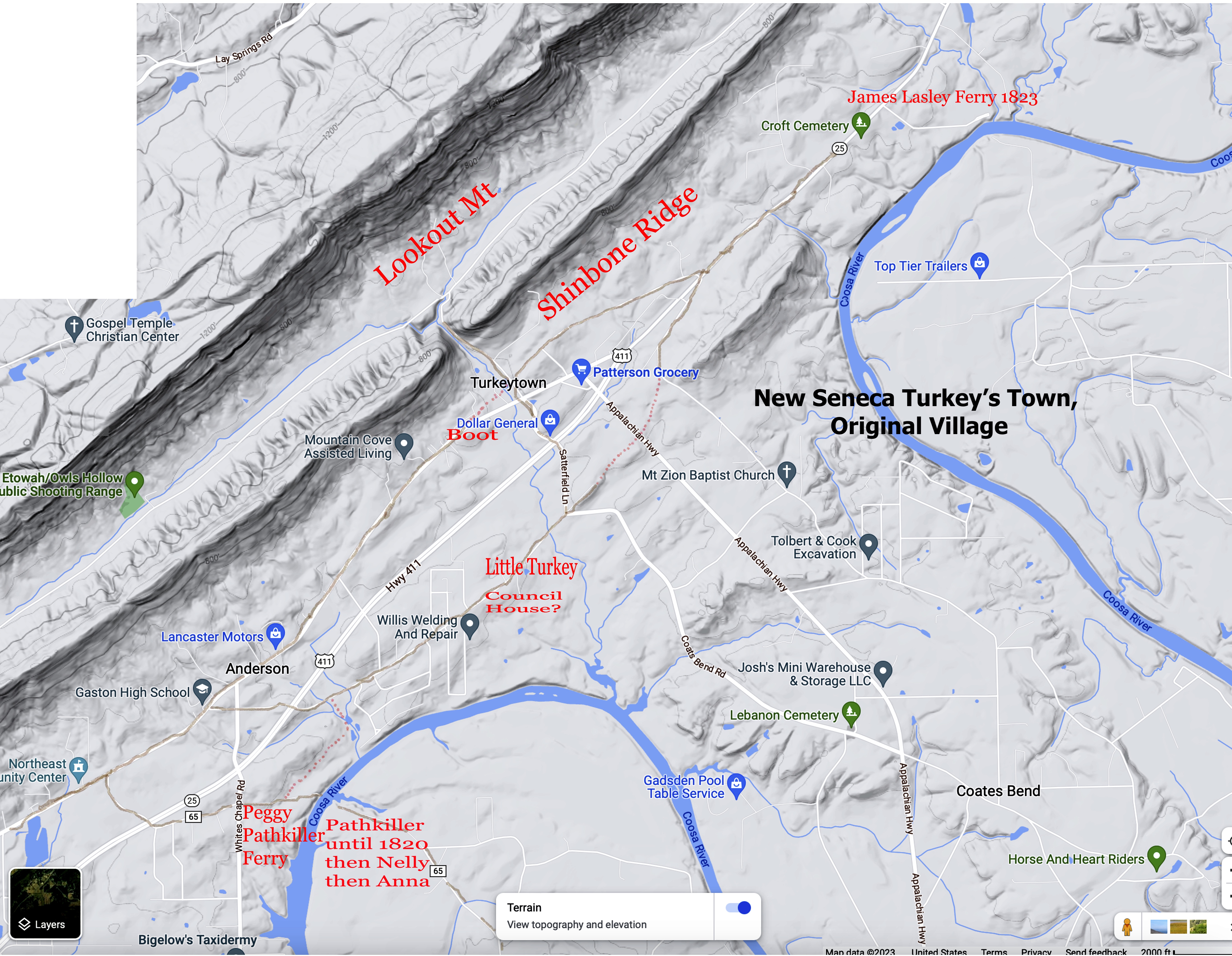
In the prior post on this subject, Chief Charles Hicks stated that friendly Creeks stayed at Pathkiller’s Fort. The fort was located in Turkey Town. The fort is 20 miles below Coosahatachee. Review the post on the Creek War Claims. Coosahatachee is on Terrapin Creek 10 miles below Fort Armstrong.
This is confirmation that the original village of Turkey’s Town would start at today’s Fitts Ferry (Pathkiller’s first ferry). This is in Etowah County, Alabama.
The Confirmation of Turkey’s Town by white intruders. The takeover of Peggy Pathkiller’s ferry
White US citizens move into Turkey’s Town. Their actions will confirm the location of Turkey’s Town. They will also confirm Pathkiller’s first residence and ferry.
A Report to the Alabama Chapter of The Trail of Tears, 2007. Chapter 8 Topography of the Removal Routes, Ferry Crossings on Major Rivers and Tributaries by Michael Wren;
COOSA RIVER #8 Township 11 South, Range 7 East, Section 20
Mrs. Pathkiller’s Ferry / Kay’s Ferry / Fitts Ferry
The road from Asheville to Jacksonville crossed the Coosa River in Section 20. George Chambers, John Ratliff, Daniel Griffin Jr., and Peggy Pathkiller Sr were joint owners of a Ferry on the Coosa River in Turkey Town Valley, Cherokee County. The Valuations gave an average annual income of $100.00. Included with this Valuation was a 16’ x 14’ house and 10-acre field of bottom land under fence. The Claimants were dispossessed since spring of 1832.
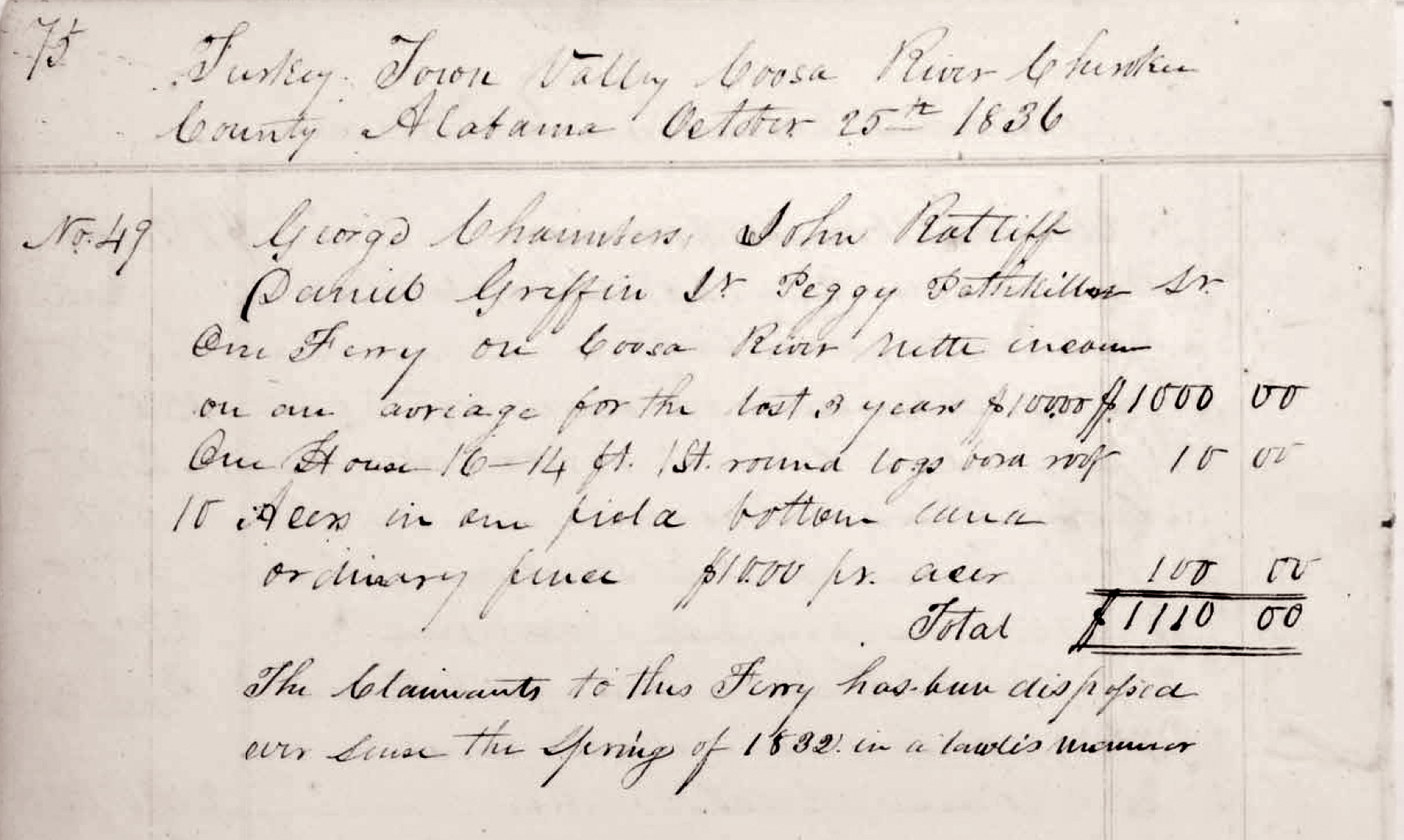
John Ratliff filed a Claim for his ferry on January 16, 1837 before Josiah Harper, Acting Justice of the Peace for Cherokee County Alabama. He stated that the Ferry was 1 ½ mile miles below Turkeytown and was then in the possession of James Kay. He stated, however, that the ferry was taken from him by a white man by the name of Hays shortly after the laws of Alabama were extended over the Cherokee lands in January 1832. The Original Patentee for the ferry’s location was James Kay.4
In the St Clair County court records, James Kay filed for a license to operate a ferry. This was on the Coosa River in the August 1833 term. Mr. Kay stated he acquired the ferry from Hannibald Hays, which was in Turkey Town.
The Applicant, Kay by attorney moved the judge and commissioners of Roads & revenue that they would grant him license and take a bond for the ferry which the legislature authorized Hanibald Hays (under which this applicant claim by purchase) to establish on the Coosa river where the road crosses the same at the place known by the name of Turkey Town in St Clair County which motion was __-ted and the court refused to grant license or take a bond from the applicant on the grounds they had previously granted to David Gage for the same ferry sometime prior to the act of the legislature giving it to Gage. James Kay by David Gage, St. Clair County, Alabama Court Minutes (1828-1834), Commissioners Court August Term 1833, pages 226-227
Page 172 of the same Court minutes; Order by the Court that David Gage be authorized to keep a ferry on Coosa River at Peggy Pathkillers provided it does not interfear with the Charter limits of John H Garrett as granted to him by the Legislature, at the following rates. . . 5
The above information shows that a white man named Hannibal Hayes took over Peggy Pathkiller’s ferry and property. He would sell it to James Kay and Mr. Kay would patent buy it in 1840s from the US government. Mr. Kay stated he was on the property with a pre-exemption date of 1838. 6 He worked with David Gage to acquire the license to operate the ferry at that location. Notice in the copy of the claim above it states, “in a lawless manner”.
David Gage is married to a Cherokee woman. Her name is Lucy Fish. He has acquired a house and property from the Dragging Canoe’s estate (Chief Pathkiller and Peggy’s son). The family filed a claim in Benton County.
David and Lucy Gage also held property in Will’s Valley. Will’s Valley is where they lived.

The above 1835 document has lots of information. Both Benton (Calhoun) and Saint Clair Counties claimed the area. The area was still in the Cherokee Nation. The document explains Dragging Canoe’s family. Dragging Canoe died about 1827 his estate records are in the Saint Clair County, Alabama estate records. The above document stated the residence for Nelly is next door. Dragging Canoe and his family do not have rights to the improvements. They could not sell the property. Gage and Dragging Canoe’s family lost in claiming the improvements. Chief Pathkiller and Peggy separated about 1816-1817. These improvements would belong to Peggy. Chief Pathkiller “took” a new wife and moved north. Review James Lasley’s statements at the top. Cherokee custom is Peggy would care for and leave her estate to the female children and their families. All of the contested improvements are in today’s Alford’s Bend. (Alford’s Bend will be discussed in its own post.)
If you are reading closely, you see the whites are taking what belongs to the Cherokee people. Read between the lines. James Brown and Tarply Nall both are white and have no connection to the Cherokee. They have moved into the area. Nall will try to buy the land from Sky-ah-too-ka. He stated in an affidavit that he spoke with some of the elder Cherokee and did not purchase the land. He said that Sky-ah-too-ka never owned the improvement. The Cherokee people have not gone to the West. This predates the forced removal of the 1835 treaty. The date is 1832, and Peggy Pathkiller is still living. Peggy died in 1833. Chief Pathkiller died in January 1827. He had moved north and started a new improvement on the Coosa River. He had taken a new wife.
Conclusion
We gather a lot of information on the location of the original village from the above information. The dispute with Pathkiller’s family places the Chief on the east side of the Coosa River. He lives there until he and his wife, Peggy, separate. This is today’s Alford’s Bend. One of the notations above stated the ferry was one-and-half miles below Turkeytown. Turkeytown Creek is one-and-half miles north of Fitts Ferry on the West side of Coosa River.
To recap the last post with this one. Chief Little Turkey lives at Turkeytown Creek on the East Road, (Coats’ Bend Rd.) The Boot lived at Turkeytown Creek on the West Road (Old US 411.) Chief Pathkiller lives on the East side of the Coosa River at his ferry (Fitts Ferry.)
In the next post, I will explain the move north and the new improvements for Chief Pathkiller. “One mile south of present day Centre.” His new wife and an illegal sale of part of his estate. Additionally, I will explain the dispute between the Garrett Family and John Ridge, who acquired most of Chief Pathkiller’s estate. Uncovering the History of Turkeytown, Pathkiller’s Ferry.
- Affidavit of James Lasley #574, 12 September 1837, Folder of James Lasley. Miscellaneous Claims Papers, 1836-1839, of the First Board of Cherokee Commissioners, Entry 236; Records of the Bureau of Indian Affairs, Record Group 75; National Archives Building, Washington DC. ↩︎
- Affidavit of Quata Campbell Miscellaneous Claims Papers, 1836-1839, of the First Board of Cherokee Commissioners, Entry 236; Records of the Bureau of Indian Affairs, Record Group 75; National Archives Building, Washington DC ↩︎
- Correspondence and miscellaneous records 1819-1920 (NARA Series M208, Roll 8), Records of the Cherokee Indian Agency in Tennessee, 1801-1835, Family Search.com, image 420, https://www.familysearch.org/ark:/61903/3:1:3Q9M-CSHM-PQM1?i=419&cat=285733 ↩︎
- Report to the Alabama Chapter of the Trail of Tears titled Alabama Collection Camps, Forts, Emigrating Depots and Travel Routes Used During the Cherokee Removal of 1838-1839, Chapter 8 on Topography of the Removal Routes, Ferry Crossings on Major Rivers and Tributaries. Page 248, https://nationaltota.com/alabama-forts-and-camps. ↩︎
- John Ratliff’s Spoliation Claim for a Ferry and Improvement. Folder of John Ratliff; Miscellaneous Claims Papers, 1836-1839, of the First Board of Cherokee Commissioners, Entry 236; Records of the Bureau of Indian Affairs, Record Group 75; National Archives Building, Washington DC. In the St. Clair (AL) County Court Minutes (1828-1834) there is a road order on pages 172-173 “Ordered by the Court that David Gage be authorized to keep a ferry on Coosa River at Peggy Path killers provided it does not inter fear with the Charted limits of John H Garrett as Granted to him by the Legislature, at the following rates…” and on pages 226-227 “The applicant James Kay by David Gage attorney moved the judge and Commissioners of Roads & revenues that they would grant him license and take a bond for the ferry which the legislature authorized Hannebald Hays (under whom this applicant claims by purchase) to establish on the Coosa river where the road crosses the same at the place known by the name of Turkey Town in St Clair county which motion was-ted and the court refused to grant license or take a bond from the applicant on the ground that they had previously granted license to David Gage for the same ferry sometime prior to the act of the legislature giving it to Hays. ” See also Acts of Alabama for 1832-1833, Extra Acts, page 150, which Act authorized Hannibal Hays on the Coosa River.
↩︎ - Bureau of Land Management, General Land Office Records, Eastern States Office, Springfield, VA. Pre-emption Certificate #6,885 for James Kay of Cherokee County Alabama issued June 1, 1845 for fraction “A” of fractional Section 20 in Township 11 of Range 7 East. Pre-emption Certificate #8,419 for James Kay of Cherokee County Alabama was issued April 10, 1847 for the northwest quarter of the southwest quarter of Section 20 in Township 11 of Range 7 East. Both in the District of Lands subject to Sale at Lebanon Alabama. http://www.glorecords.blm.gov/PatentSearch/. ↩︎
Trust in the Lord with all your heart, and do not rely on your own understanding;
in all your ways know him, and he will make your paths straight. Proverbs 3; 5-6 CSV
 New Seneca Turkey's Town