
When did Chief Little Turkey move to this location? Was there a reason for choosing this place?
A 1961 undated Civil War Centennial Edition of Gadsden Times, article; “Indians Lore Abound in Turkey’s Town Area,” by Elbert Watson1
“It was founded about 1770 by a minor Cherokee Chieftain, Little Turkey.”
“The Turkeytown Story”, a booklet written by the Turkeytown Methodist Church 1953, Etowah County, Alabama, sold as a fundraiser to help finance their new church building, they state on page 3;2
There was a day, in 1770, when Turkeytown was the thriving Capital of the Cherokee Indian Nation. It was ruled by the iron hand of the great Cherokee Chieftain “The Turkey.”
Oliver Day Street “The Indians of Marshall County Alabama”;3
About 1777, Wills’ Town was established by the Cherokee. . .about the same time Turkey Town was built by them on the Coosa river opposite the present site of Centre, Cherokee County, Alabama. (“Pickett’s History of Alabama”, vol I, page 163; Royce in the 5th Annual Report Bureau of Ethnology, Map 8)
Where did this 1770 information come from? What is the source? Albert James Pickett’s History of Alabama is listed in Mr. Street’s Marshall County Alabama history. Is that the source?
Will’s Town and Turkey Town—important Cherokee establishments. The former was
named for a half breed called Red-headed Will. At these towns lived the British
Superintendent, (the celebrated Col. Campbell,) before and during the Revolutionary
War*. * Indian Affairs, vol. 1, pp 264-269.4
Historical Society Commission wrote a History of Alabama for the Governor in 1900. In this report, they list two different Turkey’s Town. One is a Cherokee Village and one is a Creek Village. They state it was “Founded about 1770.”5
Mrs. Stewart Cherokee County History. It was founded about 1770, and was considerable size and importance. Turkey Town was established some time prior to 1770 and was one of the most important Cherokee establishments. Col. Campbell the noted British soldier and superintendent lived here at times during the Revolution.6
The confusion about the location and the fact that it is Cherokee town has been proven in the earlier post. Now to settle the confusion on when. Where did 1770 come from? There is NO SOURCE or REFERENCE to 1770 by any of the early historians or writers. Is it a guess, a speculation, I believe or what. No one gives a clue to why they used this date. The only thing I can find as a possible reference is Albert Pickett’s statement of “Colonel Campbell.”
Will’s Town and Turkey Town—important Cherokee establishments. The former was named for a half breed called Red-headed Will. At these towns lived the British Superintendent, (the celebrated Col. Campbell,) before and during the Revolutionary War*.7
* Indian Affairs, vol. 1, pp 264-269.
An extensive search for Colonel Campbell results in very little information. There is no
information showing he was the agent assigned to the Cherokee during the American
Revolution. The agent assigned to the Cherokee during that time was Alexander Cameron. He was appointed by Colonel John Stuart. Cameron answered to Royal Governor Joseph Martin. Hugh McCall’s “History of Georgia”8 Alexander Cameron died on 27 September 1781. John Graham replaced him. At this time, Alexander Campbell became his Chief Deputy Superintendent, notes from the 9th Circle blog; Chuck Hamilton.9
This appears to be the only reference. If Alexander Campbell is Col Campbell, he became the agent in the latter part of 1781. It is during this time frame that the Revolutionary War is coming to an end and is all but over.10 So one could say that Campbell is the agent during the American Revolutionary War. But the timeline is at the end of 1781. This is NOT 1770 or close to it.
1770 is Wrong
Wikipedia has this for a timeline or date on settlement. Turkeytown was settled in 1788. The town was established by Little Turkey during the Cherokee–American wars as a refuge for him and his people from the hostilities then being engaged in between the Cherokee and the American frontiersmen.11 Wikipedia has a lot of mixed info on Turkey’s Town. However, this date might be the closest to being correct. Wikipedia does not have a reference or source to the date.
Are there any references to give us a better timeline?
The Cherokee-American wars, along with the signing of the Hopewell Treaty in November 178512. This is the most likely reason for Little Turkey and the people of Seneca to move from their homeland. We have proven that Little Turkey was from Seneca. “When a Name is Not a Name” post. The lower towns on the headwaters of the Savannah River were given up in the treaty. After that, the people started moving.
Little Turkey does align himself with the Chickamauga Chiefs that are a part of the Cherokee-American wars. Dragging Canoe, and Hanging Maw. This letter is written for Chiefs, Little Turkey, Hanging Maw, and Dragging Canoe. The letter is intended for Governor Samuel Johnson in 1789 (Governor of the State of North Carolina). The context of this letter is to seek arrangements for another peace treaty. This treaty should be similar to the 1785 Hopewell treaty or adhere to that treaty.
At a general meeting held at the Little Turkey’s Town or otherwise called new Sinekaw in the Cherokee Nation Present the Chicamagies Chiefs March 10th 1789 . . . that you are willing to adjust and rectify the dispute between your people and our own __ to establish a lasting peace in our hearts desire . . .
Little Turkey Hanging Maw Dragging Canoe13
No Turkey’s Town until after 1782
We can now start a timeline for the settlement of Turkey’s Town. After 1782, before 1788.
From the American State Papers; Indian Affairs Vol 1; page 431; Letters, with their several enclosures, from Governor (Wm) Blount to the Secretary of War. (Henry Knox);
Knoxville, January 14, 1793
(fourth paragraph) At the beginning, and previous to the late Revolution, the Cherokees lived in towns, either on the head waters of the Savannah River or on the Tennessee, above the mouth of Holston. . . .That, in the year 1776 General Williamson marched an army from South Carolina, and destroyed the towns on the Keowee and Tugelo, among them old Seneca, a very principal one, and erected fort Rutledge on its ruins. . . . The Cherokees being thus burnt out of their towns, and by these treaties (1st Long Island 1777 and Long Island of the Holston 1781) very much curtailed in their hunting grounds to the eastward and northward, shortly began to erect new towns, lower down the Tennessee, and on the waters of the Mobile River. The most bold and active part settled on a creek called
Chickamauga, 100 miles below the mouth of Holston. . . . In the year 1782 they
abandoned Chickamauga creek, believing it was infested with witches; some returned to
the old towns, others went lower down the Tennessee, 40 miles, and laid the foundation
of the five towns, now generally called the five Lower towns on the Tennessee. . .14
A very similar reference is documented in a Nashville Newspaper in 1816.
That at the time of Christian’s campaign in 1776, there were no Cherokee towns on the Tennessee below the mouth of the Holston, and that the lowest belonging to the nation was on the Hiwassee.
That the peace which followed the campaign of 1776 was protested against by the Dragging Canoe, a Chief of note, who in consequence of his dissent from the rest of the national council, descended the river, with his adherents in the winter of ’76 & ’77, and settled at Chickmawga, where he continued the war, attacking almost every boat which descended the river, until the spring of 1779, when a party of whites commanded perhaps by one of the Shelby’s, beat him off, and destroyed his town. That after the destruction of Chickmawga the Cherokee made their first settlement at Nickajack and Running Water, and to the south west at Turkey Town and Will’s Town.
That these settlements were made with the permission of the Creeks, is a fact, so notorious, that it is unnecessary to give evidence in support of it. It was a subject of negotiation between the two tribes and we have it on the most respectable authority, that at every national council, which has been held in the Creek Nation, the Cherokee, have been reminded of the grant by which they held the country between the Highwassee and the Creek Path.
A friend has furnished us with the words of a Creek talk which was sent, to the Cherokee about five years ago. He is confident it is very little variant even in words, from the preceding messages, which had followed each other from ’79 to that time. It is as follows:
“The White people have drove you off your land, and you come on our land, as you must live, we let you stay, but you know that the land is our land; and we let you live on it.15
The above references state there are no Cherokee Towns or Villages in what would become Alabama until after 1782. The movements and treaties prove Turkey’s Town was not establish until after 1785. It may have been settled then during 1786. This does not mean that Cherokee people did not live in what would become Alabama, but no towns or villages.
Other references.
General John Coffee was the surveyor of Alabama. He states this in his report and explanation on the boundary line between the Creek and Cherokee. The report is dated 1829, December 30, in Florence, Alabama, to John H. Eaton.
There is abundance of evidence shewing that the Cherokees had the South bank of Hightown river fifty years ago at the old Hightown town, and that they extended their settlements out from that town, as well down as up the river. Turkey town was settled 40 years ago, and the old red Creek Town upwards of forty years since, and various other villages and settlements were made and occupied on all the waters that run into the Hightown and Coosa rivers above Turkey town 30 to 40 forty years ago and have ever since been in the constant occupancy of the Cherokees without any evidence to shew the Creeks ever set up any claim to any of the waters of those rivers above Turkey Town except the statement of 29 Creek chiefs and warriors given to me in 1816 in the absence of the Cherokees. By that statement they said many years since, and during the revolutionary war, they loaned the Cherokees land from their old line, the junction of Estanala & Hightown down to Wills Creek, and that the Cherokees had lived on it ever since and had not been reclaimed by the Creek. .16
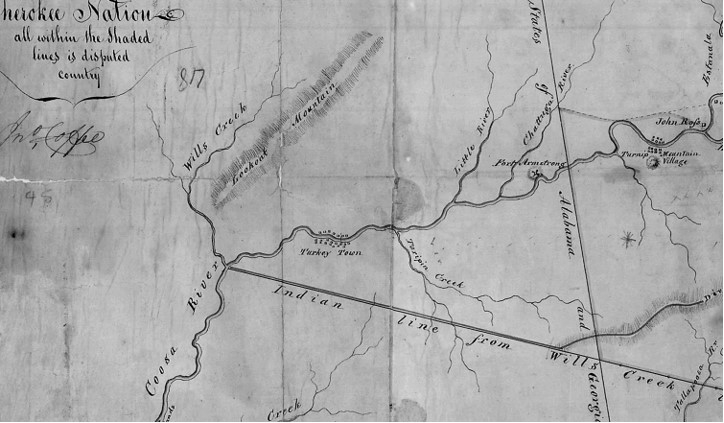
Cherokee Nation, Record Group 75, Records of the Bureau of Indian Affairs, 1793-1999, Series,
Central Map Files, 1824-1962, National Archives Catalog, General John Coffee.
From “The Cherokee Phoenix” Published June 19, 1830 Page 2 Column 1a-2b
The undersigned came into the Cherokee Nation in the year 1785-and opened a store at Stecoe in the Lookout Valley and there married the daughter of Mr. John M’Donald, and about the year 1788, he removed together with his father in-law and their families to Turkey Town, and continued trade with the Cherokees. The Little Turkey was the Principal Chief of the Cherokee Nation and resided in that town-and that the Cherokees had considerable settlements from the mouth of Will’s Creek, up the Coosa River on both sides of said river,
Head of Coosa, Cherokee Nation, December 10th, 1829. DANIEL ROSS.17
“The Cherokee Phoenix” Published May 29, 1830 Page 4 Column 1b-3b.
Old Red Bank, Cherokee Nation Southside Hightower,
10th December 1829
John Wright, a white man married to a Cherokee wife, states that he came into this
nation when a boy-he does not know his age correctly, but he thinks he was about
twelve years of age. . . Turkey Town on the Coosa river is the lowest down the river
where there has been any Cherokee settlements that he knew of, they settled that place
on both sides of the river about forty years- since. . .18
These references lead to a timeline of 1788 to 1789. The above letter from Turkey’s Town, though, has a date of March 1789. So, the timeline would be before 1789.
Conclusion
The 1770s dates are not supported by any reference. The date of settlement is somewhere between 1782 and 1788. My thoughts are 1786-87. This is based on the movements of the people and the Cherokee-American Wars.
Little Turkey was looking for a safe place to settle his New Seneca. Did he meet up with someone to show him that safe place? Chief Little Turkey’s Creek interpreter is Boot (Chulioa). Rev Daniel Butrick stated he was “full blood Cherokee raised by the Creek”. Did he guide Little Turkey to a safe place on the trading route (Hightown Pass) along the Coosa River? Was it safe to settle there?
There is a track of land lying on Wills Creek and between that creek and the Coosa River on the West side of the latter, and north of the Treaty line of Fort Jackson which they may be prevailed upon to part with, in treating for which they are willing to discuss and settle the subject of the boundary between them and the Cherokee. They however contend that their present boundary with the Cherokee is by the Suwannee path where it leaves the Western line of Jackson County to the old town on the Chatahotchie River and from thence by a drift line to the Mouth of a certain water course called by them, Little River where it unites with the Coosa. They have furnished me with a copy of certain question put by the Creeks to an old Cherokee Chief and the Cherokee Interpreter (who was their mutual Interpreter on the first settlement of the Cherokee in the Creek Country) . . . 19
The above notation is from Acting Secretary of War George Graham to Creek Agent David B. Mitchell, 31 October 1817. It is explaining the Creek boundary. The letter is recorded in Alabama Territory, Territory papers, page 183-84. The above is a footnote.
This statement is about Little Turkey and Boot. They have furnished me with a copy of certain question put by the Creeks to an old Cherokee Chief and the Cherokee Interpreter (who was their mutual Interpreter on the first settlement of the Cherokee in the Creek Country). Boot showed Little Turkey a safe place to settle. Boot died at his home in Turkey’s Town in 1827 as noted by his son Laugh at Mush.
What is next? The Beloved Chiefs from Turkeytown, Chief Little Turkey.
- 1961 undated “Civil War Centennial Edition of Gadsden Times”: Copy in possession of the writer. ↩︎
- “The Turkeytown Story”: Turkeytown Methodist Church: Mrs. Eva McCarver, Miss. Imelda Anderson, and Reverend Jack Dillard: 1955. Copy in possession of the writer. ↩︎
- “The Alabama Historical Society, Montgomery, Alabama, Reprint No. 8”: XII The Indians of Marshall County, Alabama, Montgomery, Alabama, 1904, page 206: Oliver Day Street, Guntersville, Alabama: Google Books eBook: page 185. ↩︎
- “History of Alabama and Incidentally Georgia and Mississippi From Earliest Period”: Albert James Pickett: Volume 1: Charleston North Carolina: McKee and James: 1851: Google Books eBook: Public Domain. ↩︎
- Publication of the Alabama Historical Society Miscellaneous Collection: “Report of the Alabama Historical Commission to the Governor of the State of Alabama December 1, 1900”: Edited by Thomas McAdory Owens, Chairman: Montgomery Alabama: 1901: Google Books eBook: Public Domain. ↩︎
- “Cherokee County History 1836-1956 Volume 1”: Mrs. Frank Ross Stewart: Centre, Alabama:1956. Gadsden Public Library. Page 204, and 214 ↩︎
- “History of Alabama and Incidentally Georgia and Mississippi From Earliest Period”: Albert James Pickett: Volume 1: Charleston North Carolina: McKee and James: 1851: Google Books eBook: Public Domain. Page 163 ↩︎
- “The History of Georgia Containing a Brief Sketch of The Most Remarkable Events Up to Present Day”: Captain Hugh McCall in Two Volumes: Vol 1: Savannah, Seymour and Williams: 1811: Page 365: Google Books eBook: Public Domain. ↩︎
- 08 August 2011 Cherokee-American Wars (1775-1795), Notes from the Ninth Circle, Chuck Hamilton, https://notesfromtheninthcircle.blogspot.com/2011/08/chickamauga-wars-17761794.html ↩︎
- https://www.nps.gov/subjects/americanrevolution/timeline.htm ↩︎
- https://en.wikipedia.org/wiki/Turkeytown_(Cherokee_town) ↩︎
- Clemson University; Clemson.edu; The Hopewell Plantation; The Hopewell Treaties; https://www.clemson.edu/about/history/properties/hopewell/hopewelltreaties.
html#:~:text=Hopewell%20Treaty%20Site&text=Three%20hundred%20yards%20northwest%20of,America%20and%20the%20Cherokee%20Nation. ↩︎ - Document NCU16 in the Papers of the War Department 1784-1800, Roy Rosenzweig Center for History and New Media, George Mason University, wardepartmentpapers.org. ↩︎
- A Century of Lawmaking for a New Nation: U.S. Congressional Documents and Debates, 1774 – 1875, American State Papers, Senate, 3rd Congress, 1st Session, Indian Affairs: Volume 1, page 431, https://memory.loc.gov/cgibin/ampage ↩︎
- National Banner and Nashville Whig (Nashville, Tennessee, 25 June 1816, page 3), The Indian Treaty. A reprint from the Knoxville Gazette. Newspaper.com ↩︎
- Digital Library of Georgia: Treaty of Hopewell: Galileo, Georgia Virtual Library: Coffee, John, 1772-1833. “Report of General John Coffee on the boundary line between the Creeks and Cherokees, 1829, Dec. 30, Florence, Alabama [to] John H. Eaton / Jo[h]n Coffee.” 1829-12-30. March 11, 2021.
https://dlg.usg.edu/record/dlg_zlna_tcc697#item. ↩︎ - CHEROKEE PHOENIX, Issue 31, November 11, 1829
https://www.wcu.edu/library/DigitalCollections/CherokeePhoenix/Vol2/no31/. ↩︎ - Ibid ↩︎
- https://babel.hathitrust.org/cgi/pt?id=mdp.39015010692468&seq=208 page 183-184 ↩︎
Trust in the Lord with all your heart, and do not rely on your own understanding;
in all your ways know him, and he will make your paths straight. Proverbs 3; 5-6 CSV
 New Seneca Turkey's Town