
Tags
alabama-history, cherokee-indians, native-american, northeast-alabama-history, Pathkiller, trail-of-tears, turkeytown
Estanaula, Tuesday, 26th June 1792
Present, the Little Turkey, great beloved man of the whole nation; the Badger, the beloved man of the Southern division; the Hanging Maw, beloved man of the Northern division; the Boot, the Black Fox, the Cabin, Path Killer, head-men of Turkey’s town.[1]
Chief Pathkiller
As we examine the Beloved Chiefs from Turkey’s Town. Chief Pathkiller’s information is the most confused. He is very important to the history of Turkey’s Town. He lived in Turkey’s Town for about 40 years. Today, there is a lot more information about this Chief. Yet, the internet is full of misunderstandings, misinformation, and confusion.
I will try to sort this out. All of the genealogy websites have mixed, confused information about this Chief and his family. A lot of the information has been disproved, yet not removed or replaced with corrected information.
Providing the most up-to-date information will take more than one post. I will provide what can be proven. Where needed, I will state what is “believed” to be true from the leading researchers. This is not a genealogy site, but I will provide what has been proven about Chief Pathkiller’s family with sources. This site focuses on Turkey’s Town. Thus, I am not providing information about the Western Nation after the arrival of the family.
We will explore who Chief Pathkiller is. His name. I will explain the errors in the information on the various websites. There is only one Chief Pathkiller, who was the Principal (Beloved) Chief of the Cherokee Nation (1811-1827). I will explain who Pathkiller Jr is. There are NO Pathkiller I and Pathkiller IIs. What are the most precise estimates of his birth, and when did he die? Where is he buried? We will revisit where he lived. What was his role in the Creek War and, Treaty of 1816? As the Chief of the nation, what is his role? His family can be proven. Who are they? He had a nephew who was murdered, named Charles.
Chief Pathkiller, His Name
Pathkiller is not a surname. Pathkiller, as a surname, is a European influence on the history of the Cherokee people.
Most of the genealogy records use a Cherokee name for Chief Pathkiller. This name, “Nunnadihi” translates to Path Killer. This was Major Ridge’s name when he was young. His name later evolved to “the Ridge” and eventually to “Major Ridge”. In Wilkins’ book about the Ridge Family, Major Ridge or Pathkiller is spelled “Nung-noh-hut-tar-hee.” This translates to “he who slays the enemy in the path.” In English, Path Killer. [2] This is further confused by misinformation transcribed into the website of Find-a-Grave. This is also on almost every genealogy website. Yet this is Major Ridge’s name. Chief Pathkiller does not have a historical record using a Cherokee name. It is listed as Path Killer or Pathkiller. In my opinion, assigning a name to Chief Pathkiller is disrespectful to the Cherokee People and the Chief.
Roane County, Tennessee, Pathkiller
One of the confusing Pathkillers is the Pathkiller of Roane County, Tennessee. Many people have conflicted him with Chief Pathkiller of Turkey’s Town. This Pathkiller is stated to be the last hereditary Chief of the Nation and Colonel Pathkiller. This Pathkiller received a reservation of 640 acres, including a ferry on the Tennessee River. In a blog provided by “Tennessee State Library and Archives” it holds information on the court case involving this reserve. From the blog;
This Supreme Court case centered around a land dispute between Pathkiller and James Blair of Loudon County. In 1819, Pathkiller took advantage of a provision in the Calhoun Treaty and claimed a reservation of 640 acres that included the area known as Blair’s Ferry. Blair’s Ferry was on the Tennessee River in Loudon County.[3] Throughout this court case Pathkiller is referenced as: “. . .last hereditary chief of the Cherokee, and a Colonel under Andrew Jackson in the Creek War”. In this case, there is a daughter of Pathkiller named Sarah who married James T. Gardenhire. “Blair’s sons John and Wily continued battling for the property rights against Pathkiller’s daughter, Sarah, and her husband, James T. Gardenhire. After years of litigation, the Tennessee Supreme Court ultimately decided in favor of the Blairs, claiming that Pathkiller’s sale of the land to the Gardenhires had made his reservation claim null and void. The parties ultimately reached a compromise, and the Gardenhires agreed that they would “remove and give up all of said 640 acres with the ferry, and to remove any tenants that may be in possession of any part of the said tract…”[4]
No where in the reservation claim is this Pathkiller referred to as the Chief of the Cherokee Nation. He is not proven to be Colonel Pathkiller. This is also true in the granting of the reservation.(5) It is a statement made during the court case. But, not proven. It was recorded in the Tennessee State Supreme Court Case. This Pathkiller could be one of the other two Pathkillers listed in Col Gideon Morgan Jr’s regiment.
The account of this case appeared in the National Banner and Nashville Whig newspapers in full on 12 August 1830. Pathkiller in this case is not called Chief of the Nation. There is also no mention of him being related to Chief Pathkiller in Turkey’s Town.[6] There is no evidence to confirm this. The daughter named “Sarah, who married James T Gardenhire,” has no family connection to the Chief Pathkiller of Turkey’s Town. To add to this many genealogists list Susan “Sukey, Sooky” Martin as the wife of Chief Pathkiller in Turkey’s Town. This too is not proven. Others suggest she was married to his son, Pathkiller Jr or Pathkiller II.[7] [8] There is no Pathkiller II. It gets more confusing with the memorial marker (photo attached). Stating that this Pathkiller died in 1843.[9] This Pathkiller may be the Corporal or Sergeant with Col Gideon Morgan Jr’s Cherokee Regiment in the Creek War.[10]
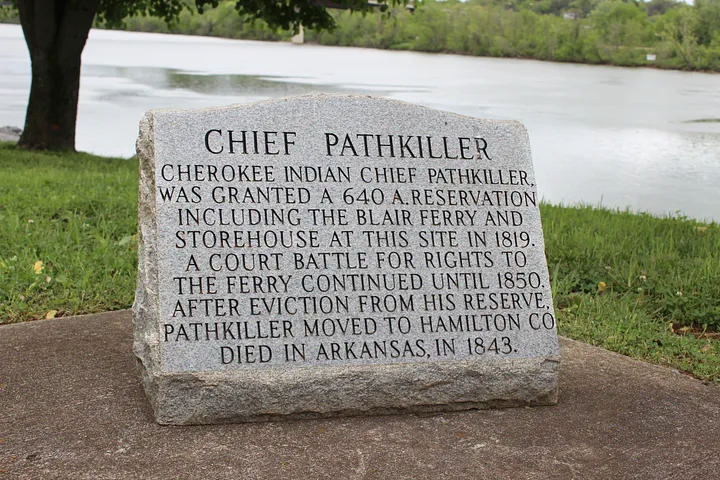
Chief Pathkiller, Chief of the Nation 1811-1827, died in January 1827, so he did not file a case in 1830. His daughter and granddaughter stated he lives in Turkey’s Town. Source with proof later in another post. They never mention moving or living on the Tennessee River. He did not die in Arkansas. He does not have a daughter named Sarah that can be proven. We will discuss his proven family and where he lived.
This Roane County Pathkiller can not be the hereditary chief of the Cherokee, with a death date of 1843. That would mean there are two Principal Chiefs of the Nation. Chief John Ross was Principal Chief from 1828 to 1866.[11] This Pathkiller did exist. He did move to Arkansas. Yet, this Pathkiller of Roane County, Tennessee, is not the Principal Chief of the Cherokee People. He has not been proven to have any family relationship to Principal Chief Pathkiller of Turkey’s Town. Nor any of his family. The only connection is the similarity of the name Pathkiller. There are many people with the name Pathkiller. Not everyone who has that name is kin.
Pathkiller Junr
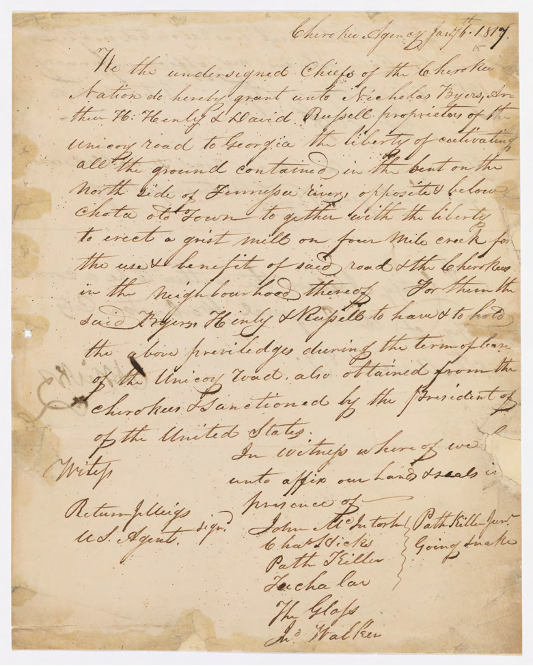
Who is Pathkiller Jr (Pathkiller Junr)? It may be the Roane County, Tennessee, Pathkiller. Attached is a copy of the only document with Pathkliller Junr. An 1817 treaty dealing with the approval of the use of roads it has two Pathkillers. Pathkiller and Pathkiller Jr.[12] This leads to the question of whether the second Pathkiller is Pathkiller’s son. The Cherokee people did not have a culture of naming a son after the father. They did not use the suffix Jr. This is the interpreter’s choice in using “Junr.” Jr. to show two different Pathkillers, one being younger than the other. They are not displaying a family notation. In this treaty, the interpreters are Return J. Meigs, and Chief Charles R. Hicks. Meigs is the Agent and Chief Hicks is an interpreter, Chief Pathkiller’s second. Hicks is half Cherokee and half European. [13]
Conclusion
This Pathkiller of Roane County, Tennessee, is not the Principal Chief of the Cherokee People. He has not been proven to have any family relationship to Principal Chief Pathkiller of Turkey’s Town. Nor any of his family. Pathkiller Junr is a younger man with the same name. There is no son of Chief Pathkiller of Turkey’s Town named Pathkiller Jr.
We will continue the exploration of Chief Pathkiller and the misunderstandings in the next post. The Beloved Chiefs of Turkey’s town.
[1] Indian Affairs, Volume 1, ASP IA Vol. 1, searchable online the Library of Congress American State Papers web site pages 271-273, 26 June – 1 July 1792.
[2] “Cherokee Tragedy”, The Ridge Family and the Decimation of a People, Thurman Wilkins, second edition, revised, University of Oklahoma, Norman and London, 1986, page 7.
[3] https://tslablog.blogspot.com
[4] Ibid
[5] Survey of Pathkiller’s land on the south side of the Tennessee River at his ferry; https://teva.contentdm.oclc.org/digital/collection/p15138coll23/id/857
[6] National Banner and Nashville Whig, (Nashville Tennessee) 12 August 1830, Newspaper.com, Second paragraph; Pathkiller, the defendant in the court and Plaintiff below, claim a reservation under the treaty of 1817 and 1819, of 640 areas of land with a life estate there in to himself and a reversion in fee simple to his children, out of the lands surrendered by these treaties to the United States. He was the head of an Indian family; and on register of life interest reservations, in the office of thee United States Agent for the Cherokees, is in the following entry: “1818, June the 14th, Pathkiller a native, 5 in family, on the main Tennessee river, about 2 ½ miles above the mouth of Sweet-water creek. There is a ferry on the place: Given under my hand and private seal, there being no seal office, the 2d Sept. 1826. H. Montgomery, United States Agent for the Cherokee. . . Pathkiller moved to this reservation, the land in dispute, in April or May 1819, having occupied of by his tenet Caves, from 1817.
[7] Chattanooga Daily Times (Chattanooga, Tennessee) · Sun, May 27, 1934 · Page 41, Newspaper.com
[8] WikiTree, Susan Martin; https://www.wikitree.com/wiki/Martin-4178
[9] Chasing Path Killer, Ross Rogers, blog, 30 April 2019; https://medium.com/@TheRossRogers/chasing-path-killer-38a53d015538
[10] US, Index to Compiled Service Records of Volunteer Soldiers Who Served During the War of 1812, 1812-1815; fold3.com
[11] https://collections.gilcrease.org/anthology-articles-john-ross-papers-collection
[12] CHEROKEE AGENCY, January 6, 1817. CHEROKEE AGENCY, January 6, 1817. The use of the Unicoy road, so called, was for twenty years. Treaties with the Cherokees, 1819, Oklahoma State University, Digital Resources and Discovery Services, Tribal Treaties Database; https://treaties.okstate.edu/treaties/treaty-with-the-cherokee-1819-0177?query=%20path%20killer
[13] https://catalog.archives.gov/id/100595161 Image of the Treaty. January 6, 1817, NARA
Trust in the Lord with all your heart, and do not rely on your own understanding;
in all your ways know him, and he will make your paths straight. Proverbs 3; 5-6 CSV
 New Seneca Turkey's Town