
Tags
Black Fox, cherokee-indians, native-americans, northeast-alabama-history, trail-of-tears, turkeytown
I am not going to reinvent the wheel. Wiki Tree has a good overview of Chief Black Fox. I am providing info on Chief Black Fox because he was listed as one of the Headmen from Turkey Town. This occurred at the June 1792 Grand Council meeting. This is not my research. From my research, I agree with it with an exception.
https://www.wikitree.com/wiki/Cherokee-129
The one piece of info I disagree with is. Almost all of the genealogy sites have Chief Black Fox born about 1750 [uncertain] in Eustanali, Cherokee Nation (East). The estimated birth date. I agree with. The issue is the location, being Eustanali. This town did not exist until after 1782. After Dragging Canoe settled in what would become Chattanooga, the Cherokee moved into western Georgia. This is already documented in an earlier post. Black Fox may be from one of the lower towns on the headwaters of the Savannah River. Chief Little Turkey is documented as being from Seneca. (See post on Chief Little Turkey). Major John Norton referred to Black Fox as the uncle of Chief Little Turkey’s children. If Norton was speaking from his English upbringing, then Little Turkey and Black Fox are brothers. I believe Norton was not speaking culturally as a Cherokee. He refers to the children of Little Turkey as cousins.1
He may have been living in Eustanali (Ustinali) at the time Little Turkey settled his New Seneca, Turkey’s Town. He lived most of his time as Chief of the nation in Creek Path. This is present-day Guntersville, Alabama.
The following is from Wikitree with some documentation to offer sources.
Disputed Origins
Black Fox was not a son of Oconostota. Enoli called Dragging Canoe “Uncle” in his eulogy, but this probably meant only that he was an older man from the same clan. [1]
Nothing is known of the early life of Enoli, known in English as “Black Fox.” He was probably born by 1750. He first appears in the historical record as one of 42 signers of the 1791 Treaty of Holston. [2]His town is not named but he was from one of the “Lower Towns” in the area along the Georgia/South Carolina border. In June of 1792 he participated in a grand council at Ustinali, where he made a speech eulogizing Dragging Canoe. [3]
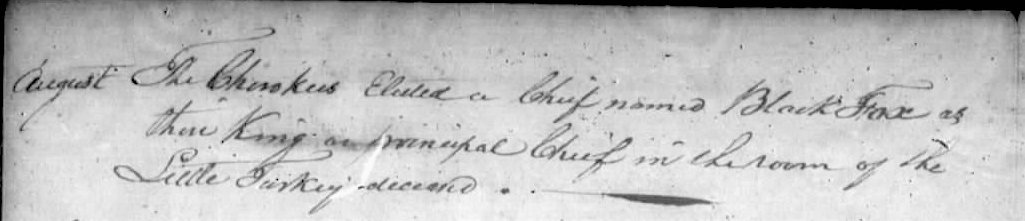
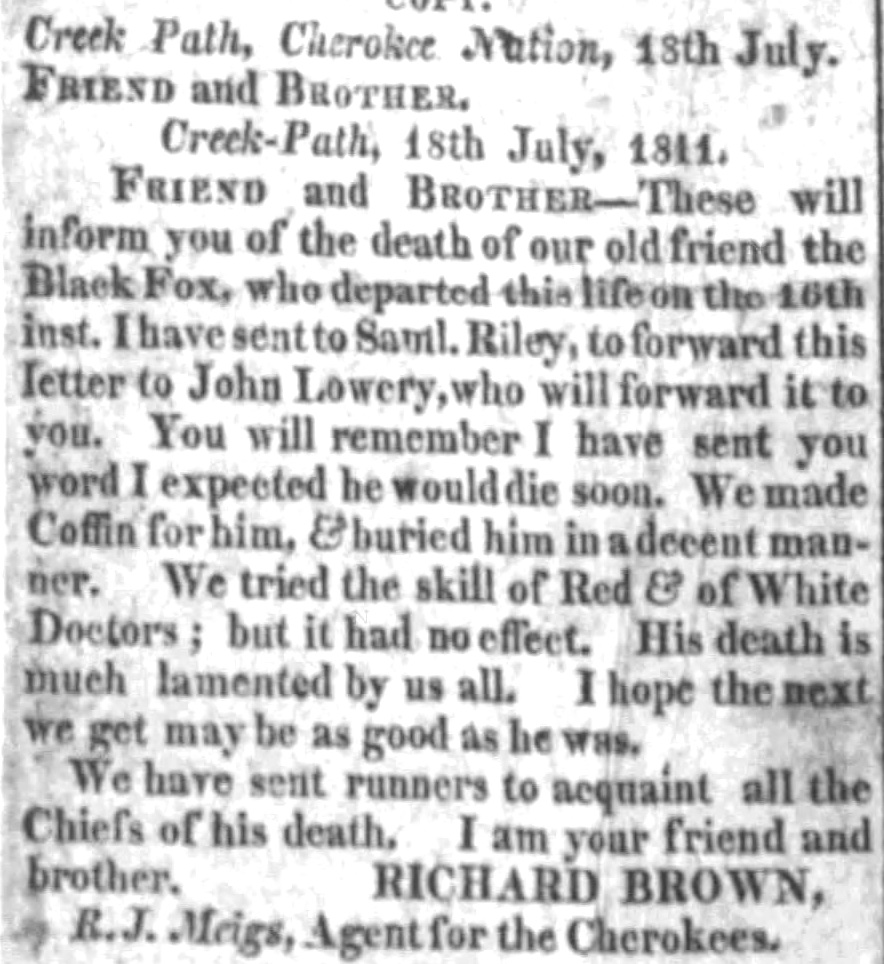
Enoli apparently rose in prominence through the 1790’s. When the Little Turkey died in 1802 he was chosen Principal Chief even though there were differences of opinion between the Upper Town chiefs and the Lower Town chiefs who included Black Fox. [4] He had a somewhat checkered career as chief, being deposed in 1808 for his part in the Treaty of 1806 leading up to and following the death of Doublehead. He was reinstated 1809 following an agreement between the Upper and Lower town chiefs to put their differences aside. [5] John Norton met the chief in 1810 and recorded that he was about 60 years of age, “of an ordinary stature, a sedate aspect, and good character…. [6] Black Fox died in August 1811 and his death was reported in a number of newspapers of the day.
Chief Black Fox signed the October 20, 1803 agreement for opening a road through the Cherokee Nation. He signed the Oct. 27, 1805 treaty at Tellico. [7]
On March 3, 1807, the U.S. Senate and House of Representatives enacted a statute at large giving “Chief Black Fox” a life annuity of $100.
In 1808, Chiefs Black Fox and The Glass were deposed in what was called “the revolt of the young chiefs”. This faction led by James Vann and Major Ridge, mostly of the Upper Towns. This driving force of this revolt likely due to the peoples’ resentment of the National Council’s domination by its’ older leaders. Black Fox and The Glass were deposed for siding with Chickamauga (faction) Chief Doublehead during the rebellion of 1806-1811.
In 1810 both Black Fox and The Glass were reinstated. On April 18, 1810, he and others signed an act of the Cherokee Nation abolishing clan revenge, after the death of Doublehead.
Black Fox last received his $100 stipend by proxy on July 11, 1810. Following his death in 1811, Pathkiller was elected Principal Chief.
American newspapers published reports of his death:
Black Fox — Died. The beginning of August,”Black Fox,” a distinguished Chief of the Cherokee Indians, and a strong friend to the United States, who has often restrained his nation when they were about to make war on the whites. [8]
Death of the Black Fox
The death of this distinguished Chief of the Cherokees, is an event of importance to the people of this section of the Western country. Many of the young men of the nation it is known, have expressed themselves with jealous hostility of the whites, insomuch that on several occasions misunderstandings, like to produce bloodshed have frequently taken place. Notwithstanding detachments of the U.S. troops have frequently been employed in removing trespassers off the Indian lands, encroachments continue to be made, and continue to furnish just subjects of complaint to this tribe of Indians. Circumstances of this kind afford to the restless and designing the means of sowing the seeds of hostility in the minds of many. On such occasions the influence of the Black Fox never failed to in quieting the minds of his unreflecting brethren – and when it is considered that a commercial intercourse with Mobile, through the waters of the Coosa, which rise in and pass through a considerable part of the Cherokee country, is an object of particular interest to the people of this State, the death of a Chief whose information enabled him to estimate the advantages that would result to this tribe, from a measure of the kind, is so much to be regretted ~12 Aug 1811[9]
There is no record of a wife or children. John Looney took a reservation under the Treaty of 1817 on the land where Blackfox had lived, and when John died his obituaries stated that he was a nephew of Blackfox. This suggests some kind of familial relationship, but “uncle” had a much broader meaning among the Cherokee and usually indicated a more distant relative.
There were six men named “Black Fox” on the 1835 Cherokee Census. There is no information to suggest that any of them were related to the chief.
In the disputed source “Shawnee Heritage VI, 1700 – 1750”, by Don Greene, 55 – 56, the identity of Nancy Black Fox, daughter of Chief Black Fox is created. In this book she is Nancy born in 1760, who first marries Joseph Looney in 1775, and then Robert Benge in 1786. Don Greene’s work is speculative, historically wrong, and not a reliable source. This is where the myth of Nancy Black Fox is created, and has morphed into Black_Fox-7
- ↑ Brown, John. P. “Old Frontiers.” Southern Publishers, Kingsport, TN. 1938. p. 331
- ↑ Treaty image (image 11) at mark
- ↑ American State Papers, Indian Affairs, vol. 1, pp. 271-272. Image at Black Fox
- ↑ Journal of Occurrences in Cherokee Agency in 1802, Records of the Cherokee Agency in Tennessee National Archives and Records Administration.
- ↑ McLoughlin, William G. Cherokee Renascence in the New Republic. Princeton University Press, Princeton, N.J., 1986. pp. 137-139, 145,147,155, 157
- ↑ Klinck and Talman, eds. Journal of Major John Norton. The Champlain Society, Toronto, ON. 1970. p. 117
- ↑ National Archives and Records Administration, digitized at digitreaties.org at
- ↑ 10 Sep 1811; The Gleaner – Submitted by K. Torp
- ↑ Carthage Gazette,12 August 1811; Submitted by K. Torp
See also:
- Dead link: Cherokee Tribe Newspaper Items, Obituaries and Death Notices. Retrieved on 5 Sep 2016 from obits
The following are not reliable and/or do not pertain to the man in this profile:
- Cherokee DNA Studies: Real People Who Proved The Geneticists Wrong, By Donald N. Yates, Teresa A. Yates
- “Shawnee Heritage VI, 1700 – 1750”, Don Greene (not a reliable source – see Shawnee Heritage Fraud) (Disputed)
The ending of the Wikitree.
In the next post, we will begin to unravel the confusion of Chief Pathkiller. The Beloved Chiefs of Turkeytown.
- Journal of Major John Norton, introduction pages xxiv-xxvii, and pages 112-118 of the journal 1809-1810, Hathitrust.org ↩︎
- Not in Wikitree, added by the author ↩︎
- Ibid ↩︎
Trust in the Lord with all your heart, and do not rely on your own understanding;
in all your ways know him, and he will make your paths straight. Proverbs 3; 5-6 CSV
 New Seneca Turkey's Town