
Tags
alabama-history, cherokee-indians, Chief Pathkiller, native-americans, New Seneca, northeast-alabama-history, Pathkiller, trail-of-tears
Mr. R. S. Cotterill states in the Preface of his book, “The Southern Indians”;
“The Southern Indians . . .the records of their history are records by whites and are marred by prejudices and misunderstandings.1
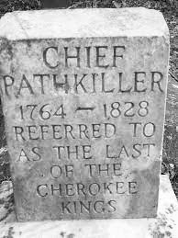
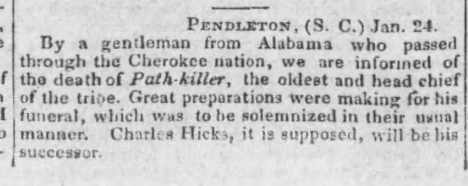
The above statement is so true. When we review Chief Pathkiller on genealogical websites, the information is so confusing. It is full of speculations, misunderstandings, incorrect information, and made-up fill-ins. It is worth stating again that Pathkiller is not a surname. That everyone who is referred to as Pathkiller is not the King, or Principal Chief Pathkiller (Principal Chief 1811-1827). That they are not all related as family. What can be proven? The genealogical websites have very few historical source citations. Most of what is referred to is from a modern-day history article. Some are from history books. What can be proven?
Proven
Chief Pathkiller’s parents can not be proven. They are unknown. Shelia Ford, a descendant of Nancy Ward, led me to new information on Moytoy. “Nunnadihi Pathkiller, Pathfinder Moytoy is a fictional name for the real Pathkiller.” 2
“In the summer of 2018, the Cherokee Heritage Center removed all mention of an alleged Moytoy family from their website. They determined that the fictional Amatoya/Amadoya Moytoy had not existed. James Hicks, from whom the incorrect information appears to have come, had hypothesized that all Cherokee came from a single ancestor. He named that fictional ancestor Amatoya/Amadoya Moytoy with no evidence or documentation whatsoever.” 3
If Chief Pathkiller’s parents are unknown, what can be proven about his family?
Chief Pathkiller has at least three wives.
The first wife’s name is unknown. They had three sons and one daughter. These children show up in historic documents and are not guesses. The first son is Bearmeat. It must be stated again that not everyone whose name is Bearmeat is the son of Chief Pathkiller. There are discussions on genealogical websites. They include correspondence of Chief Pathkiller talking about his son in the Creek War (1813-1814). Several of them state this must be Pathkiller II or Junior. There is no Pathkiller II or Junior as a son.
Bearmeat served under Gen. Cocke with Gen. Andrew Jackson in the Creek war. Bearmeat served as a scout for General Cocke. Gen. Cocke wrote a letter commending Bearmeat. “the son of the old Path Killer known by the name of Bear meat,.”4


Major Robert Searcy in a letter to Gen. John Coffee commends Bearmeat as well; “Bearmeat the son of the Path Killer king & principle Chief of their nation.”5
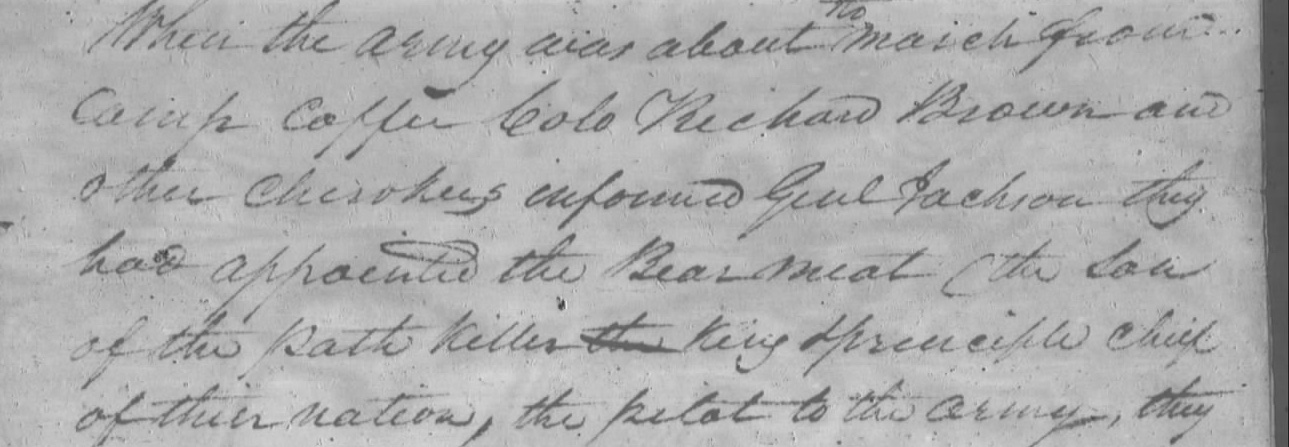
Bearmeat settled in the Creek Path (Guntersville, Alabama). He would have his own town Southwest of Creek Path.
Whitemankiller is another son. He is reported in Richard Blount’s journal while surveying the Georgia-Alabama boundary. “1 September 1826 met a Cherokee named Whitemankiller, wife, and daughter. . . Charles Hicks had sent a runner to his father Pathkiller.”6
James Lasley states the names of Whitemankiller’s children with their mothers in a deposition about their reservation. Lasley stated that Whitemankiller died in 1823 on his reservation at Turnip Mountain, Coosa River, Georgia. Whitemankiller’s family was disposed of the 320 acres in 1834-35. Lasley states his death date is “best of my recollection”. The dates conflict. This creates a plausible date of after 1826 and before the forced removal from the land of 1834.
“ Soo-wagi . . . Tahnuh-cas-tat-he, Oo-nee-skoo-koo and Thi-ah-muh-nuh children of White Man Killer and Joh-Ke-die;: Tee-sak-ni whose mother is deceased and Jackson, Mary heir of Buck Deceased;: Scott and Choo-wah-nas-kee and Peter children of Whit Man Killer and Yoo-yas-ki also decease.”7
A final son Tah-ka-ha-kee is listed on the Rice and McCoy/Rawlings and Massey’s Valuations, Claims, Cherokee County, Alabama, claim #44, property valuations, entry 224; Records of the Bureau of Indian Affairs, Record Group 75; National Archives Building, Washington, DC.
“Of the remaining portion, Crying Snake received 1/8th, Hughston (Houston) received 2/8th, Tarkaga (Tah-ka-ha-kee) received 1/8th, and the final 1/8th went Nancy (Pathkiller), Crying Snake’s mother.”8 John Ridge received the other 3/8. This is with Chief Pathkiller’s estate on the Coosa River (Centre, Alabama, Garrett Ferry).
Tah-ka-ha-kee is not mentioned in any of Peggy’s estate.
Unknown named daughter, sister to Bearmeat
Ahnoah stated in her Chatoogga District Court deposition that Bearmeat was her uncle. Cherokee culture would place Bearmeat as the brother of Ahnoah’s mother.
Plaintiffs witness May 26th 1830 Ahnoah Deposeth and saith that she was living in the neighborhood of Gunters Landing when her uncle the Bears Meat told her that the Pathkiller wanted her the Deponent to come and live where the Pathkiller was clearing a place on the Couse River on the West Bank at Pathkillers Ferry so called; the Pathkiller told her that he would get some young men to build some houses, and bout one year after the Pathkiller brought the Hammer there with his mother the Pathkillers wife.9
Wife Peggy a Cherokee woman
Peggy is one of Chief Pathkiller’s wives. She has a will drawn up for her in 1829. Did issues over Chief Pathkiller’s estate at the new ferry cause this? Were improvements at the new ferry a factor in needing “White man’s court?” A lot of the genealogical websites have her death date based on this record. The “will” was submitted on 13 March 1829. Chief Pathkiller died in 1827. Issues with his estate (Garrett Ferry, Centre, Alabama) went to court in May 1830. Peggy’s will was probated on 14 March 1833.10
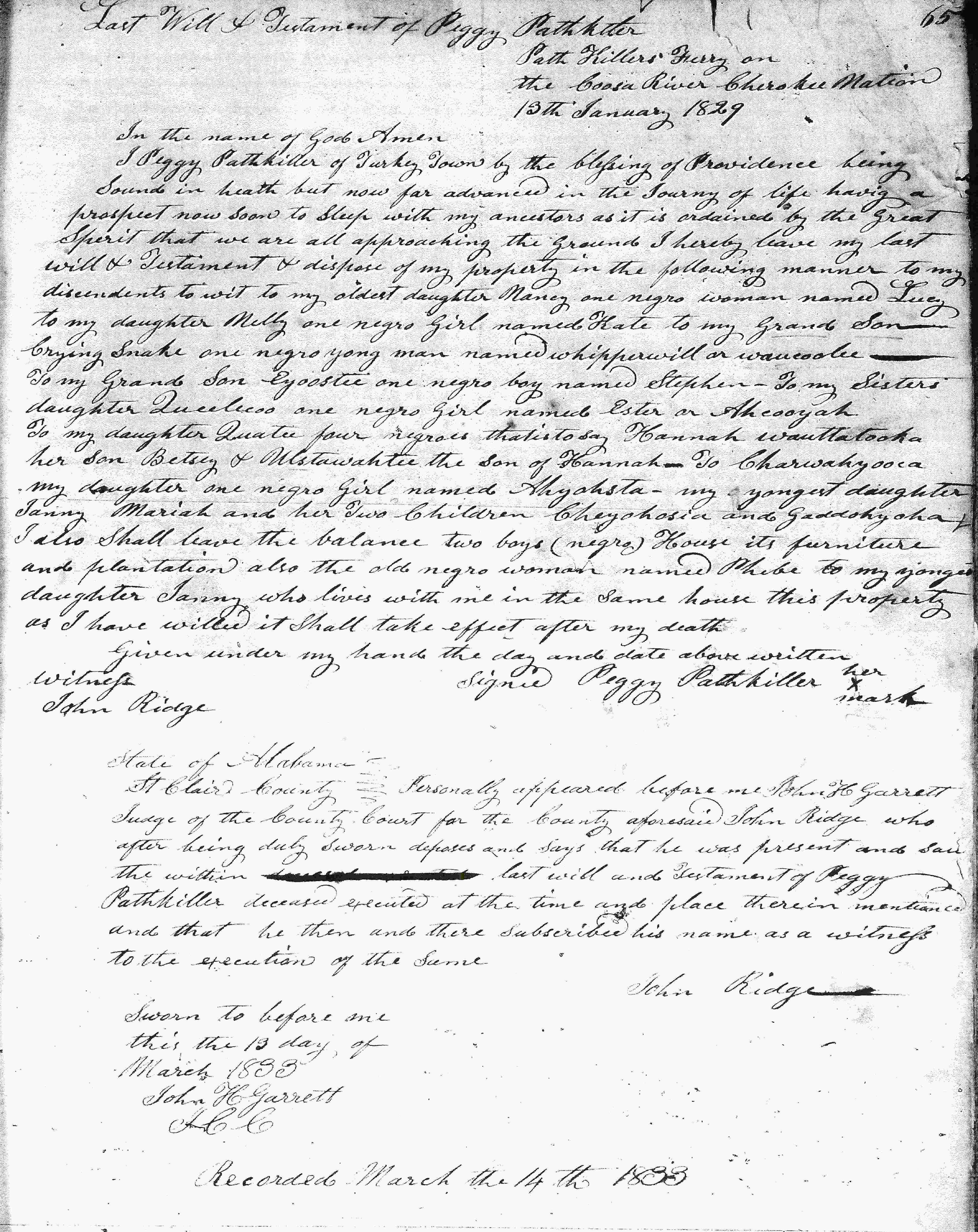
Peggy is listed as part-owner of a ferry near Turkey’s Town. It states they were “dispossessed since the spring of 1832”. She died sometime between this time and March 1833. She is buried somewhere on the property.
George Chambers, John Ratliff, Daniel Griffin Jr., and Peggy Pathkiller Sr were joint owners of a Ferry on the Coosa River in Turkey Town Valley, Cherokee County. The Valuations gave an average annual income of $100.00. Included with this Valuation were a 16’x14’ house and a 10-acre field of bottom land under fence. The Claimants were dispossessed since spring of 1832.11
Five Daughters
We have discussed Nancy. To review. Nancy is listed in Peggy’s will “to my oldest daughter Nancy“. Nancy’s sons Crying Snake and Eyoostee, also known as Houston are listed in the will; “To my grandson Crying Snake. To my grandson Eyoostee.”
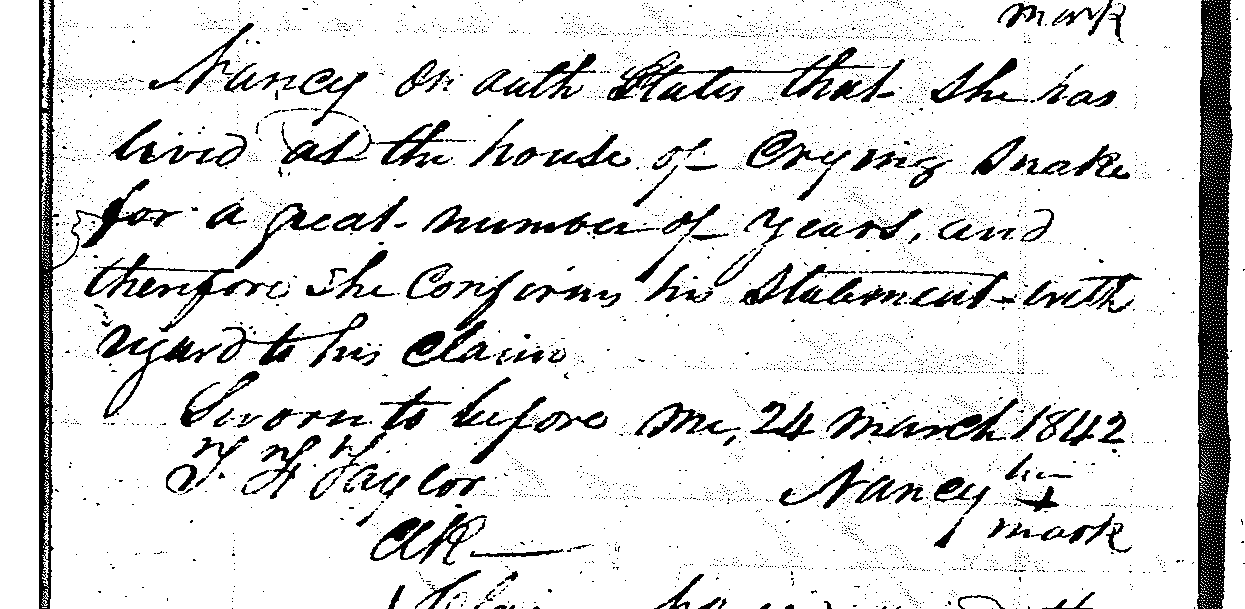
Nancy on oath states that she lived at the house of Crying Snake for a great number of years, and therefore she confirms his statement with regards to his claim.12
Register of Payments, Book A. Page 14; Crying Snake and Nancy are paid for their portions of Pathkiller’s ferry; #12, Crying Snake, Alabama, Ferry on the Coosa, share of C. Snake $796. 87 ½ Sent West Jany 1839; #13, Nancy. Crying Snake’s mother. Ferry on Coosa, Share for Nancy $796. 87 ½ Sent West Jany 1839.
St Clair County; Special Orphans Court, October 1833, page 241; October 31st 1833. . . settlement had on the Estate of Peggy Pathkiller Deceased the papers and vorchers being filed in office. . . Nancy one of the heirs receipt $455.00. Crying Snake one of the heirs receipt $450.00. Eustee one of the heirs receipt $300.00. 13
Nancy Pathkiller, Crying Snake, and Houston are listed in the Captain John Benge14 Detachment. They left Fort Payne in September 1838. They arrived in the West in January 1839 on the “Trail of Tears”.
Nelly or Nella is listed in Peggy Pathkiller’s will; “to my daughter Nelly. . .”15
Special Orphans Court, October 1833, page 241; October 31st 1833. . . settlement had on the Estate of Peggy Pathkiller Deceased the papers and vorchers being filed in office. . . Nelly one of the heirs receipt $375.00 16
Nelly is possibly the N. Pathkiller of Turkey Town listed in Forman’s 1835 Cherokee Census. She is listed on page 80; 5 fullbloods, one farmer, 3 readers of English, 1 weaver, 1 spinster (spinner).Nelly is listed in the Benge Detachment for the “Trail of Tears”. Nelly has a daughter named Anna. Anna married Frances Hampton.
Quatee is listed in Peggy Pathkiller’s will; To my daughter Quatee. . .17
Special Orphans Court, October 1833, page 241; October 31st 1833. . . settlement had on the Estate of Peggy Pathkiller Deceased the papers and vorchers being filed in office. . . Quata one of the heirs receipt & George Campbell one of the heirs} $1200.00.18
Quatee married George Campbell. George Campbell is listed on the Lieutenant Edwards Deas detachment. They left for the West on 6 June 1838. Their departure point was near Ross Landing on the Tennessee River.19
Charwahyooca is listed in Peggy Pathkiller’s will; to Charwahyooca my daughter. . .20
Special Orphans Court, October 1833, page 241; October 31st 1833. . . settlement had on the Estate of Peggy Pathkiller Deceased the papers and vorchers being filed in office. . . Charwahyooca and Richard Ratliff receipt $300.0021
She married Richard Ratliff Jr. Richard Ratliff Jr. is listed on the Lieutenant Edwards Deas detachment. They left for the West on 6 June 1838 near Ross Landing on the Tennessee River. 22
I will share more on the Ratliff family. Not because they married into Chief Pathkiller’s family, but their involvement in the Turkey’s Town Story.
Jenny is listed in Peggy Pathkiller’s will; my youngest daughter Jenny. . .I also Shall leave. . .House its furniture and plantation. . .who lives with me in the same house this property. . .23
Special Orphans Court, October 1833, page 241; October 31st 1833 . . . .settlement had on the Estate of Peggy Pathkiller Deceased the papers and vouchers being filed in office. . . Jenney one of the heirs receipt $1188.60 24
Jenny “Jane” Pathkiller was listed in the Captain John Benge Detachment. They left Fort Payne in September 1838. They arrived in the West in January 1839 on the “Trail of Tears”. 25
Dragging Canoe. He is not to be confused with the Chickamaugan Chief who died in 1794. He is the only male sibling of the women above. The girls named him in affidavits about Anna Hampton’s improvement claims in 1837 as their brother. Anna is the daughter of Nelly.
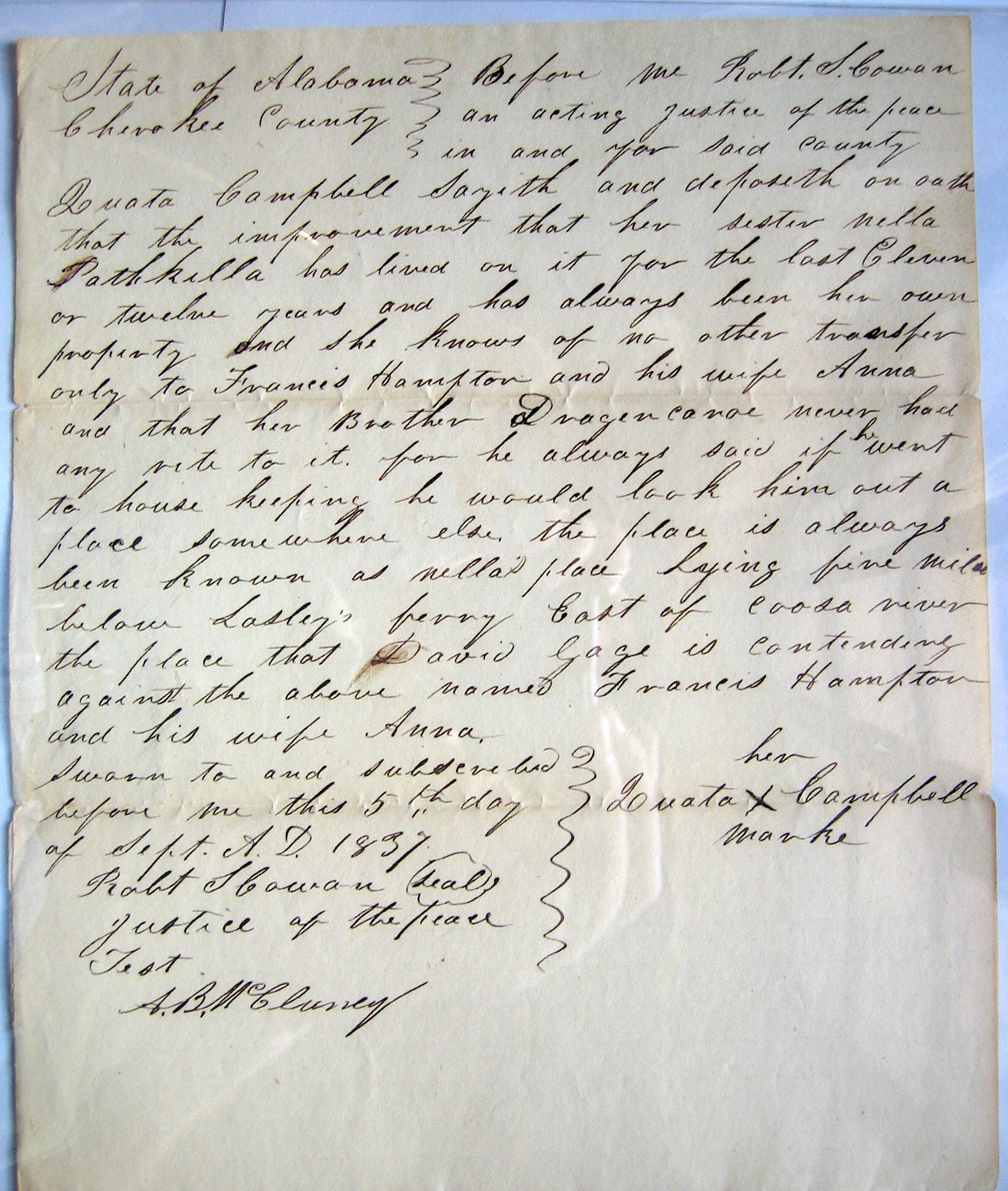
Dragging Canoe died before August 1829. The heirs with the Administrators of his estate sued in the Cherokee Supreme Court his mother, Peggy. This was over slaves Simon and Phoebe with her children, and some other property. St Clair County, Alabama Orphans’ Court Records show that James G Carrol received the appointment as Administrator. He was responsible for the estate of Dragging Canoe. Dragging Canoe was a Cherokee. The appointment was made in the 1833 term (page 207). Also appointed were David Gage, Thomas Machen, and James C Street.27 They were appraisers of the estate. There are no copies of the estate records on the internet.
Dragging Canoe may have been murdered. Chief Pathkiller complained to Rev. Daniel Butrick in 1822 about the murder of a son. His complaint was that the US President had done nothing about it. Butrick’s Journal. This will be discussed further in a discussion on Charles, Chief Pathkiller’s nephew. Charles was murdered in 1821.
Dragging Canoe was married to Watty, a Cherokee Woman. He had a son, Sky-ah-too-ka, and a daughter, Martha. Sky-ah-too-ka contested the improvements claimed by Anna Hampton. You can review this by looking back at the section, “Location by Chief Pathkiller’s family”.
Third Wife
Oo-loo-cha, a Cherokee Woman.
“Ahama, or Hammer, the son of Oo-loo-cha”
“after the treaty of 1819, she (Oo-loo-cha) married Path-killer the chief of the nation and she abandoned her reservation and moved with him to Turkey-town”. 28
Conclusion
“My granny says that her granny was a Cherokee Princess.”
The information on the genealogical website for Chief Pathkiller is full of folklore, family traditions, and wishful thinking. The sources are written histories. Some are just stories. One needs to ask, “How do you know this?” “What is the source?” I hope what you have read here helps explain the proven family of Chief Pathkiller.
We will continue the discussion on Chief Pathkiller. The Beloved Chiefs from Turkey’s Town, Pathkiller, the Last King of the Cherokees. Next time.
- The Southern Indians, The Story of the Civilized Tribes Before Removal”, R. S. Cotterill, Norman and London, the University of Oklahoma Press, 1954, page IX Preface.
↩︎ - https://www.familysearch.org/en/tree/person/collaborate/LY36-VTS ↩︎
- https://www.indianreservations.net/2017/10/moytoy-of-tellico-emperor-of-cherokee_22.html#google_vignette ↩︎
- Hargrett Rare Book and Manuscript Library, The University of Georgia Libraries, Telamon Cuyler Collection, Box: 77, Folder: 30, Document: 02. ↩︎
- Fold3 Ancestry.com, Correspondence and Miscellaneous Records; page 271-274, Records of the Cherokee Indians Agency in Tennessee 1801-1835, Record Group 75, National Archive ↩︎
- Richard Blount’s Papers, Alabama State Archives, digital.archive.gov site, page 9 August 30-September 6, 1826 ↩︎
- 4th Board Claims, Entry 250, Image 199; Records of the Bureau of Indian Affairs, Record Group 75; National Archives Building, Washington DC. ↩︎
- Rice and McCoy/Rawlings and Massey’s Valuations, Cherokee County, Alabama, #44; Property Valuations, Entry 224; Records of the Bureau of Indian Affairs, Record Group 75; National Archives Building, Washington, DC. Annual Income $1,460.00 based on certificates of David Vann, James Lasley, Wm Childers and John Fields. Of the amount allowed Ridge received 1/8th of the whole for ferrying, 1/2 of the remaining balance, 3/8 of the other half. Of the remaining portion, Crying Snake received 1/8th, Hughston (Houston) received 2/8th,Tarkaga (Tarkahagee) received 1/8th, and the final 1/8th went to Nancy (Pathkiller), Crying Snake’s mother. This is the present-day Garrett Ferry site 1 mile South of Centre on the Coosa River. Now County Road 20. ↩︎
- Penelope Allen Johnson Collection, University Tennessee Knoxville, Series V, Box 1, FOLDER 201 ↩︎
- https://www.pellcitylibrary.com/wp-content/uploads/2022/03/Native-Americans.pdf Pell City Library, Court Records Links, Estate Book B, Page 65, Page 23 in the library document. ↩︎
- Rice and McCoy/Rawlings and Massey’s Valuations, Cherokee County, Alabama, #49; Property Valuations, Entry 224; Records of the Bureau of Indian Affairs, Record Group 75; National Archives Building, Washington, DC. The $1,100 total allowance was divided among the four partners. ↩︎
- Manuscript Collection #1787, Box 16, Folder 1 Tennessee State Library and Archives Microfilm Collection 815, Reel 6, Flint District Claims, Claim #10, Crying Snake’s portion of claim is missing from the file. ↩︎
- https://www.pellcitylibrary.com/wp-content/uploads/2022/03/Native-Americans.pdf Pell City Library, Court Records Links, Orphan Court March fifth 1833, Orphan Court Book, page 241, 1827-1844. Page 19 in the library document. ↩︎
- Hargett, J. L.. Muster roll of John Benge detachment. 4026.707. John Ross Papers. September 28, 1838. Tulsa: Gilcrease Museum, https://collections.gilcrease.org/object/4026707 (02/19/2018). ↩︎
- https://www.pellcitylibrary.com/wp-content/uploads/2022/03/Native-Americans.pdf Pell City Library, Court Records Links, Estate Book B, Page 65, Page 23 in the library document. ↩︎
- https://www.pellcitylibrary.com/wp-content/uploads/2022/03/Native-Americans.pdf Pell City Library, Court Records Links, Orphan Court March fifth 1833, Orphan Court Book, page 241, 1827-1844. Page 19 in the library document. ↩︎
- https://www.pellcitylibrary.com/wp-content/uploads/2022/03/Native-Americans.pdf Pell City Library, Court Records Links, Estate Book B, Page 65, Page 23 in the library document. ↩︎
- https://www.pellcitylibrary.com/wp-content/uploads/2022/03/Native-Americans.pdf Pell City Library, Court Records Links, Orphan Court March fifth 1833, Orphan Court Book, page 241, 1827-1844. Page 19 in the library document. ↩︎
- Cherokee Registry Trail of Tears-Deas detachment, Cherokeeregistry.com ↩︎
- https://www.pellcitylibrary.com/wp-content/uploads/2022/03/Native-Americans.pdf Pell City Library, Court Records Links, Estate Book B, Page 65, Page 23 in the library document. ↩︎
- https://www.pellcitylibrary.com/wp-content/uploads/2022/03/Native-Americans.pdf Pell City Library, Court Records Links, Orphan Court March fifth 1833, Orphan Court Book, page 241, 1827-1844. Page 19 in the library document. ↩︎
- Cherokee Registry Trail of Tears-Deas detachment, Cherokeeregistry.com
↩︎ - https://www.pellcitylibrary.com/wp-content/uploads/2022/03/Native-Americans.pdf Pell City Library, Court Records Links, Estate Book B, Page 65, Page 23 in the library document. ↩︎
- https://www.pellcitylibrary.com/wp-content/uploads/2022/03/Native-Americans.pdf Pell City Library, Court Records Links, Orphan Court March fifth 1833, Orphan Court Book, page 241, 1827-1844. Page 19 in the library document. ↩︎
- Hargett, J. L.. Muster roll of John Benge detachment. 4026.707. John Ross Papers. September 28, 1838. Tulsa: Gilcrease Museum, https://collections.gilcrease.org/object/4026707 (02/19/2018). ↩︎
- Records of the Bureau of Indian Affairs, Record Group 75; National Archives Building, Washington DC, E236 Misc Claims Papers Image 584 ↩︎
- https://www.pellcitylibrary.com/wp-content/uploads/2022/03/Native-Americans.pdf Pell City Library, Court Records Links, Orphan Court March fifth 1833, Orphan Court Book, page 207, 1827-1844. Page 18 in the library document. ↩︎
- Hammer filed a claim several times to be paid by the US government for the improvements after he was in the Arkansas territory. Minute Docket 4th Board of the
Cherokee, claim #24 Reservation 141, September 21, 1846, Records of the Bureau of Indian Affairs, Record Group 75; National Archives Building, Washington DC ↩︎
Trust in the Lord with all your heart, and do not rely on your own understanding;
in all your ways know him, and he will make your paths straight. Proverbs 3: 5-6 CSV
 New Seneca Turkey's Town