
Tags
alabama-history, cherokee-indians, Chief Pathkiller, native-americans, northeast-alabama-history, Pathkiller, trail-of-tears, turkeytown
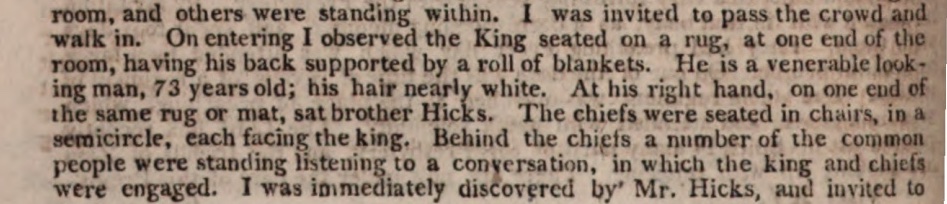
King
The term “King” was applied to the principal Chiefs of the Cherokee by Europeans and Spaniards. The Cherokees did not have a title for the “Beloved Headman”. The title of Principal Chief is used today for the leader of the nation. Since there was no word, the Europeans and Spaniards used Chief and King. This was a way for them to relate to the leadership of the nation. The white people then used “King” or “Principal Chief” as the title for Chief Pathkiller.
The above journal is one example. There are several references using “King”. Reverend Daniel Butrick refers to Chief Pathkiller as the King in his journal in 1822. The grave stone had “Path Killer The last King of the Cherokees.”
Chief Pathkiller had influence, but, was the leader of the nation only in title. After Chief Black Fox died in 1811 Chief Pathkiller became Principal Chief. In late 1811 the Cherokee Nation adopted a National Council. Dr. Susan Abram, in her doctoral thesis, wrote;
The Cherokee National Committee, which conducted the nation’s affairs in this volatile atmosphere, informed Meigs of its newly appointed membership, on 18 November 1811. The group was composed predominately of younger headmen, including Charles Hicks, The Ridge, Seekickee, John McIntosh, John Walker, John Lowry, George Lowry, John McLamore, Duck, Wasausee, Sour Mush, and Chulioa. John Ross served as the thirteenth member of the committee and its clerk. Most of these men, while relatively young, had served their people for many years as warriors, headmen, lighthorse regulators, and Cherokee representatives to the Cherokee Indian Agency. The committee, which answered only to the “old Chiefs” of the Cherokee National Council, dealt with the nation’s everyday business, collected the annuity, and would soon become instrumental in determining the Cherokee course of action in the time of war soon to come.2
Chief Pathkiller is now the “King” or Principal Chief of the nation, and they are in transition. The progressiveness of mixed blood is now an influence on the nation. The Cherokee have settled into the practice of farming. At the beginning of Chief Pathkiller’s tenure, war is brewing. The Shawnee from the north urges the Southern Indians. They want them to join a coalition to fight the “whites”. The Cherokee walk away and want no part of the war. They see no benefit in fighting. The Chickasaw and Choctaw walk away as well. The Americans and British have their own conflict starting again. The Shawnee go home. This leaves the Creek with a civil war of their own. The Red Stick faction is created.
The War Within a War
The British and Americans were at war with each other again. (War 1812). This weighed heavy on Chief Pathkiller and the decision makers of the Cherokee. Which side to take was not an easy choice. Just south of them was going to make the decision for them.
On July 23, (1813) Cherokee principle chief Path Killer had several head men from the Creek Path area to write to Meigs of the “rebellion in the Creek Nation” and that the Red Sticks were “endeavouring to brake [sic] the chain of friendship between the U.S. & that Nation.” They further relayed that the national Creeks had sought assistance against possible attacks by the Red Sticks on Coweta and Cusseta. They warned Meigs that, in their estimation, their situation was dire:
It appears that the situation of our villages on the borders of the Creek Nation is not altogether safe, as we have been advised by the Big Warrior & his friendly Chiefs, to furnish ourselves with guns. To be guarded against the rebellious Creeks, that they should be suppressed, in case an attempt to invade our Country. A number of Creeks of the Natchez tribe have come to Turkey’s Town for refuge from the merciless rebels their friendly disposition towards the US. Appears to be usually firm, their number consists of nearly 200 men besides their women & Children. We hope the White People will not think that we have suffered those Indians to come amongst us with any hostile intentions towards them, as they are part of those who have suffered their friends & relations to spill their blood in giving satisfaction to the US. For the murder which was committed on the Ohio.3
Friendly Creeks have moved into Turkey’s Town. They have sought refuge there. A fort is created around the residence of Chief Pathkiller. By September of 1813 the Cherokee have joined forces to combat the Red Sticks.
Chief Pathkiller would receive a commission as Colonel. He never left Turkey’s Town. He did not fight in a battle. His age would not allow him to. He would be about 68 years old (1745). By the end of October 1813 Turkey’s Town is threatened with being attacked. Chief Pathkiller sent a letter to Andrew Jackson. He explained the issues. Jackson sent a letter to William Blount, Governor of Tennessee.
Two runners arrived here yesterday, from the Path Killer bringing the information that the hostile Creeks, were assembling in considerable numbers within 15 or 20 miles from the Turkey Town. . . .it is probable we shall have a fight, if the creeks means to fight us.4
Turkey’s Town was never attacked. The first battle for the Tennessee Volunteers and Cherokees was at Tallasahatachee near the Ten Islands. Supplies and food was taken by the Volunteers from the Cherokee people living in Turkey’s Town. Not even the Chief or King Colonel Pathkiller was safe from the looting. Chief Pathkiller would have Chief Charles Hicks file claim for losses in 1814.
By the end of March 1814 the battle of Horseshoe Bend will take place, and the Red Sticks defeated. This will bring an end to the Creek uprising.
The recovery for Turkey’s Town would take place. The 1814 War Claims would seek retributions from the United States with the losses of the Cherokee people. In the section already posted about the location Chief Pathkiller’s claim is shown. Chief Charles Hicks also files claim for friendly Creeks from Coosahattchee. See Location by the Cherokee People.
The Aftermath
The Chickasaw and the Cherokee can not come to an agreement on boundaries. Next post. Chief Pathkiller and the Turkey Town Treaty of 1816.
- The Pansophist, and Missionary herald. v. 15 (1819). Journal of the Mission at Brainerd, page 42. https://babel.hathitrust.org/cgi/pt?id=nyp.33433068276272&view=1up&seq=64&q1=King ↩︎
- “SOULS IN THE TREETOPS:” CHEROKEE WAR, MASCULINITY, AND COMMUNITY, 1760-1820
Susan Marie Abram, A Dissertation, Submitted to the Graduate Faculty of Auburn University
In Partial Fulfillment of the Requirements for the Degree of Doctor of Philosophy Auburn University
August 10, 2009, page 97 ↩︎ - Ibid, page 104 ↩︎
- Jackson’s White Plumes, An Historical and Genealogical Account of Selected Cherokee Families who Supported Andrew Jackson during the Creek Indian War of 1813-1814, Charlotte Adams Hood,1995, Lavender Publishing Company, page 32 ↩︎
Trust in the Lord with all your heart, and do not rely on your own understanding; in all your ways know him, and he will make your paths straight. Proverbs 3: 5-6 CSV
 New Seneca Turkey's Town