
Tags
alabama-history, Brainerd Mission, cherokee-indians, Chief Pathkiller, native-americans, northeast-alabama-history, Pathkiller, trail-of-tears, Treaty of 1816, turkeytown
The aftermath of the Creek uprising/Creek War 1813-1814 led to another boundary settlement with the Indian tribes. The consequences of the war for the Creeks set their boundaries. The Treaty of 14 September 1816 involved the United States and the Chickasaw, Choctaw, and Cherokee nations. This was held at the Council House of the Chickasaws.
In the year after the war, the US Government sent a delegation of surveyors to Fort Strother. This was located at the Ten Islands, Coosa River. Two of the surveyors die as they are setting up for the survey. General John Sevier1 is one, and Major John Strother2 is the other.3 These two men were very important to Jackson’s Creek War Campaign. There were several affidavits taken. Letters are sent back and forth from Gen. Andrew Jackson and William H. Crawford, Secretary of War. All the letters and affidavits were prep work to set up the treaty in September. The United States was claiming new lands to be ceded to them because of the war. 4

The delegation of the Cherokees did not like the boundaries that were set. This delegation did not include Chief Pathkiller. They stated they were not prepared or notified as to the nature of the meeting. The delegation left the meeting. They set a new date to be presented to the whole nation and Chief Pathkiller. The Cherokees deferred it to a meeting at Turkey’s Town for ratification. They met at the Turkey Town Council House on 4 October 1816. The United States delegation included Major General Andrew Jackson and General David Meriwether. Jesse Franklin, Esq., served as Commissioner. James Gadsden was the Secretary to the Commissioner. Return Meigs and Richard Taylor, as well as A. McCoy, acted as interpreters. Signing for the Cherokee’s; Pathkiller, The Glass, Sour Mush, Chulioa, Dick Justice, Richard Broom, Boot, and Chickasawlua.5
General Andrew Jackson’s delegation arrived at Turkey’s Town on 28 September 1816. All of the Cherokees had not arrived. They would assemble on 4 October. The speech was given by Jackson. He reviewed the information from the meeting at the Chickasaw Council House. Chief Pathkiller did not want to give up any more territory. 6
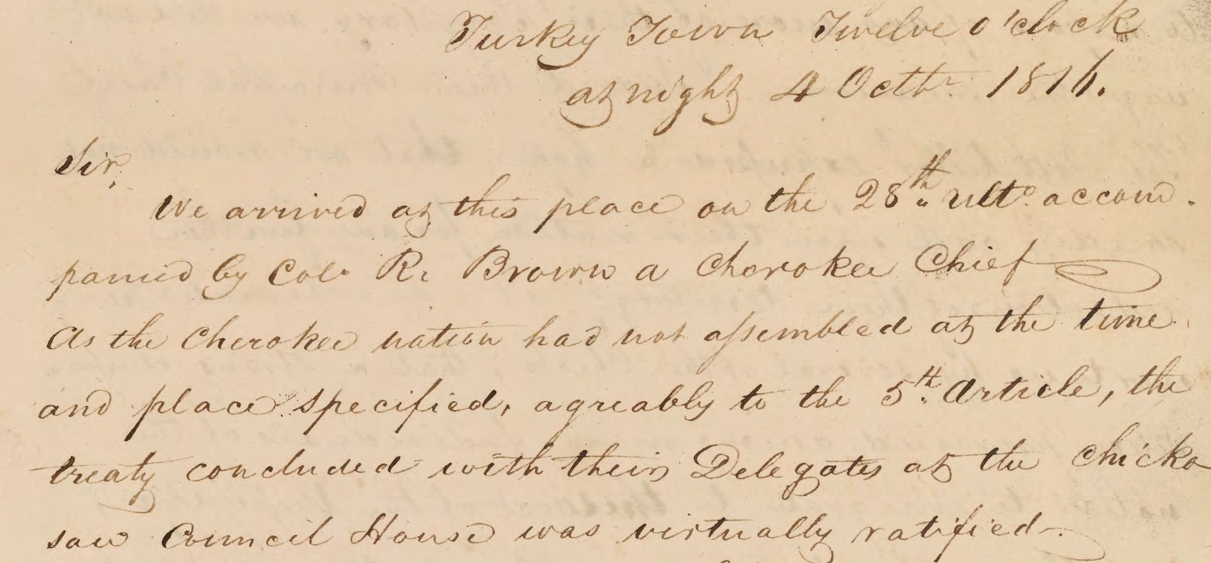
At midnight on 4 October 1816, Andrew Jackson and David Meriwether dictated a letter to be sent to William H. Crawford, Secretary of War with a summation of the treaty and other comments. In this letter at image 113, they talked about the removal West of the Mississippi. Several Chiefs inquired about the effects on the nation.
It was internalize to us however several of the chiefs that a strong disposition prevailed among many individuals of the nation to emigrate to the west of the Mississippi and they wished to know whether in the event of national removal it was practicable to effect an exchange with the General Government. . .8
The US will gain territory. This will set in place, along with the treaties of 1817 and 1819 the creation of the State of Alabama. The boundaries are best viewed on John Melish’s 1819 map of the State of Alabama. https://www.loc.gov/item/gm71005414/
Mission Schools
A US citizen, Reverend Cyrus Kingsbury observed the signing of the ratification of the treaty on 4 October 1816. He had asked permission to attend to make a plea to set up schools in the Cherokee Nation. He wrote to Reverend Samuel Worcester. Both were a part of the American Board of Commissioners for Foreign Missions. Kingsbury advised Worcester about the event and his progress in establishing a Mission School.
Kingsbury to Worcester;
It was now twelve o’clock at night and they had been in session two to three days, But they concluded to give me an answer that night, after a short consultation one of the principal Chiefs, took me by the hand very affectionately, said I had appeared in their full council they had listened to what I said and understood it. They were glad to see me that they wished to have the school established.9
This would give the consent to move ahead for schools. It would create what became the Brainerd Mission. This was the base of operations for the American Board of Commissioners for Foreign Missions (ABCFM). They ministered to the Cherokee people. It was located near the Tennessee River along a track of land at the Chickamauga Creek. Nowadays this is Chattanooga Tennessee. From this Headquarters, they would place mission schools at Wills Town, and Creek Path in what is now Alabama. They sought permission to put a school in Turkey’s Town. That was approved, but did not happen.
From the Bio on the website; The Brainerd Mission, University of Tennessee, Chattanooga.
The ABCFM tasked Reverend Cyrus Kingsbury with founding the mission. He received permission from both the President of the United States and the Cherokee Nation in 1816 to start the school. For land, Kingsbury purchased a plantation in what was known as ‘Chickamauga Territory’. He paid 500 dollars for 25 acres of land. The mission officially opened in March of 1817 as the Chickamauga Mission. However, as Chickamauga territory was so expansive, the name was deemed too unspecific. In 1818 the name was changed to Brainerd Mission, in honor of prominent missionary David Brainerd.10
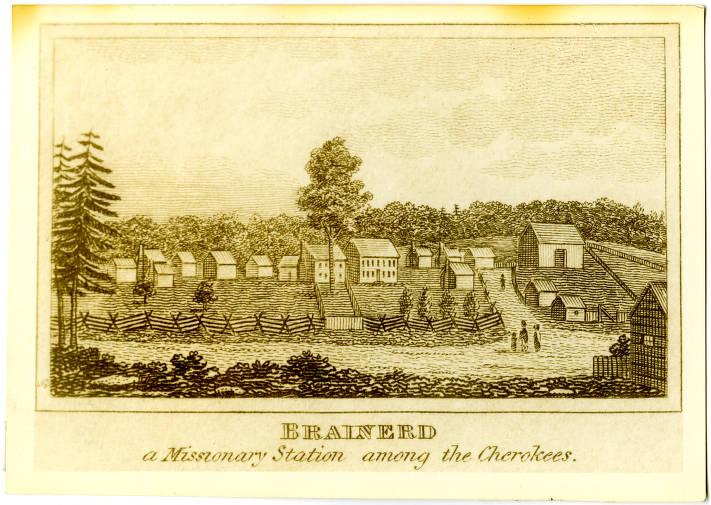
The Brainerd Mission closed in August 1838. This happened due to the forced removal of the Cherokee people on the Trail of Tears. All but two of the missionaries went west with their Cherokee congregation.12 One of the missionaries to survive on the Trail of Tears was Rev. Daniel Butrick. He has been quoted in this work. His journal and book are valuable to this work.13
Conclusion
A treaty is ratified. Permission for schools is granted. But lots of questions persist. General Jackson came with a delegation of Commissioners. Who was his escort? How many soldiers made up this escort? Were they the US Army or the Tennessee Volunteers? Captain John Hutchings is in charge of the supplies14. Lots of people are on the banks of Turkeytown Creek. Where did they camp?
We will leave Chief Pathkiller here. The “King” and his accomplishments are significant to the Cherokee Nation. They became more progressive during his reign. Henry Thompson Malone provides an excellent overview of this in his book. The book is titled Cherokees of the Old South A People in Transition. Refer to Chapter 6, A Republic is Born, on pages 74-90. Some of the nation’s accomplishments during his reign and while he was the Second Beloved Man. The National Council adopted a written legal code on 11 September 1808. District Judges and a council preside over hearings on local matters. A National Superior Court. A National Constitution. The establishment of mission schools is described above. The above treaty of 1816. Chief Pathkiller will be involved with the Treaty of 1817 and 1819.
Several recorded that due to his age, he was just a figurehead. The emerging mixed-bloods were taking charge of the nation. One example is his second, Charles R. Hicks. Chief Pathkiller, the last of the full-blood Cherokee Chief of the Nation, was still an influence.
Next we will briefly discuss Chief John Ross. The Beloved Chiefs From Turkey’s Town.
- https://northcarolinahistory.org/encyclopedia/john-sevier-1745-1815/ ↩︎
- https://www.ncpedia.org/biography/strother-john ↩︎
- Jackson’s White Plumes, An Historic and Genealogical Account of Selected Cherokee Families who Supported Andrew Jackson during the Creek Indian War of 1813-1814, Charlotte Adams Hood, Lavender Publishing Company, Bay Minette, Alabama, 36507,1995, pages 65-67 ↩︎
- National Archives, Record Group 11, General Records of the United States Government, Series Indian Treaties; RIT #83; Ratified Indian Treaty #83, Cherokee, Chickasaw Council House September 14, 1816, There are 231 images of this with correspondence of letters and a journal. https://catalog.archives.gov/id/100220646 ↩︎
- Ibid, Images 1-10.
↩︎ - Ibid, Images 110-112 ↩︎
- Ibid, Image 112 ↩︎
- Ibid, image 113 ↩︎
- American Board of Commissioners for Foreign Missions Boston MA
Unit 6 – Missions on the American Continents and to the Islands of the
Pacific18.3.1 (Cherokee Mission) Vol 3, item 1,Records at Houghton Library, Harvard University. From Microfilm Reel 738 ↩︎ - https://findingaids.utc.edu/agents/corporate_entities/17 ↩︎
- https://digital-collections.library.utc.edu/digital/collection/p16877coll7/id/32/rec/6 ↩︎
- Ibid ↩︎
- Cherokee Removal: Journal of Reverend Daniel S. Butrick, Trail of Tears Association-Oklahoma Chapter; Fulll Title: Cherokee Removal: Journal of Reverend Daniel S. Butrick May 19, 1838 – April 1, 1839, various pages from the miscellaneous files of Reverend Daniel Sabin Butrick, 1822, Michael Wren personal collection. ↩︎
- National Archives, Record Group 11, General records of the United States Government, Series Indian treaties; RIT #83; Ratified Indian Treaty #83, Cherokee, Chickasaw Council House September 14, 1816, Image 39 ↩︎
Trust in the Lord with all your heart, and do not rely on your own understanding; in all your ways know him, and he will make your paths straight. Proverbs 3: 5-6 CSV
 New Seneca Turkey's Town