
Tags
alabama-history, cherokee-indians, Chief John Ross, northeast-alabama-history, trail-of-tears, turkeytown
Chief John Ross
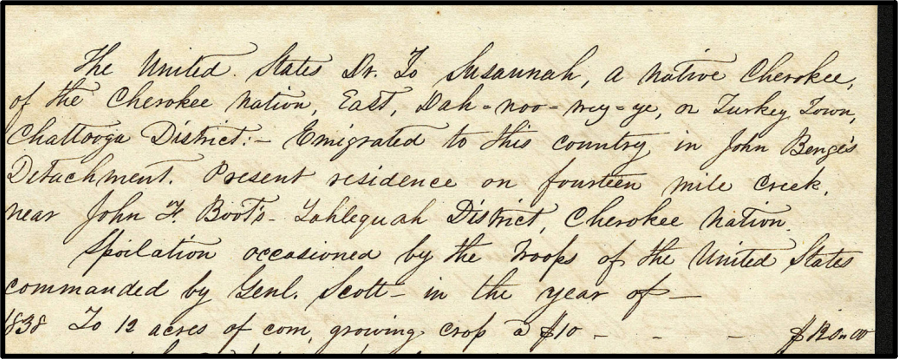
The last of the Principal Chiefs who is from Turkey’s Town. Chief John Ross was born there on 3 October 1790. John Ross was born in “Tahnoovayah.”1 Notice the similarity to the spelling in the above 1842 claim, “Dah-noo-ney-ya”. He would become one of the most, if not the most, beloved Chiefs of the Cherokee Nation. His family moved to Turkey’s Town in 1788. They would leave and move back to the Chickamauga Creek site by 1800. This information is supported by Myth and History: The John Ross House through Time. It was published by The National Park Service and The John Ross House Association, Inc. 2007. It was written by William J. Bishop, Vice-President Trail of Tears Association, Georgia Chapter, on pages 33, 56-57;2
McDonald, living “about 25 miles south west from Chickamagga,” could unwittingly be a prime source of the “earliest and best Intelligence that can be had from that quarter,” Martin said. “He has great influence with the Indians on that quarter, deals at Pensacola, corresponds with Mr. Gilvry, in the Creek Nation and one Mr. McClatchey at the mouth of St. Mary’s, a British Merchant who furnishes some part of the Towns near him with goods.”
Ross said that “about the year 1788, he removed together with his father in-law and their families to Turkey Town (“Tahnoovayah,” according to Eaton, or, according to Brown, “Kanagatugi”), and continued trade with the Cherokees. The Little Turkey was the Principal Chief of the Cherokee Nation and resided in that town.”
Chickamauga move
It does seem to make sense that, following the peace treaty with the Americans, McDonald would want to return back to the site of his original homeplace, where he had raised his children for nearly a decade – much longer than any period of time he had spent in any other Cherokee town. Cementing this idea, correspondence from McDonald’s wife in 1809 is shown as being sent from “Chickamauga,” rather than from Poplar Spring, as Rossville was then known (Cherokee Agency at Tennessee official records, U.S. Archives, M-208, Roll 4). Further, we know that McDonald was in fact living at Chickamauga Creek when he finally did sell his holdings to the founders of the Brainerd Mission 17 years later, in 1817 (Phillips, 1998, p. 27).
(We do know for a fact, however, that McDonald was living on Chickamauga Creek in 1800, as previously demonstrated. So if Hawkins’ eyewitness account can be trusted to mean that the McDonald trading post at Rossville was non-existent in the summer of 1799, then in order to believe that such a trading post did exist prior to McDonald’s establishment at Chickamauga Creek we are necessarily left with only a one-year window. His supposed residence at what is now Rossville, then, would have been exceptionally brief.)
We can be reasonably assured that Ross was living somewhere east of Lookout Mountain by June of 1802 because he sent a letter (Ross, 1802) from “Chickamoga” to the Tennessee Agent, Major William Lovely, regarding, again, some horses that had been stolen .
Commissary in Turkey’s Town
We can see his grandfather’s influence in Turkey’s Town. During his time there, he turned the place into a commissary. He bargained trades, goods, and munitions from the Spaniards. Myth and History: The John Ross House through Time; pages 27-57, John McDonald and the Chickamauga Page 37
James Carey related the following information to Gov. Blount in Nov., 1792 (Coker, 1986, Reel 7): The contents of the letter was to invite Watts and the Bloody Fellow, in the name of Governor O’Neal, to come down to Pensacola with ten pack horses; that they should have from Governor O’Neal arms and ammunition, as many and as much as they wanted, and that Panton himself would supply their nation with goods in plenty. Mr. Panton, during his stay in the nation, made the house of his countryman, McDonald, his headquarters, from whence they together paid a visit to the Little Turkey, and spent several days, Mr. McDonald acting as interpreter between Mr. Panton and the Turkey.
After this visit, Panton wrote to Gov. O’Neill, advising him on the best way to conduct the proposed meeting. The Cherokees, he said, should be supplied with much-needed arms, horses, and guns, and generous presents should be given. He specifically pointed out that “Mr. McDonald, the old British superintendent,” should be welcomed personally. He knew McDonald was very dissatisfied with the American treatment of the Cherokee and with Gov. Blount’s efforts to tamper with Indian trade. Panton, like Martin on the American side, knew that McDonald with his influence over the Cherokee could be either “very serviceable” or “very dangerous.”
Myth and History: The John Ross House through Time is a very well-documented source of the Ross house in Rossville, Georgia. It clears up the history of the house. It has a very well-documented history of the Chickamauga Cherokees. Web link below.
https://www.nps.gov/trte/learn/historyculture/upload/Myth-and-History-The-John-Ross-House-508.pdf
Chief John Ross did not live in Turkey’s town while he was Chief. There are many books written about him, so I will not repeat his story. The exact location of the McDonald/Ross home and trading post in Turkey’s Town is not known. It must have been on the main road through the Town. This would be the High Town Pass or Hightower Pass. There are no statements about their location on any of the Claims. There are also no notes of their location submitted by the people of Turkey’s Town after removal. They do not comment on the Ross or McDonald trading post or stand.
Chief John Ross became the Principal Chief in October 1828 by election of the National Council. He would lead them through the Trail of Tears.3 He sued the State of Georgia for land rights and laws. Worcester v. Georgia. He won in the Supreme Court of the United States in 1833. President Andrew Jackson did not honor the verdict.4 The New Echota Treaty of 1835 fixed the removal West.5 They had two years to move. In 1838, the forced removal took place, the Trail of Tears. Ross also led them through the American Civil War. He died in 1866.
Conclusion
This concludes the Chiefs. Before we move to the next chapter. I want to introduce you to a couple of people. One we have talked about before. One you do not know. Boot (Chulioa), you have met. He is Cherokee, but he was raised among the Creek. He helped Chief Little Turkey settle New Seneca. I will discuss him in detail next. Then I will introduce you to Charles Chief Pathkiller’s nephew.
- Eaton, Rachel Caroline. John Ross and the Cherokee Indians. Menasha, Wis., George Banta publishing company, 1914. Pdf. https://www.loc.gov/item/14018822/, Image 23, page 3 ↩︎
- https://www.nps.gov/trte/learn/historyculture/upload/Myth-and-History-The-John-Ross-House-508.pdf ↩︎
- Eaton, Rachel Caroline. John Ross and the Cherokee Indians. Menasha, Wis., George Banta publishing company, 1914. Pdf. https://www.loc.gov/item/14018822/, Chapter VII ↩︎
- Ibid, Chapter VIII ↩︎
- Ibid. ↩︎
Trust in the Lord with all your heart, and do not rely on your own understanding; in all your ways know him, and he will make your paths straight. Proverbs 3: 5-6 CSV
 New Seneca Turkey's Town