
Tags
alabama-history, cherokee-indians, native-americans, northeast-alabama-history, trail-of-tears, turkeytown, Wills Town
A person I collaborate with is Michael Wren. He is a Board Member of the National Trail of Tears Association. He leads their research on the Cherokee Removal. A great number of the documents I have on Turkey’s Town come from Mike. I sort through them to let the voice of the Cherokee people tell the story. Chulioa’s (Boot) family is complex. Mike Wren explains the family this way;
Laugh at Mush, Nelly, and Nancy are all full siblings. Boot was their father and a woman whose last name was Beamer was their mother.
John Thompson who lived at Creek Path and is on the 1819 Reservation Roll was their maternal half-brother.
Turner and his sister Polly were paternal Half-siblings to Laugh at Mush, Nelly & Nancy. Boot was their father and Wattee was their mother.
John Huss aka Spirit the Peacher, was married before he married Nancy (Boot). Nancy was married before to someone whose name I don’t know.
John Thompson, above, is the English interpreter for Little Turkey. It is Thompson’s plantation that Little Turkey’s family moved to after Little Turkey died in 1802. This confirms the relationship with Chulioa, John Thompson, and Little Turkey. Blackfox lived near John Thompson, also.
We do not know what year Chulioa was born. He died about 1828. Laugh at Mush tells us this.
Laugh at the Mush appeared before the commissioners April 12th 1845 and made the following statement.
I am the son of Chooli-wah and one of his heirs, I have no brother living have two sisters name their names are Nelly Nightkiller and Nancy Huss. My father died about seventeen years ago, after his ^death farm was occupied by me and my sisters until about five years before the Cherokee Removal, when it was taken passion of by a white citizen of Ala. See a copy of the claim below.
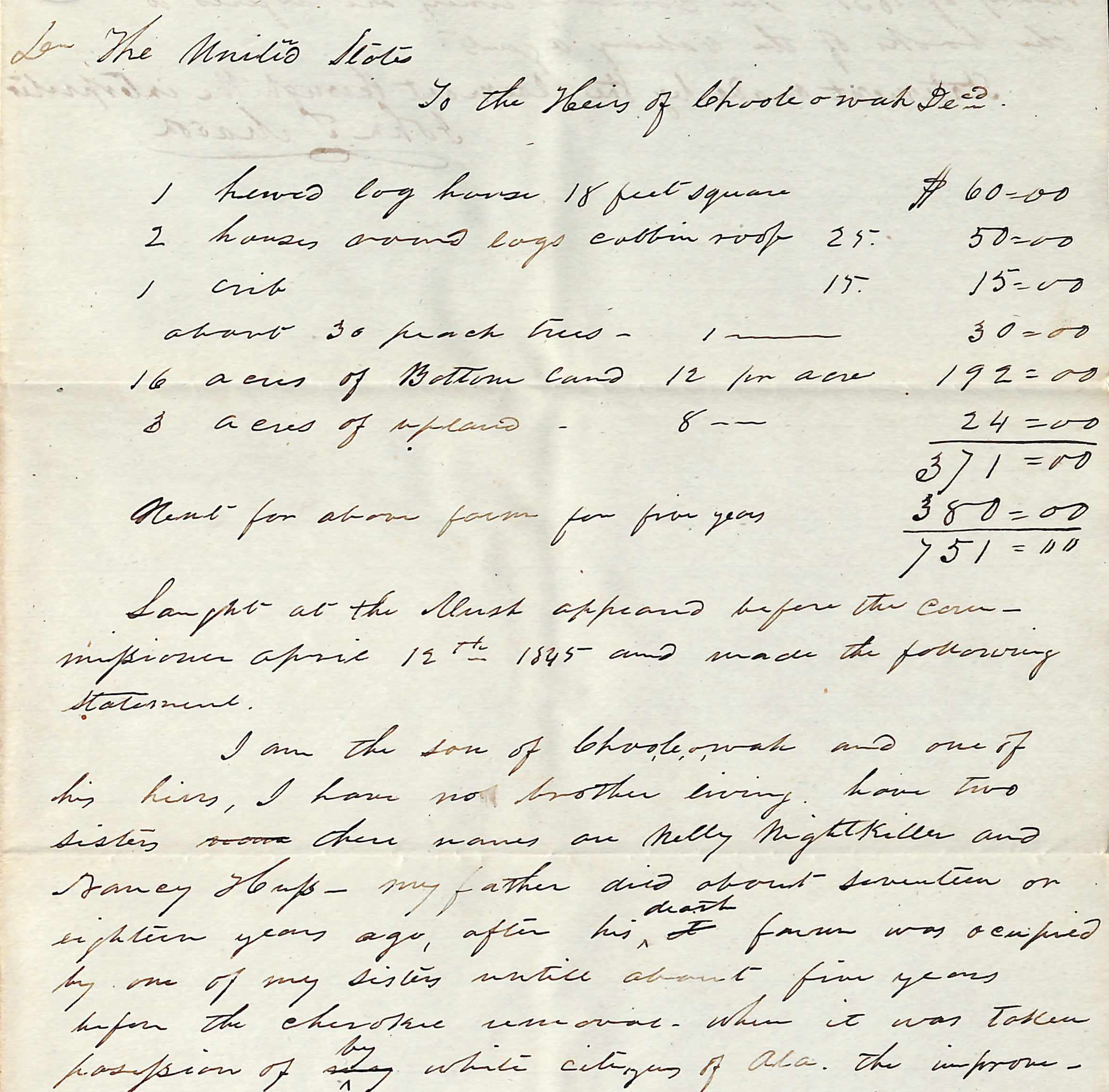
As stated by Laugh at Mush. Laugh at Mush. John Huss, also known as Spirit the Preacher, and Nancy. Nelly Nightkiller, they all lived in Turkey’s Town until around 1833. Yet, John and Nancy moved to Will’s Valley about 1824. Their home would become one of the launching points for the Trail of Tears. It is called Fort Payne. 2 Information from Landmarks of Fort Payne.
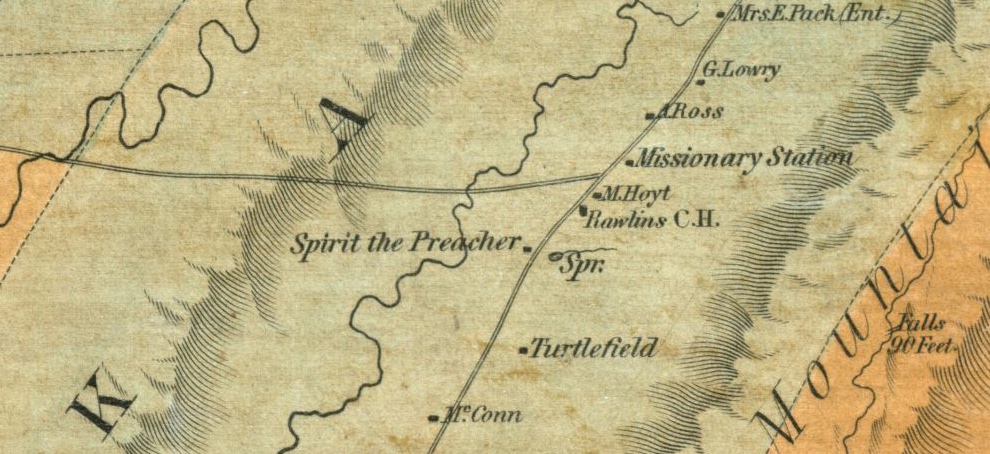
Laugh at Mush stated he lived near the “Old Council House of Turkey Town”. He noted this was about one mile from Pathkiller’s ferry. (The ferry became Peggy’s before 1819. Today, it is known as Fitts Ferry. It is in Northeast Etowah County, Alabama.)
Something to note. I refer you to the topic of the location of Turkey’s Town. Tradition is held in the Abraham Whorton family. An Indian Chief was buried near the large tree in the backyard. See “Location by the People of Turkey’s Town” on this site. Could this burial be Chulioa?
Chulioa and family lived in what is today Turkeytown Creek area. Chulioa lives on the Hightower (Hightown) pass (Old US 411). This was the main trade route through. His family then lived from this road over to the East Road (Coats Bend Road). Rev. Butrick tells us this.
Set off for Wa-sa-si’s, but hearing he was not at home returned [to
Browns], took our leave & rode to br. Brister’s 16 miles. 18 Jan 1822
Rode to the Boots in Turkey Town 25 miles. This man I believe is
some like a prince regent. He attends to business when the king is
absent or in ill health, and is his Creek interpreter. 19 Jan 1822.3
Brown is John Brown, at Creek Path, which is now Guntersville, Alabama. This is the father of Catherine Brown, the first Cherokee woman Brainerd Mission Teacher.4 Brister’s refers to Warwick Bristow. He settled in a valley that was given the name of Bristow’s Cove. In Northwest Etowah County, Alabama, there is a road named Bristow Cove Road and a stream by the same name. This is now the Aurora Community on Etowah County road 179. In 1829, a post office was established under the name Brister’s Cove at Brister’s store. In 1830, the Brister’s Cove Post Office became the Aurora Post Office.5 If you travel on today’s roads, the distance is 26 miles. It is from Aurora at Bristow Cove Creek to Turkeytown Creek on Old US 411. This places Chulioa at Turkey’s Town Creek.
The Meeting with the Headmen
Rev. Butrick recorded in his journal a meeting that was the intent of Butrick. This meeting would lead to a meeting with Chief Pathkiller, all organized by Chulioa.
Sabbath. 20 Jan 1822 The Chiefs assembled. I told them that I should be glad to see all the people of their town, old and young, as far as practicable, but still was willing to refer it to them, whether to call them together or not, or at such time as they should think best. The Boot sent the other chiefs out to consult together, and in a few minutes, they sent for him to communicate if he pleased their answer. He then informed us that they had appointed the third night for the meeting, & would send messengers to the king & others of the Town. He then requested us to sing a Cherokee hymn, after which some of the chiefs, left us, & others spent most of the day. Br. John spent much time in talking with them respecting the school at Brainerd, & in answering objections that were sometimes made. The Boot said it that our visit would be a great help to him in answering the objections of some of his people to schools, as he would now not only tell them what br. John had said, but could point to him as a specimen of the advantages of education; and he thought it would be well to have a school in each District, that the people might have more correct views of the proceedings &c of the missionaries among them. Toward evening two Creeks came, with whom, by means of two interpreters, I had the pleasure of a short conversation. They told us they would meet with us day after tomorrow evening at the council house. This morning the Boot presented me the pipe of Peace, stating that he did not smoke in that at all times, but on certain occasions with his friends of different nations & tribes. This was a Tomahawk. The head forming the bowl, and the handle the stem, having three silver bands. He expressed great joy to see a white man, Creeks and Cherokees alternately smoothing with this pipe – a token of their mutual love and confidence.6
Jan 21 1822 The Boot again presented me with the pipe of peace, expressing his great joy at seeing us at his house & his desire that we would not be lonesome. Some of the neighbors came & we spent the day in singing conversing &c as we thought most expedient. The Boot’s son in law invited us to visit and take supper with him. We accordingly did, being accompanied by the Boot & his wife. On our arrival we were told that the little boy named Bonaparte 6 or 7 years old, whom I invited yesterday to go with me, had made up his mind to go. He had been thinking much on the subject all day, & had finally resolved in the affirmative. I then told him he had better stay one year longer with his parents. After supper we returned. A number of Cherokees came and spent the evening with us.7
“The Boot’s son in law invited us to visit and take supper with him.” Is this John Huss? Is it Nightkiller?
Meeting with Chief Pathkiller
22 Jan 1822 After dinner we returned to and found the head men of the Town collected. About sunset 6 Creeks, one a chief, came. Br. John & myself met them. With tokens of the greatest friendship they took us by the arm, their manner of salutation on certain occasions. We spent some time in conversation with them. Sometime after dark our dear father the Pathkiller arrived. He appeared much rejoiced at seeing us. After some conversation he told us how his son had been killed murdered by a white man – that he had written twice to his father the President respecting it, but could get no answer and [__]eared the murdering of his son was thought no more of by his father than the killing of a beast. We accompanied our two fathers the Path Killer i.e. the king, and the Boot, to the council house about one mile distant.8
“his father the President” This would be President James Monroe. “How his son had been killed murdered.” Is this Dragging Canoe, who was his son (not the Chickamauga War Chief)? Is this Charles Chief Pathkiller’s nephew? In the culture of the Cherokee. As a male, your sister’s son became your son upon the death of her husband. We will explore Charles’s death. Charles was murdered in April 1821.
The council house is “one mile from the Boots” (Chulioa). It is one mile from Old US 411 to Coats Bend Road.
And every thing in nature visible to us, seemed to unite in their exertions to render the scene and the season delightful. Above were the sparkling stars, almost continually stealing my thoughts from all these lower scenes, to contemplate the Divine glory, the amazing grandeur of that Divine Original from whom they borrow all their luster. Around was the dark, but pleasant forest, as a strong wall to serene us from the sight of mortals, & shut us out from all the noise & tumult of a wicked world. While the whistling leaves bid us welcome to their silent retreat. At my right hand sat our dear brother John a brilliant star. At my left hand our dear father the king & next to him our father the Boot & then in proper order all the honorable of the Town. At a suitable time, the king arose and addressed the people in few words. After this br. John explained the design of our visit and read our letters from Brainerd and from br. Hicks. I then spoke in few words.9
Notice the seating order. “At my right hand sat our dear brother John a brilliant star. At my left hand our dear father the king & next to him our father the Boot & then in proper order all the honorable of the Town.” Rev. Butrick is sitting next to Chief Pathkiller. Next to Chief Pathkiller is Chulioa (Boot). The “brother John” is Rev John Arch. Reminder, he is a converted Cherokee and Butrick’s interpreter. He died in 1825 at the age of 27. Brainerd is the Mission headquarters, today’s Chattanooga, TN. The “br. Hicks” is Chief Charles R. Hicks. He is Chief Pathkiller’s Second.
Conclusion
We see that Chulioa (the Boot) is a very important person to Turkey’s Town. He has influence on the Cherokee Nation. He has the utmost respect from Rev. Butrick and the nearby Creek Indians.
I call the Boot and his wife father & mother because this morning he requested br. John & myself to call them so, and we assured him we would, and desired them to consider us as their own sons, and shook hands in confirmation of this mutual agreement.10
Next, we will see the tragic impact of the Trail of Tears on this family.
- 4th Board claim #1174. NARA, Records of the Bureau of Indian Affairs, Record Group
75; National Archives Building, Washington DC., ↩︎ - https://www.landmarksdekalbal.org/preserving-dekalb-county-alabama-landmarks/the-old-cabin-site/ ↩︎
- Report of the American Board of Commissioners for Foreign Missions, Thirteenth
Annual Meeting 1822, page 47, Daniel Butrick, Yale University, https://findit.library.yale.edu/catalog/digcoll:445026 ↩︎ - https://utc.iath.virginia.edu/christn/chfiraat.html Memoir of Catharine Brown, Rufus Anderson
Philadelphia: American Sunday School Union, 1831 ↩︎ - U. S. Appointments of Postmasters 1832-1971, ancestry.com ↩︎
- Journal of Reverand Daniel S. Butrick, American Board of
Commissioners for Foreign Mission (ABCFM), 18.3.1 V3, Unit 6, reel 738 1819-
1845, Michael Wren’s personal copy. Original copy and transposed copy. ↩︎ - Ibid ↩︎
- Ibid ↩︎
- Ibid ↩︎
- Ibid ↩︎
Trust in the Lord with all your heart, and do not rely on your own understanding; in all your ways know him, and he will make your paths straight. Proverbs 3: 5-6 CSV
 New Seneca Turkey's Town