
Tags
alabama-history, cherokee-indians, Etowah County Alabama History, native-americans, northeast-alabama-history, trail-of-tears, turkeytown
There are many people named Richard Ratliff who resided in or near Turkey’s Town. There are many stories about Richard Ratliff. I am going to concentrate on Richard Ratliff, who was married to a Cherokee Woman. Richard Ratliff, who moved to Turkey’s Town after he found himself in Alabama and not the Cherokee Nation. Richard Ratliff, who is in an area called Ratliff Valley. Try to answer a question on why he is a “Notable Person” of Turkey’s Town.
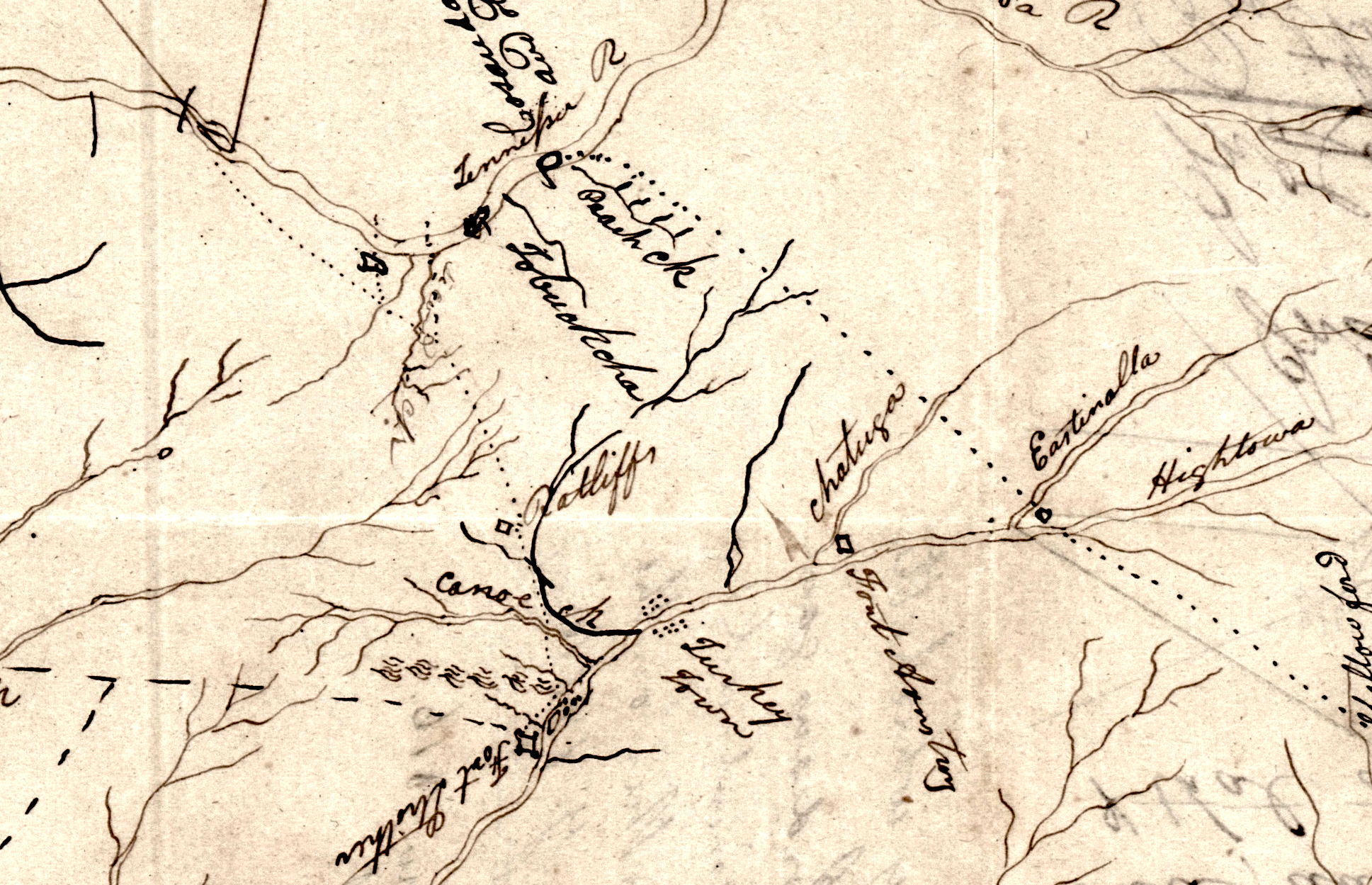
First, we find a Richard Ratliff living between Clear Creek and Ratliff Creek. Ratliff Creek is also known as Line Creek due to its proximity to the Alabama-Cherokee border. This area will be on the Cherokee Border in Alabama after it became a State. Alabama became a State in 1819. Richard Ratliff operated a “stand” or trading post at this intersection. The Hightown Path/Creek Path passed by his stand. This path started at Gunter’s Landing on the southernmost point of the Tennessee River. It led to the Double Springs at the Coosa River. Then the Creek Path continues into the Creek land. The Hightown Path takes an east turn to reach Hightown (modern-day Rome, GA). At the Southernmost point of the Tennessee River Fort Deposit was built during the Creek Indian War. This was a supply fort for General Andrew Jackson and the Tennessee Militia. The Path would become the Jackson Military Road.1
We learn a lot from the “Ten Island Three Research team”. Three ladies who researched the Cherokee and Friendly Creek Indians during the Creek Indian War. As well as a study on Fort Strother. These three were Charlotte Hood, Betty Sue McElroy, and Patsy Hanvey. Their work produced a book titled Jackson’s White Plumes.
Chapter2, page 19,
In 1800, Cherokee Captain John Brown and his family, including a new baby daughter, lived in Will’s Valley, not far from Ooe-Asah. Twenty five years later in 1825, Rufus Anderson, of the American Board of Commissioners for Foreign Missions, was inspired to write and publish a book on the life of that little daughter. It was entitled Memoir of Catherine Brown, A Christian Indian of the Cherokee Nation. Anderson’s account stated that “John Brown’s residence in 1800 was within the chartered limits of the state of Alabama … between the Raccoon and Lookout mountains, twenty-five miles south-east of the Tennessee River”. This is where John Brown lived when Catharine Brown was born. The Alabama state line that divided the United States from the Cherokee Nation, Between Raccoon and Lookout Mountain in Will’s Valley, in 1825, was Ratliff’s or Line Creek, near present- day Highway 431 in Etowah County. This places John Brown in the vicinity of today’s Attalla, Alabama, in 1800. There is a branch of Clear Creek, below Ratliff’s or Line Creek, identified as Brown’s Creek. It is 25 miles southeast of the southern bend of the Tennessee River {i.e. present day Guntersville AL}.3
The intersection of the streams and crossroads is important. One could continue south, travel east, or west. This is where Richard Ratliff Sr. lived. We see it plotted on the map above. He encountered David Crockett.
David Crockett
We started and went to a Cherokee town about twenty miles off, and after a short stay there we pushed on to the house of a man by the name of Radcliff. He was a white man, but married to a Creek woman, and lived just in the edge of the Creek nation. He had two sons, large, likely looking fellows, and a great deal of potatoes and corn, and indeed almost everything else to go on, so we fed our horses and got dinner with him, and seemed to be doing mighty well. But he was bad scared all the time. He told us that there had been ten painted warriors at his house only an hour before and if we were discovered there they would kill us and his family with us. I replied to him that my business was to hunt for just such fellows as he had described, and I was determined not to go back until I had done it. Our dinner being over, we saddled up our horses and made ready to start.4
After our meeting we went on the Radcliff’s, where I had been before, while out as a spy; and when I had got there, we found he had hid all his provisions; We also got into the secret, that he was the very rascal who had sent the runner to the Indian camp, with the news that the “red sticks” were crossing at the Ten Island; and that this object was to scare me and my men away, and send us back with a false alarm.
To make some atonement for this, we took the old scoundrel’s two big sons with us, and made them serve in the war.
We then marched to a place which we called Camp Wills; and here it was that Captain Cannon was promoted to a colonel, and Colonel Coffee was promoted to a general. (November 1813) 5
Crockett thought Ratliff was married to a Creek Woman. Richard Ratliff’s children will tell a different story. He was married to a Cherokee Woman. I will let them tell that story a little later.
Chief Pathkiller’s Complaint to Gen Andrew Jackson
The Path Killer (a principal King of the Cherokee nation) complains to Majr Genl Jackson that a part of the East Tennessee troops on their return home from this place went to John Ratliffs – a half breed Cherokee & took Ratliff & a parcel of his negroes perhaps Twenty & some horses, the number not known – They also took from a cherokee by the name of the Whooping boy eight horses – from one El__ a half breed, they took two horses and a mare & colt from an Indian called the Duck. — The Whooping boy is one of the Cherokee of Dick Browns party, who marched himself to Majr Genl Jacksons army and was in the battles of Tallishatchee & Talladega at the latter place he got wounded & was down with his wounds –6
If any thing could have been proved against old Rattcliff, of any Treason, or hostility …………. I have to request on the receipt of this you will cause old Rattcliff to be liberated, his property returned, and the offenders arrested and punished ……….. Is it not cruel that the whooping boy who fought bravely at Talushatchey and got wounded at the Battle of Talladega – should be plundered, by the east Tennessee troops, whilst confined with his wounds ……To John Cocke from Andrew Jackson.7
John Ratliff, Whooping Boy, and William Ratliff are sons of Richard Ratliff Sr.
John Coffee’s Journal January 1816
10th January (1816) This day traveled to Thompson’s Ferry and lay all night at Capt. Thompson’s. Bill $7.50
11th January Travelled to Young John Brown’s at the foot of the mountain – Lay all night – Paid the bill to amount of $1.50
12th January Travelled to Ratliffe’s – Lay all night
13th January Snowing. We lay all day and night at Ratliffe’s – Paid the bill to amt. $6.50
14th January Set out from Ratliffe’s early in the morning – and arrived at Fort Strother the same evening – Took a house in the old fort and got our supplies from Capt. George Blaik, who resided at the fort with his family.
15th January Reed, who I had engaged as a pack horseman at Ratliffe’s, arrived this day, brought with him a Negro fellow named Jo – The property of Tom Bruner who had been in the Cherokee Nation, and was then on his way home. Sent for Fife.
28th January (1817)….. Crossed Canoe Creek in a canoe and swam the horses – Travelled the road towards Ratliff’s, ten miles, and after traveling in it about five miles struck the road a little sout of the lick ……
29th January A file morning, the first we have had in ten days, statrted early, got to Ratliff’s and bought supplied to carry on, viz ………….. $5.75. Bought a tomahawk at the Old Duck’s – Price $1.008
All of the above are notations from the Creek War 1813-14. It shows that Richard Ratliff Sr. was very involved with Jackson’s army. A notable person. At this time, he lived at what would become the border of the State of Alabama and the Cherokees. Present-day, a few miles north of Attalla, Alabama.
Post the Creek War, why did he move? Where did he move to? The story continues.
- Tracing Gen. Andrew Jackson’s Army Across Marshall County, Alabama. A Publication of the Guntersville Historical Society, Tyrus M. Dorman Jr., Editor. Chip Manning, Larry Smith, Danny Maltbie, Pete Sparks, John Oliver Ross. Kindle Direct Publishing. 2025 ↩︎
- Map by which the Creek Indians gave their statement at Fort Strother on the 22nd Jany, 1816 : [Alabama and Georgia]. Digital Library of Georgia. https://dlg.usg.edu/record/loc_military-battles-and-campaigns_2007626786?canvas=0&x=593&y=765&w=2951 ↩︎
- Jackson’ White Plumes. Charlotte Adams Hood. 1995. Lavender Publishing Company, Bay Minette, Al ↩︎
- THE LIFE OF DAVID CROCKETT, The Original Humorist and Irrepressible Backwoodsman. An Autobiography. Chapter 5, page 52. (after the Creeks massacre at Ft Mimms, Aug 31, 1813) ↩︎
- Ibid. chapter 6. ↩︎
- Papers of Andrew Jackson. Reel 8, Fort Strother, December 28th 1813 ↩︎
- Ibid Reel 7, December 28th, 1813 ↩︎
- Jackson’ White Plumes. Charlotte Adams Hood. 1995. Lavender Publishing Company, Bay Minette, Al. Chapter 6, page 68-73. ↩︎
Trust in the Lord with all your heart, and do not rely on your own understanding; in all your ways know him, and he will make your paths straight. Proverbs 3: 5-6 CSV
 New Seneca Turkey's Town