
Tags
alabama-history, Cherokee County AL History, cherokee-indians, Etowah Co AL history, Gadsden AL history, native-americans, northeast-alabama-history, trail-of-tears, turkeytown
John Riley is a notable person of Turkey’s Town. He was half Cherokee and half white. I am not going to go into his genealogy. This post will focus on his involvement in his farms. These farms will be known as the Double Springs, Turkey Town Valley, Cherokee County, Alabama. How it became Gadsden, Alabama.
There are several written histories of the City of Gadsden. All stating that John Riley’s house was the first house of Gadsden and that Gabriel Hughes purchased it. His son Joseph R. Hughes was the first white child to be born in Gadsden. The location of his house is at the intersection of North 3rd Street/Tuscaloosa Avenue/Reservoir Street/Ewing Ave. The house faced Tuscaloosa Avenue. At this location was the first Post Office of Gadsden.1 It was known as Double Springs and was established on 28 January 1833. The Postmaster is William B. Walker. The post office originally was in St Clair County.2 Cherokee County was established in January 1836.
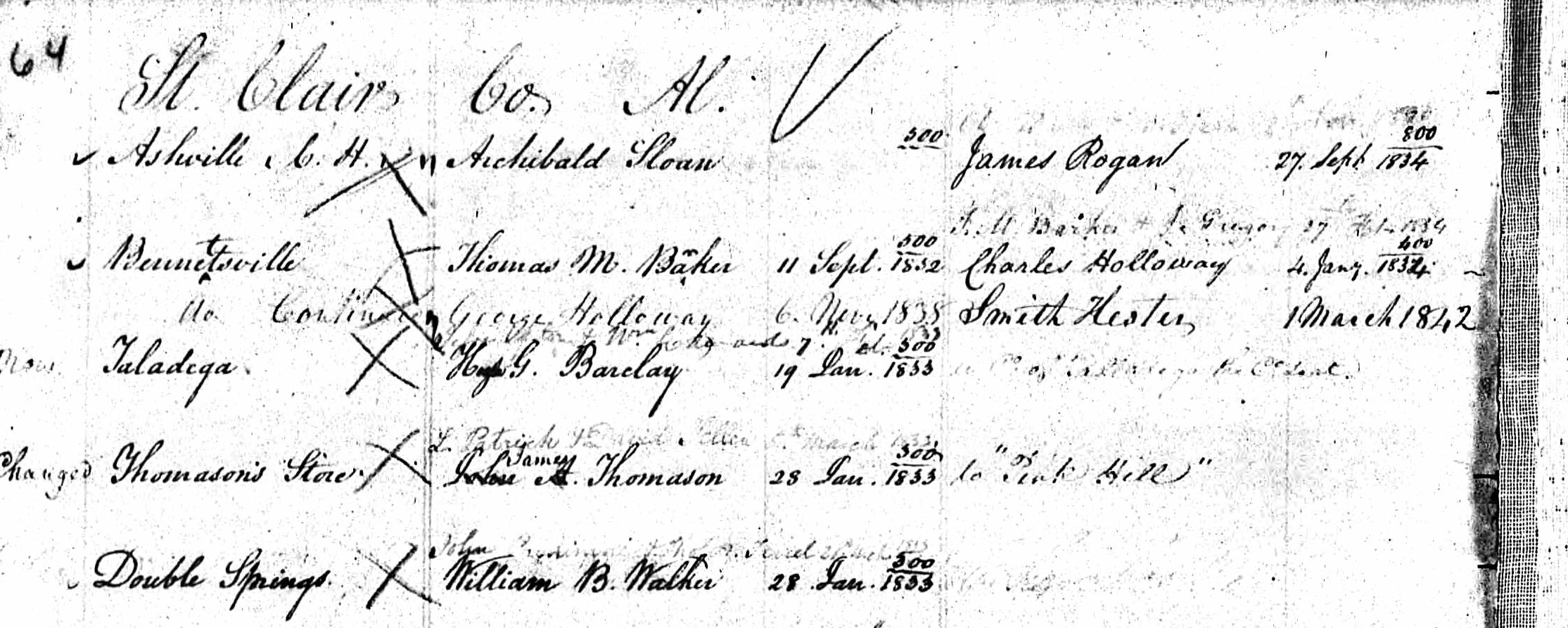
The Postal records have William B. Walker as Postmaster, 1833. Is he living in John Riley’s house? John Riley is operating a “stand” out of his house. L.V. Bierce, in his journal, does not mention paying a toll to cross Black Creek. He does mention the “stand”. This was in 1823. A stand is a stop for travelers.
April 4. Struck our tent and went sixteen miles to Rileys stand, two miles farther and crossed Black Creek, a deep muddy, sluggish stream that takes its name from the tenge the earth gives the water. Three miles from Black Creek we encamped. 21 ml3
“Toal (Toll) Bridge”

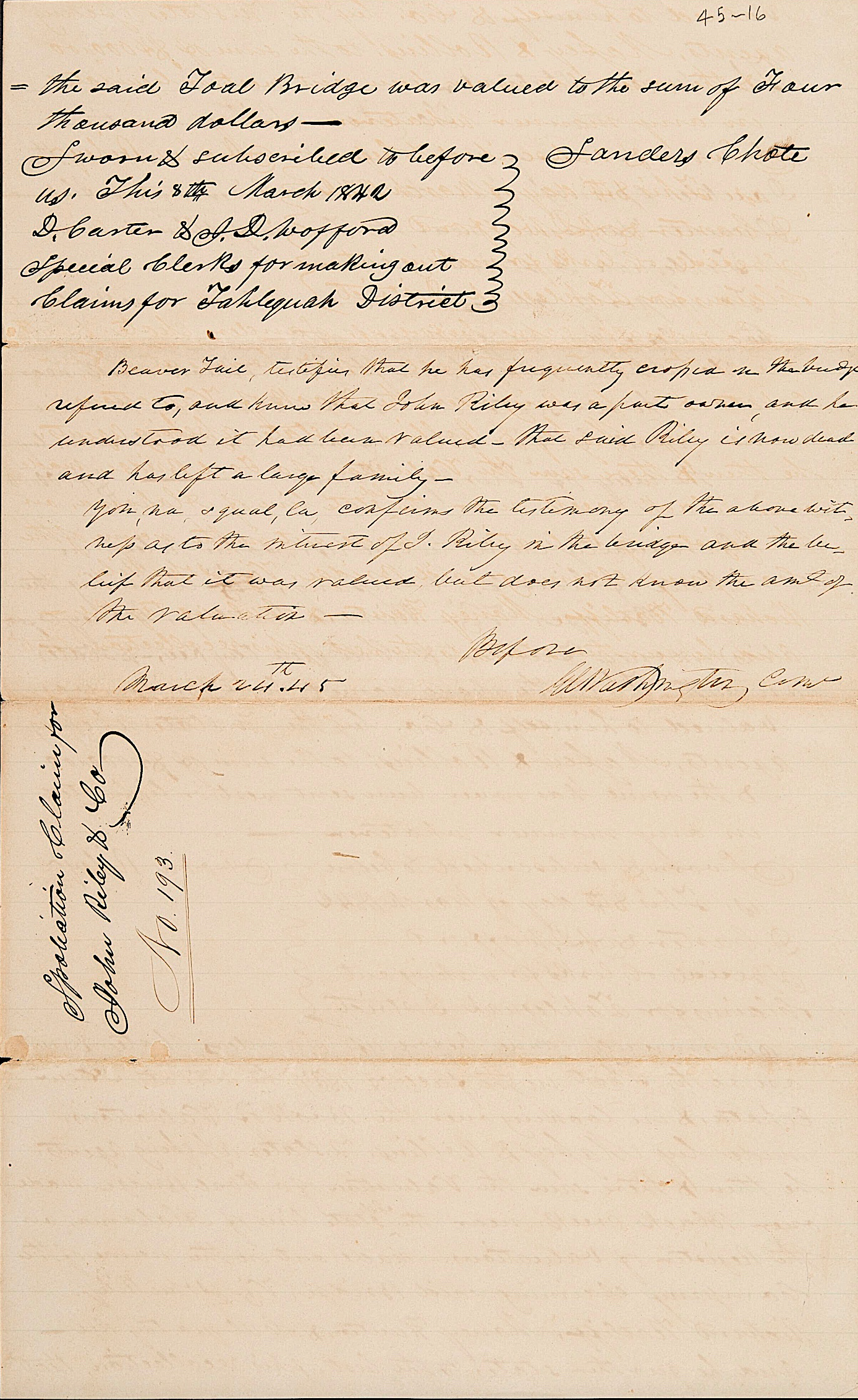
The above claim was made by John Riley in 1842. It is from Tahlequah District Claim #193 dated March 8, 1842. It provides a lot of information. The Toal (Toll) Bridge is 2 miles from his residence. It is over Black Creek. The “Stand” as stated by Beirce is 2 miles from Black Creek. (I have driven from the intersection to Black Creek on Tuscaloosa Ave, it is 2 miles today.)The “Stand” is John Riley’s residence. So William B. Walker is the Postmaster at the time the PO is established. He may be living in one of Riley’s houses. Yet, he is most likely to have his own on the East side of the Coosa River. (See the Walkers involved with the ferry and other property on the Coosa in the claim with the ferry). Riley has 3 farms with several houses, the toll bridge, and a ferry. Walker will have ownership of quite a bit of Riley’s property. This is after Riley leaves for the West. The ferry on the Coosa River will be called Walker’s Ferry. Notice that others are involved with this toll bridge. They are called the “company”. Richard Ratliff, (this is Richard Ratliff Jr., who is married to Chief Pathkiller’s daughter.) Money Crier alias Money Hunter and Cul-qua-tay-kee. Cul-qua-tay-kee was the Cherokee name of Turner, the son of Widow Boot and Boot, the Creek Interpreter for Little Turkey. Boot and Turner were discussed in an earlier post. The Widow Boot is the one originally in the company. She died at Fort Payne during the Trail of Tears 1838. One other outstanding item in the above claim is the value. $4000 is today’s equivalent of $158,108. The next claim shows what else is at the bridge farm.

You can click on the images to make them larger. If you can read cursive writing, they are easy to read. You may have to look up some of the terms. “Puncheon” is a method for flooring made from a log shaved flat by an adze. The stand is one of the houses on one of John Riley’s three farms. These farms stretched from Black Creek to the Coosa River and onto the East side of the river. A line separates the farms listed in the claim.
The Farms
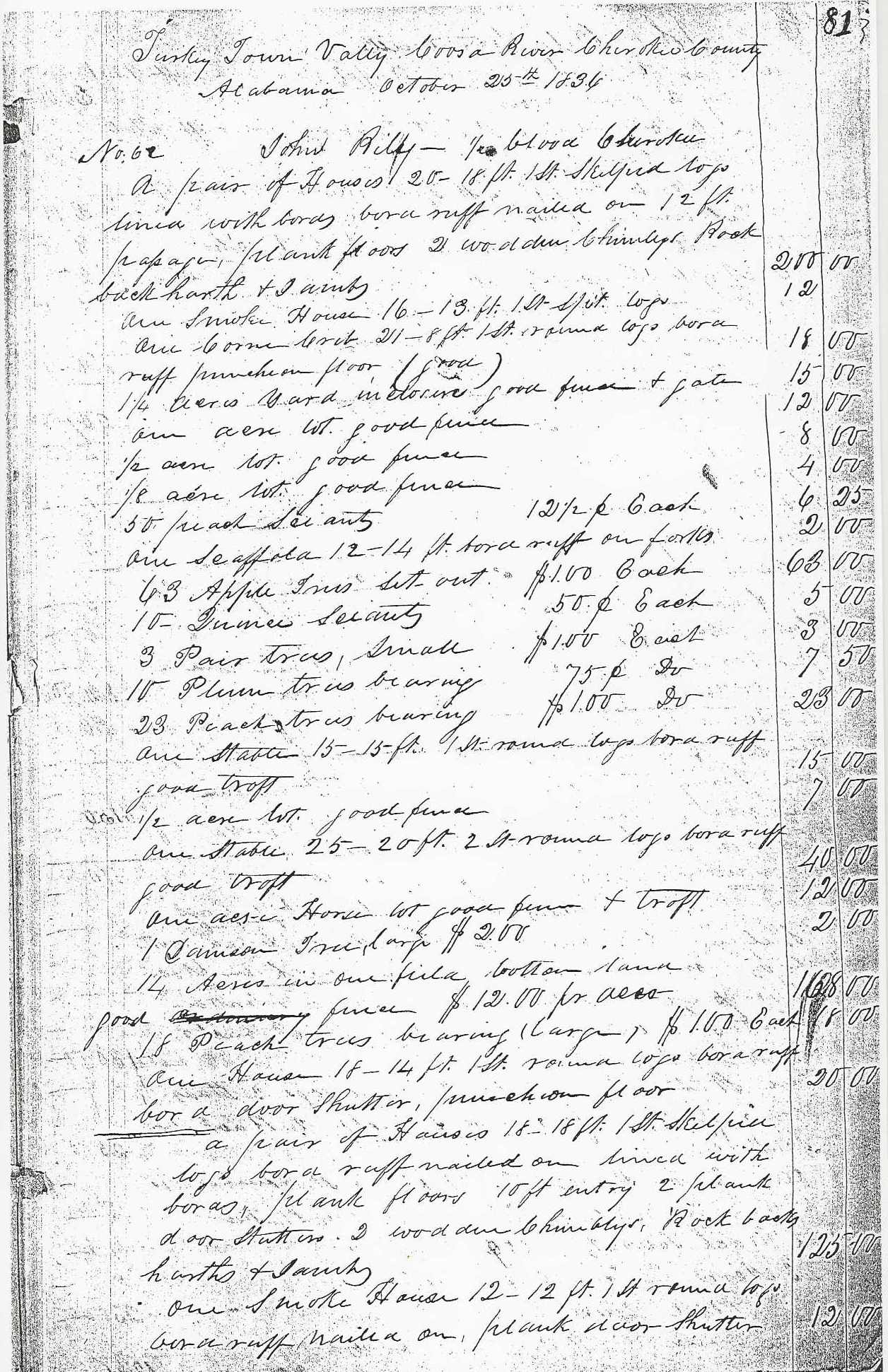
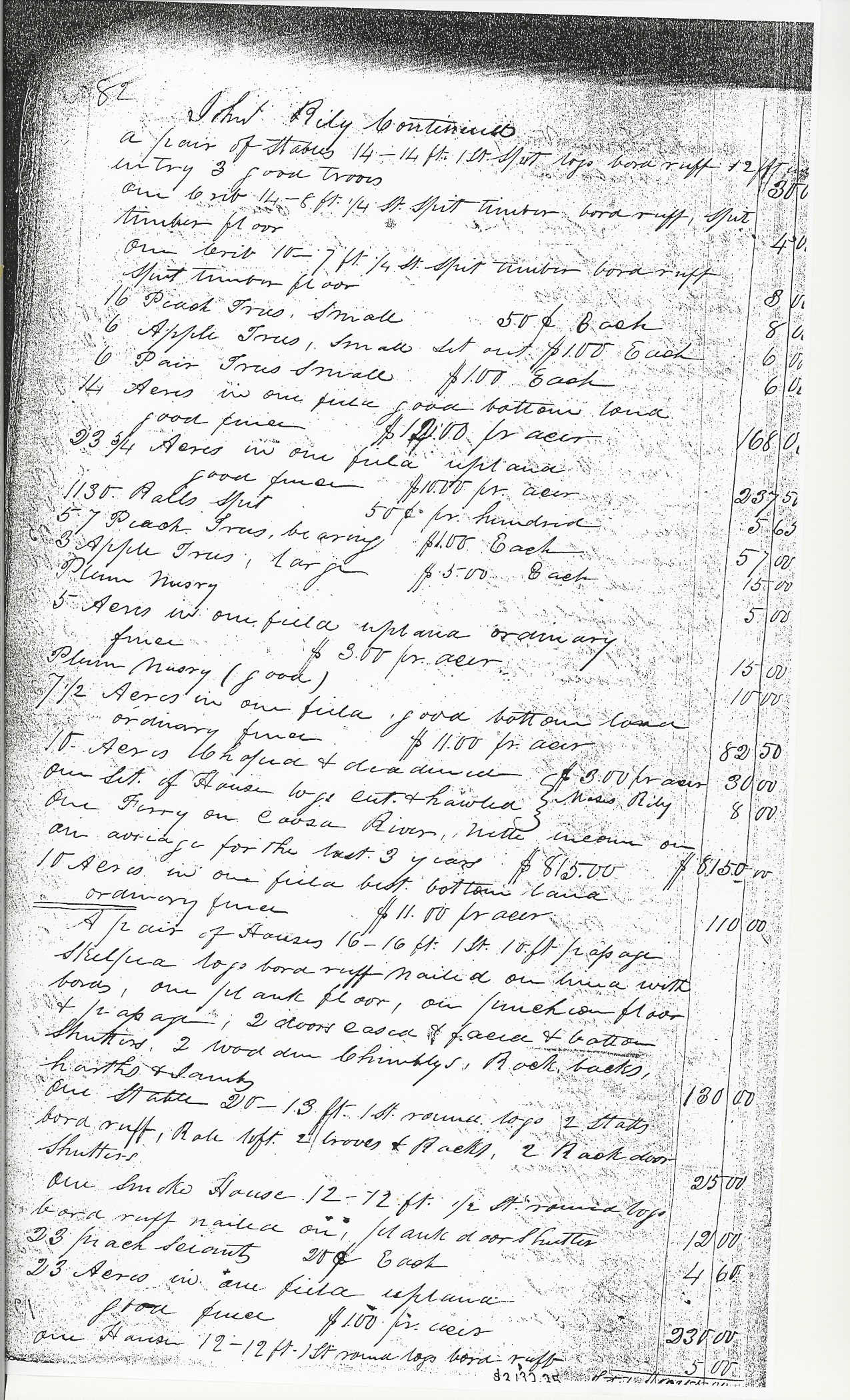
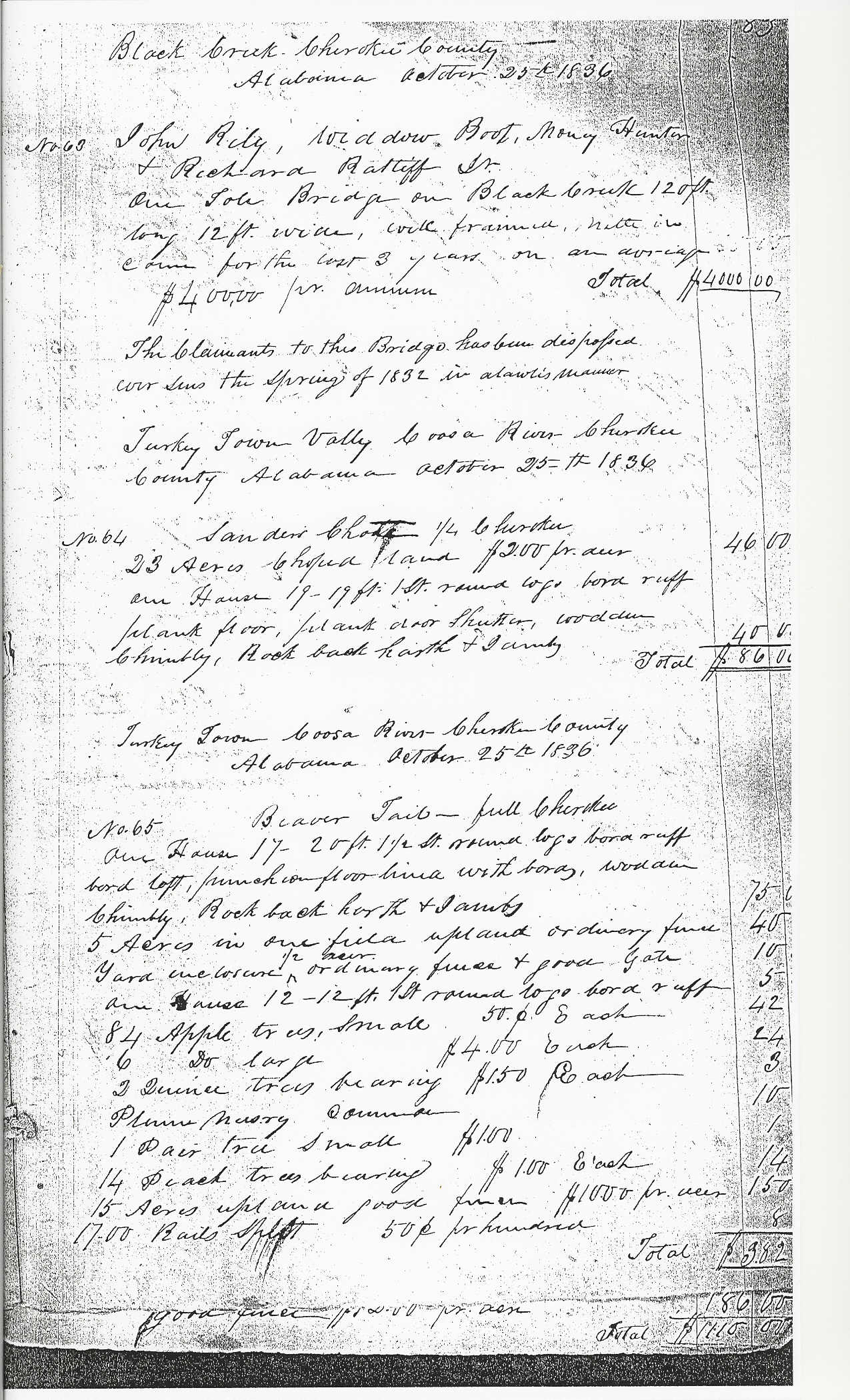
Is the first farm listed on this claim #62 the house where John Riley lived?
The Ferry
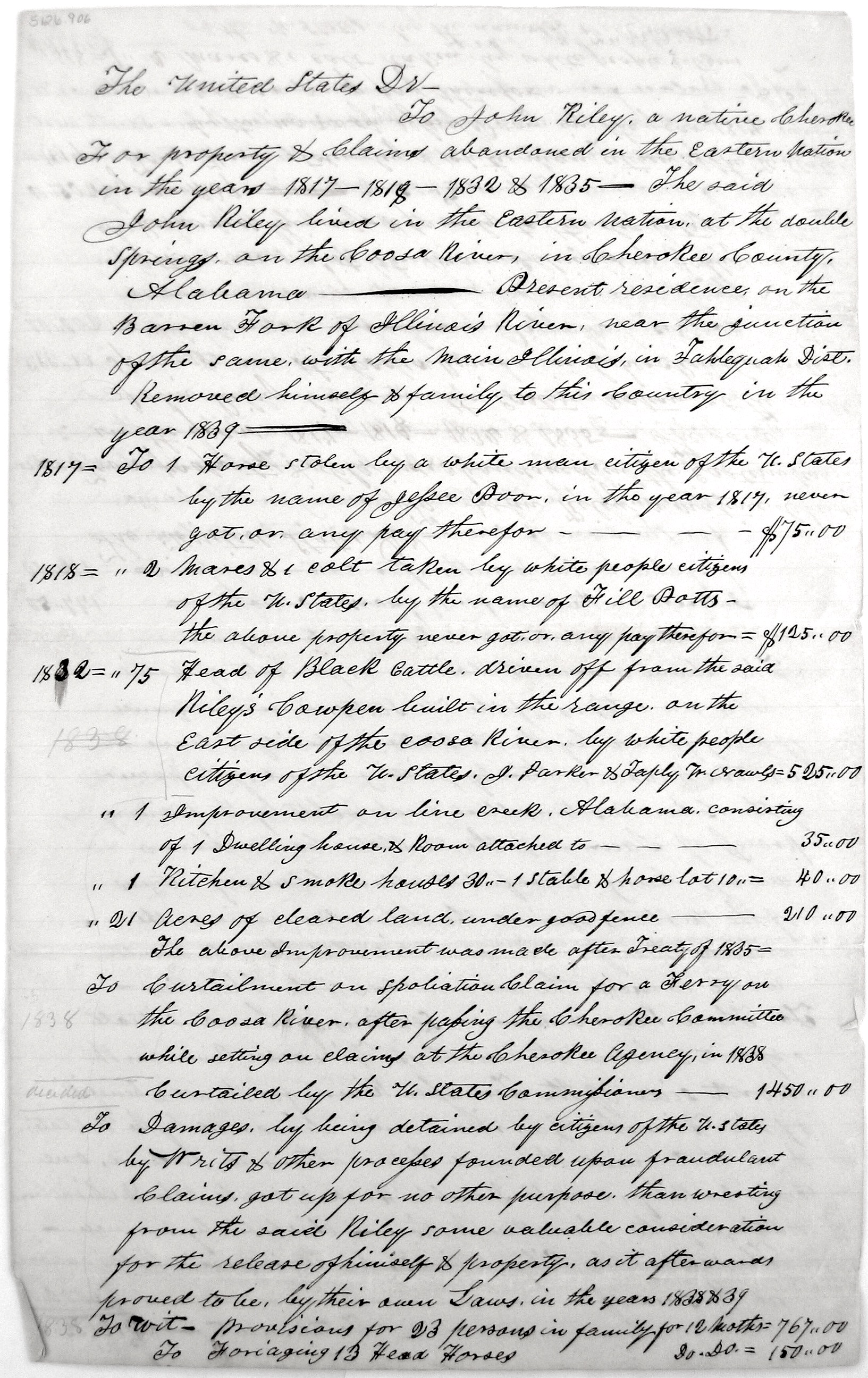

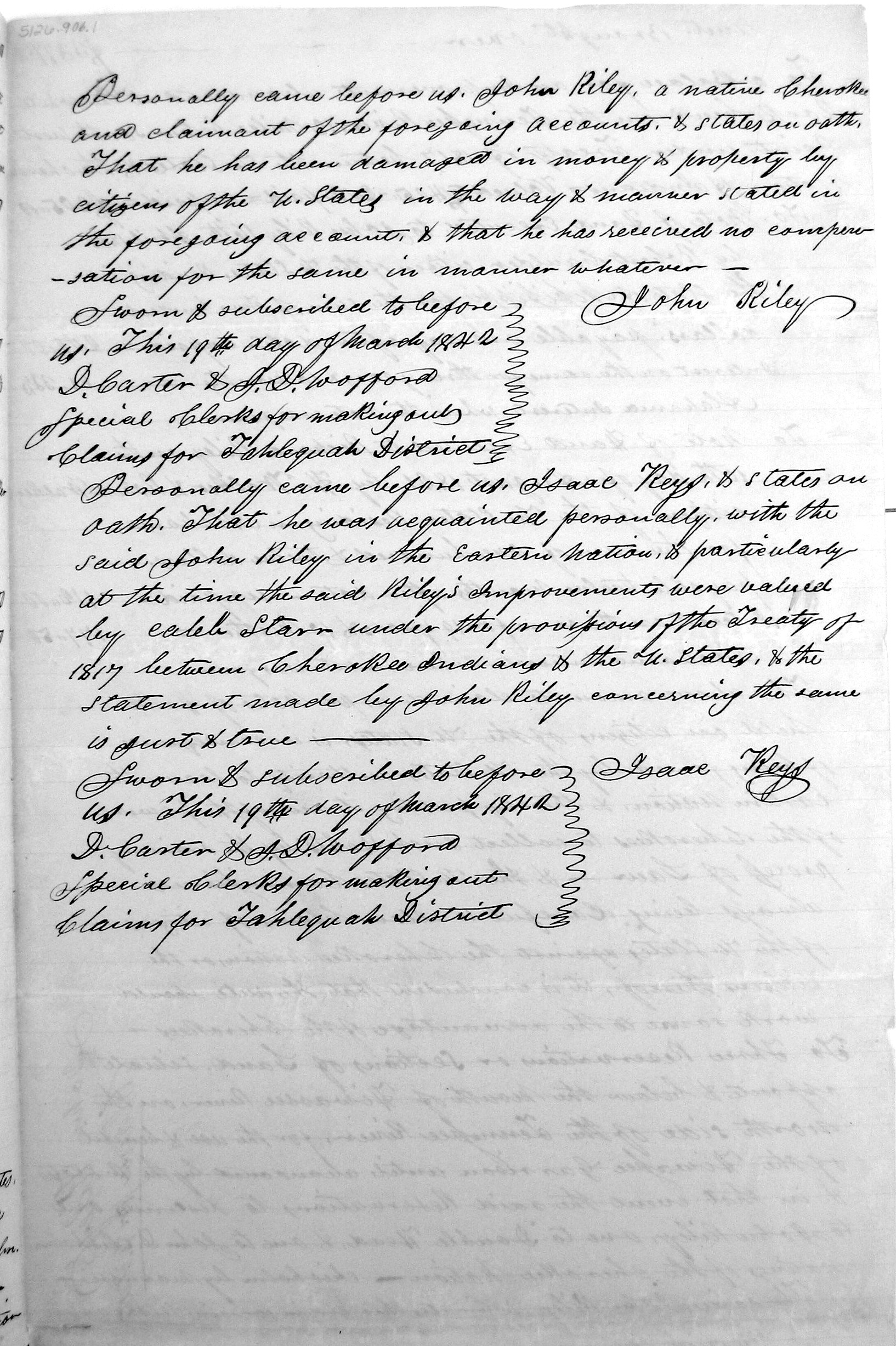
John Riley names some white people by name. One of those is Tapley W. Nawl, who was also involved with trying to obtain parts of Peggy Pathkiller’s estate. The others are difficult to locate and follow.
Notice John Riley has property in Tennessee. He received a reservation below the Hiwassee River. This river empties into the TN River below Knoxville TN. John Riley is from Roan County, TN, which is this location. The area today is Kingston, TN. By these statements, John Riley and his family must have moved to the Double Springs after 1817 but before 1823. L.V. Bierce’s statement from above. The Gabriel Hughes family has a tradition. They noted that a man named Powell lived in the house before Riley. Gabriel Hughes will own the house after William B. Walker. More on this in the next post.
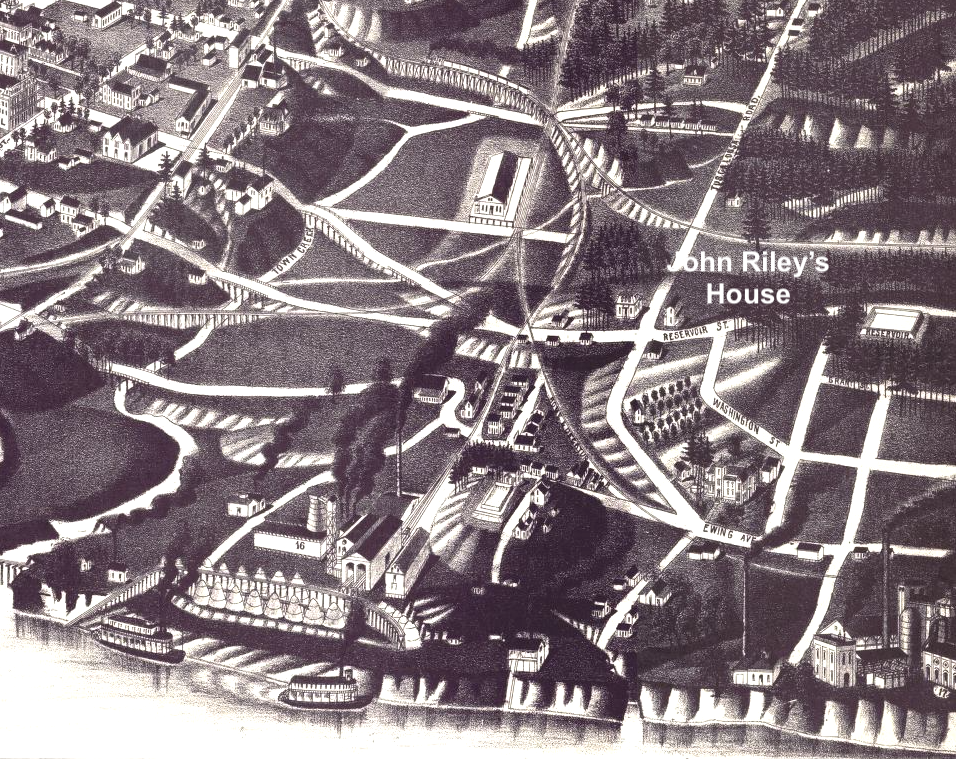


John Riley and his family left on their own for the West sometime between the dates listed above. They were not on the Trail of Tears.
Riley’s house, used as the PO, was purchased by a descendant of Gabriel Hughes. It was disassembled and moved to Whorton’s Bend, Etowah County, Alabama. There, it was reassembled as it would have looked in the 1830s. This happened in the late 1990’s.10

Next, we will look at how it became Gadsden, Alabama.
- A History of Etowah County, Alabama. Etowah County Centennial Committee, Gadsden Alabama, 1968; Part II, History of Gadsden, written & Compiled By Etowah County Historical Society – Joe Barnes, Coordinator, 1966. Pages 220-241. ↩︎
- Appointments of U.S. Postmasters 1832-1971, Volume 11 ca. 1832-44, Saint Clair County, Alabama, Ancestry.com ↩︎
- Travels in the Southland, 1822-1823, The Journal of Lucians Verus Bierce, page 93 ↩︎
- 1842 Tahlequah District Claim #193 of John Riley dated March 8, 1842, John Ross Collection, Folder #962, The Thomas Gilcrease Institute of American History and Art (a/k/a Gilcrease Museum), Tulsa OK. ↩︎
- 1838 Claims made Before Emigration; Book A #242 and Book B #121; Tennessee Cherokee Collection, Box 5, Folders 1 and 2, Microfilm Collection 815, Reel 2, frame 25 and frame 75 respectively. Tennessee State Library and Archives, Nashville, TN. ↩︎
- Rice and McCoy/Rawlings and Massey’s Valuations, Cherokee County, Alabama, #62, #63, #64, #65; Property Valuations, Entry 224; Records of the Bureau of Indian Affairs, Record Group 75; National Archives Building, Washington, DC. ↩︎
- Tahlequah District Claim #194. Folder 815. John Ross Collection. The Thomas Gilcrease Institute of American History and Art (a/k/a Gilcrease Museum), Tulsa OK. ↩︎
- http://cartweb.geography.ua.edu/lizardtech/iserv/calcrgn?cat=North%20America%20and%20United%20States&item=States/Alabama/Counties/etowah//Etowah1887a.sid&wid=1000&hei=900&props=item(Name,Description),cat(Name,Description)&style=simple/view-dhtml.xsl Perspective Map of the City of Gadsden, Alabama, 1887, portion showing the Riley house ↩︎
- National Archive Microfilm M234 Roll 115, Records of the Bureau of Indian Affairs, Record Group 75; National Archives Building, Washington, DC. ↩︎
- Messenger, July 3, 2002, The Vagabond, Vagabonding in Histories and Adventures by Danny Crownover, Returning to Gadsden’s First House ↩︎
Trust in the Lord with all your heart, and do not rely on your own understanding; in all your ways know him, and he will make your paths straight. Proverbs 3: 5-6 CSV
 New Seneca Turkey's Town