• Home
  • About
  • Alabama Chapter Trail of Tears Association
  • National Trail of Tears Association
  • Local History

New Seneca Turkey's Town

~ Uncovering the History of Turkeystown, a Cherokee Village/Town in Northeast Alabama

New Seneca Turkey's Town

Monthly Archives: February 2026

David A Gage, Representative

21 Saturday Feb 2026

Posted by Jeffrey Sauls in Local History

≈ Leave a comment

Tags

alabama-history, cherokee-indians, Etowah County Alabama History, northeast-alabama-history, trail-of-tears, turkeytown

This is the last person I am posting in the “Notable People of Turkey’s Town, Chapter. David Gage is a white man married to a Cherokee Woman. She is Lucy (she is of the Fish family, not a surname). The Fish family lived in Will’s Valley. David and Lucy have a farm in Will’s Valley. He also has a farm in Turkey’s Town. He served many Cherokee people of the area as their representative (like a lawyer). I will show documents. I will also show who he was involved with. This will help you understand his role and his involvement with Turkey’s Town.

The following is from the GINI website. I know some of the people who helped with the research for this profile, so I trust it. It is an overview of David Gage.

GAGE, DAVID (1796–1854). David Gage, early settler and legislator, was born in Kentucky (or White County, TN according to enlistment records for War of 1812) in 1796. He moved to Texas from Alabama in 1839 and, on May 21, purchased a fourth of the Leonard Williams league; he settled in the Williams Settlement in southern Rusk County, near Mount Enterprise. A few months later he organized and was made captain of a company of minutemen for protection against the Indians. He served with the company during 1840 and 1841. Gage was elected representative to the Eighth and Ninth congresses of the republic, December 4, 1843, to June 28, 1845, and in 1845 was elected senator for the Fourth District and delegate to the Convention of 1845. After annexation he served three terms in the Texas legislature. He died at his home near Mount Enterprise in 1854.


A BRIEF HISTORY OF DAVID GAGE’ The homesite of David Gage is located in the southern part of Rusk County, in the John Rutland survey, approximately five miles north of Mt. Enterprise and approximately two miles southwest of the community of Minden. This location is just north of what is now the ASH Griffin farm. His homesite is described by the Handbook of Texas as being one-fourth of the Leonard Williams league in Southern Rusk County, near Mt. Enterprise, Texas.
He was granted a 3rd class certificate for 320 acres of land as an immigrant after October 1, 1837, and prior to January 1, 1842. The Certificate is dated December 31, 1839.
At the time of his death, he owned approximately 12,000 acres of land in the southern part of Rusk County.


He immigrated to Texas in May 1839, from Arkansas. The Handbook of Texas states (in error) he came to Texas from Alabama. He was a veteran of the War of 1812. He enlisted 10 July, 1814, and was discharged 9 July, 1819, at Ft. Scott, Ga. He was a corporal in Capt. Thomas Blackstone’s Company, Seventh Regiment of Infantry. From 1840-1841, David Gage served as Captain of a company of minute men in Rusk County. These minute men were organized for protection against the Indians.


He was elected Representative to the Eight and Ninth Congresses of the Republic of Texas December 4, 1843, to June 28, 1845. In 1845, he was also elected a delegate to the Annexation convention. He was a signer of The Joint Resolution for annexing the Republic of Texas to the United States. He was also a signer of the Constitution of the State of Texas adopted in convention at the City of Austin, August 27, 1845. After Annexation, he was elected to serve three terms in the State Legislature: the 2nd, 1847-48; the 3rd, 1848-1850; and the 5th, 1853-54. His name appears along with the other sixty signers of the Resolution and Constitution on the west wall of The Memorial Museum, Univ. of Texas Campus, Austin, Texas.


On February 5, 1847, a Post Office was established at Gage’s with David Gage appointed Post Master. It was discontinued on October 21, 1847. (See letter, Gen. Service Administration, dated May 14, 1962.)
David Gage married Elizabeth Austin in Madison County, Alabama, February 28, 1820. He had one known child, William Patterson Gage, born 1821. (1860 Census, Rusk County gave his age as 39.) Record is lacking of dissolution of this union by death or otherwise.


The next record we have of David Gage is in Cherokee Country in Northeastern Alabama, where he was elected Constable of Turkey Town, St. Clair County, on January 13, 1833. He was one of seven captains presiding over the St. Clair County Beats, his beat being Turkey Town. David Gage’s second wife was Lucy Fish, a full-blooded Cherokee Indian. Their marriage was about 1832 or 1833, as Rusk County 1850 Census shows the age of their oldest child, Mary Ann, as being 16. Their second child, Eliza Jane, age 12, (married James A. Bane, Laneville) was shown as being born in Arkansas. David Gage had five farms in DeKalb County, Alabama. I have a list of property for which the U.S. paid him when the Indians were removed from Alabama to Indian Territory, Oklahoma. He lived on Little Wills Creek, DeKalb County, Alabama. This inventory was dated September 29, 1836, and valued at $3,843.54.
David Gage died April 26, 1854 at his home near Minden, Texas. His place of burial is on the west side of Highway #259, on the first little hill across the stream, south of the farm of the late W.G. Hodges. The burial place is located on the farm known in the 1920’s as the Bill Shadden farm.

1

The above is mostly about David Gage after he moved from Turkey’s Town. How is he connected?

Turkey Town Constable

The first election held in Turkey Town was in 1833. This would become Cherokee County in 1836. It later became Etowah County, Alabama, in 1868. Saint Clair County, Alabama, claims the territory. David Gage was elected Constable. Notice that the “beat” in Turkey’s Town is “Capt. Gage’s beat.
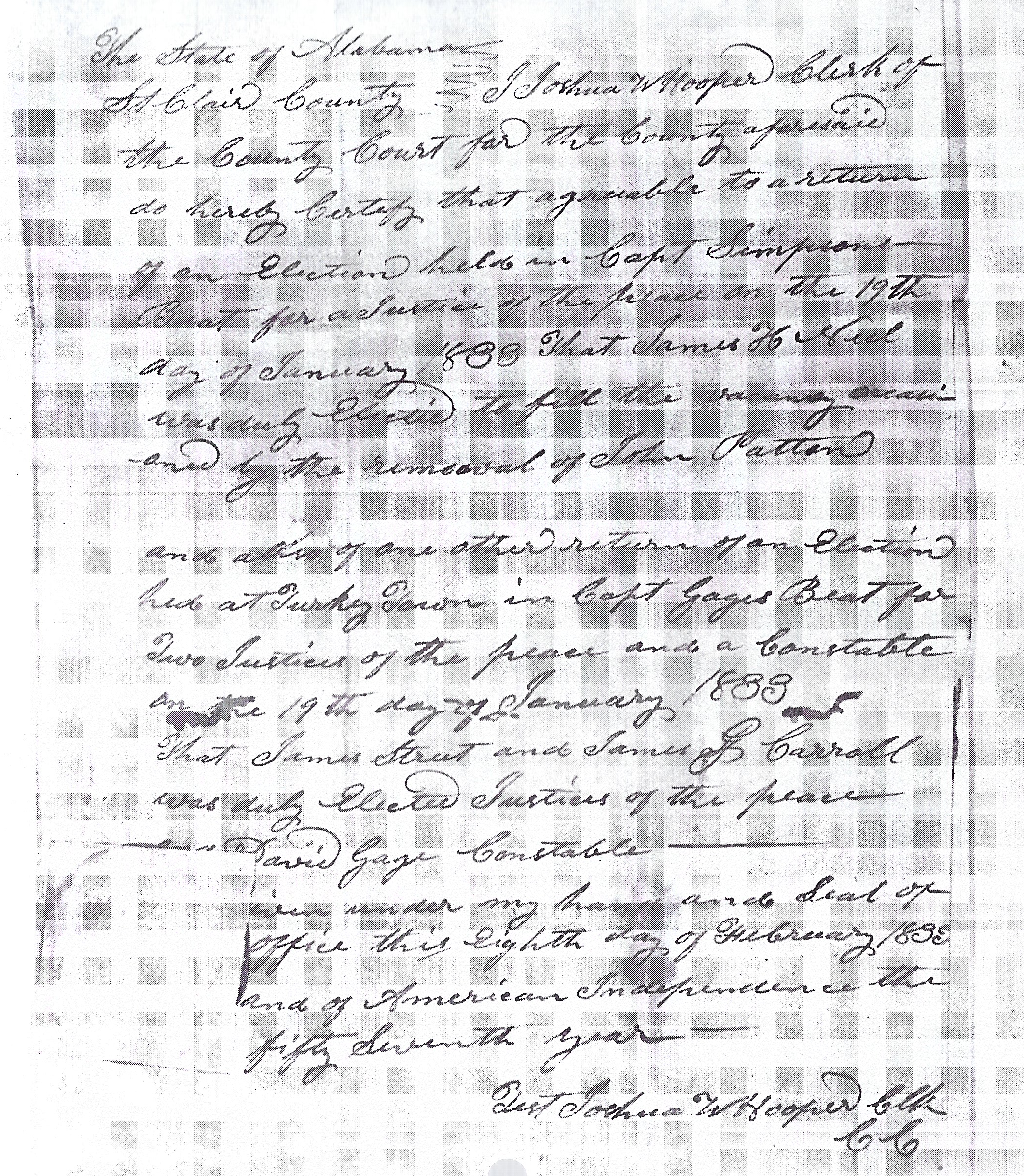
2

“and also of one other return of an Election held at Turkey Town in Capt Gages Beat for Two Justices of the peace and a Constable on 19th day of January 1833 That James Street and James G Carroll was duly Elected Justices of the peace. Capt David Gage Constable ———–“

There was no Etowah or Cherokee County at the time. This is the first election in what would become Etowah County, Alabama. A constable in the 1800s was a local law enforcement officer. They were responsible for keeping the peace, serving legal documents, and enforcing minor laws. They represented the primary form of policing. The Treaty of 1830 with the Cherokee set in motion the removal to the West. The Treaty of Cusseta in 1832 moved Alabama to proclaim laws over all of what would become Alabama.3 So this brought the election to take place. Saint Clair County claimed the territory that is Turkey Town. Follow the timeline. 1830 Treaty, 1832 Treaty, 1835 Treaty, then Trail of Tears, 1838.

As a Constable, David Gage can represent people in legal proceedings.

David Gage and Chief Pathkiller’s Family

David Gage became involved with Chief Pathkiller’s family. Dragging Canoe, Chief Pathkiller, and wife Peggy’s son died in 1833. Dragging Canoe’s son, Sky-a-too-ka, entered into a dispute with Anna, daughter of Nelly (sister of Dragging Canoe). The disagreement was about who had the right to the improvements on the East side of the Coosa River. This site is the old residence of Chief Pathkiller. This is at today’s Fitts Ferry on the east side of the river, known as Alford’s Bend. This is in present-day Etowah County, north of Gadsden. This area became Peggy’s when Chief Pathkiller move north and took a new wife. He created the new improvements, which are the Garrett farm in Centre, Alabama. At the time of the dispute, Dragging Canoe, Chief Pathkiller, and Peggy were deceased. When Peggy died, she left it to Nelly. Nelly gifted it to Anna, who is married to Frances Hampton. Sky-a-too-ka is claiming this for himself, his mother, Watty, and his sister, Martha.

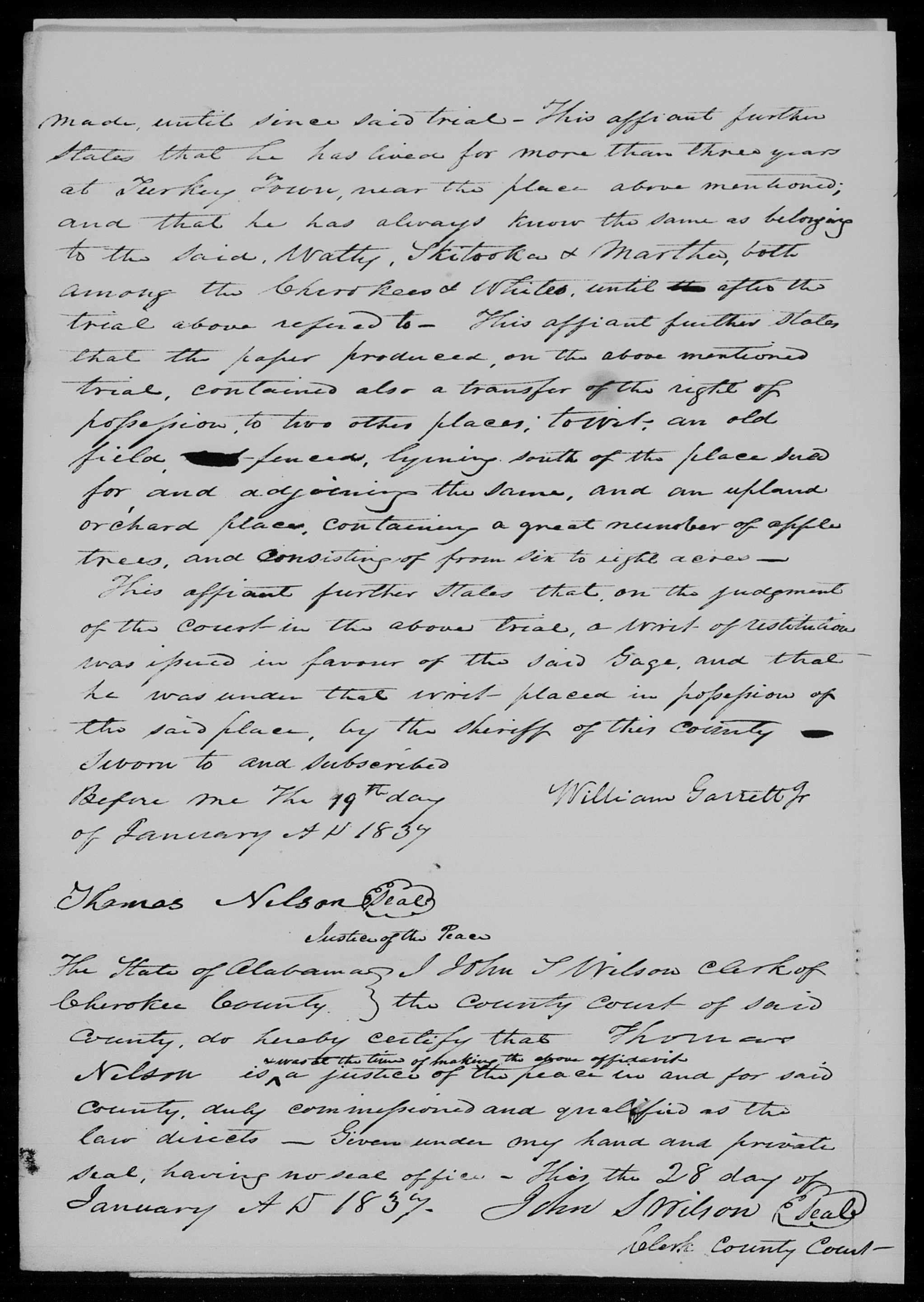
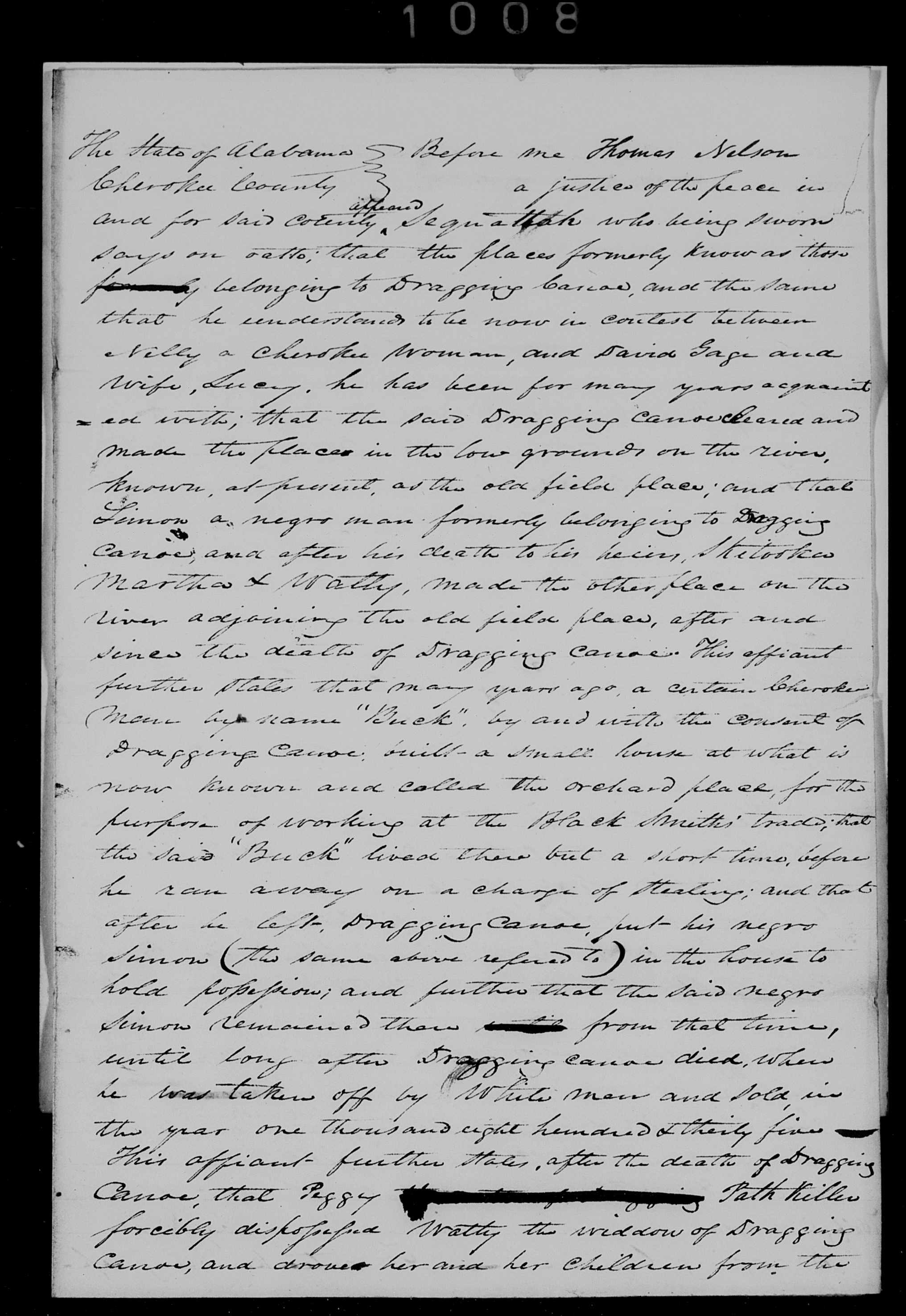
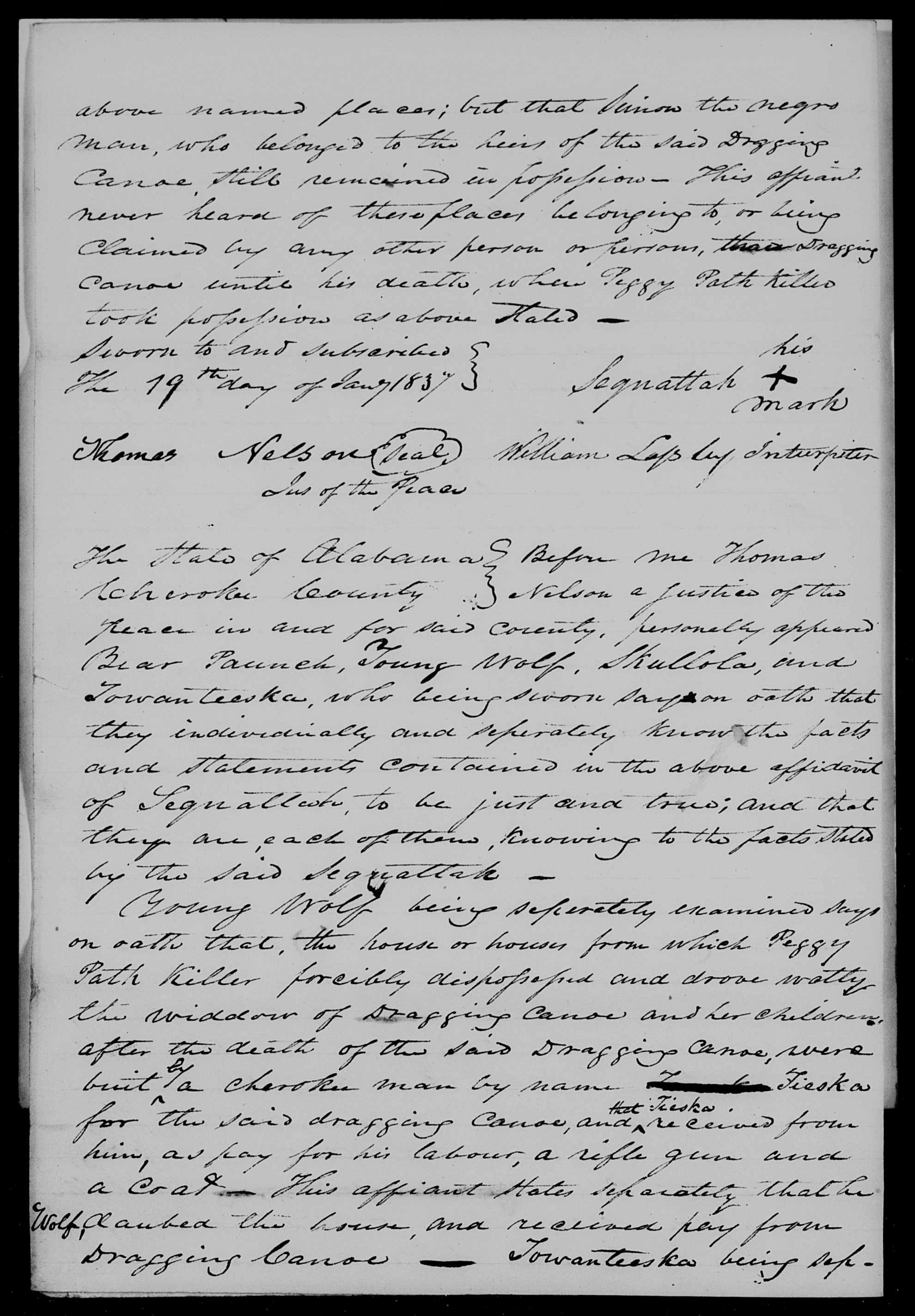
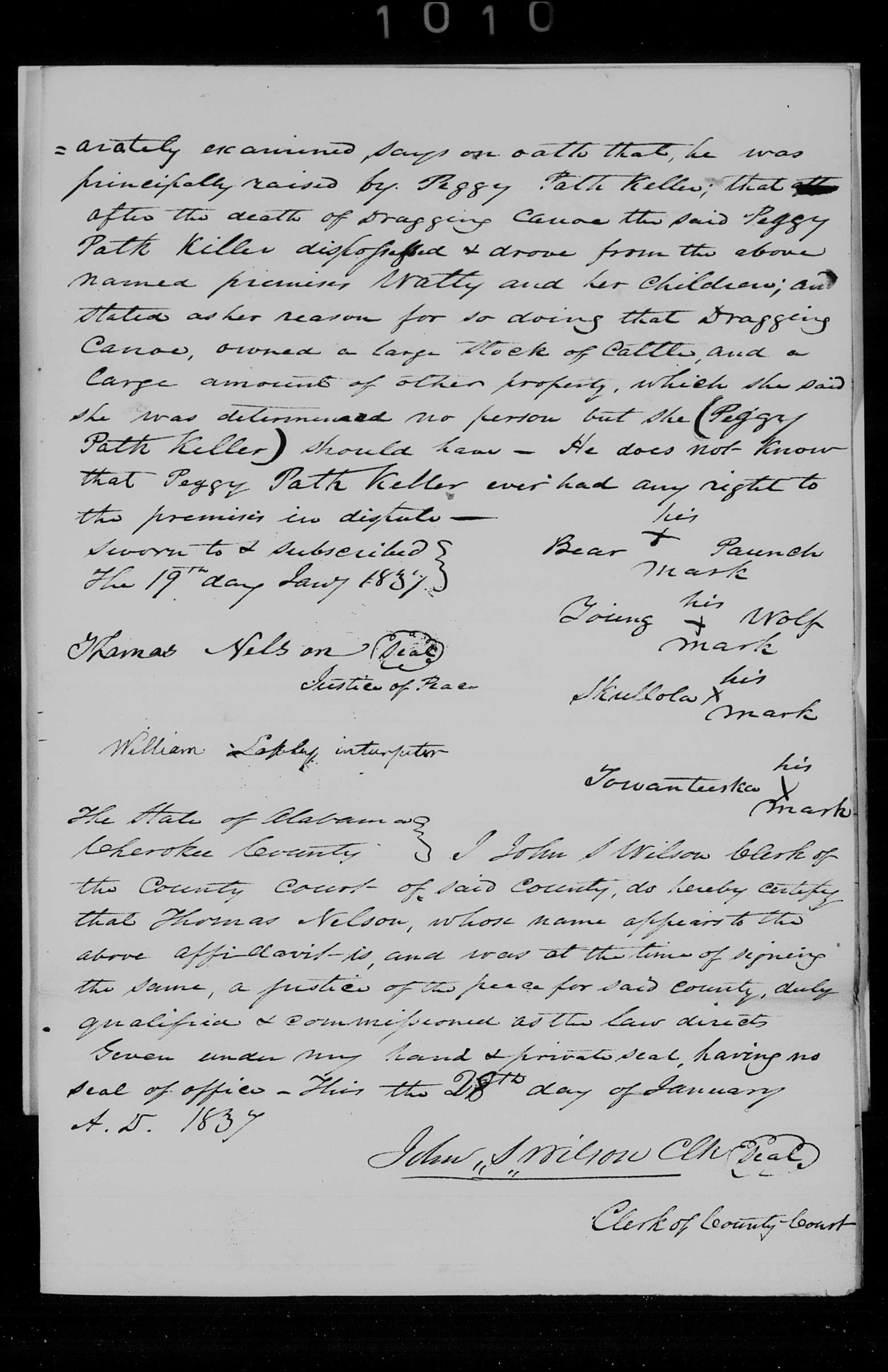
The following are documents showing Sky-a-too-ka’s claim. These involve several people. Several of them are white people who are intruders now moving into the area because of the Treaties. The first document is recorded in Benton (Calhoun) County. This county also would claim Indian territory. Read them closely. Click on them to make them larger. These also confirm Turkey’s Town’s location in today’s Etowah County, Alabama. They are all from the NARA microfilm. 4
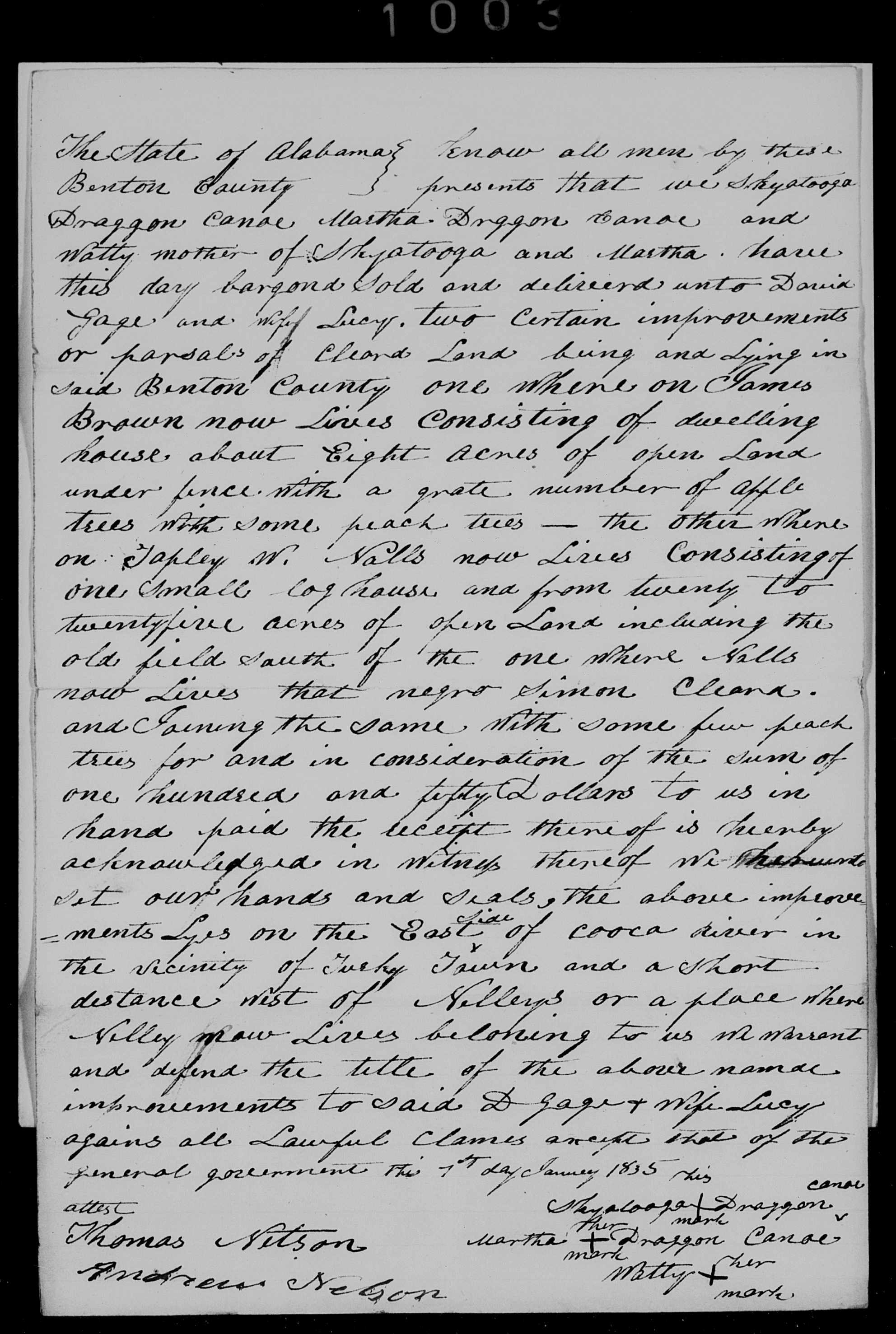
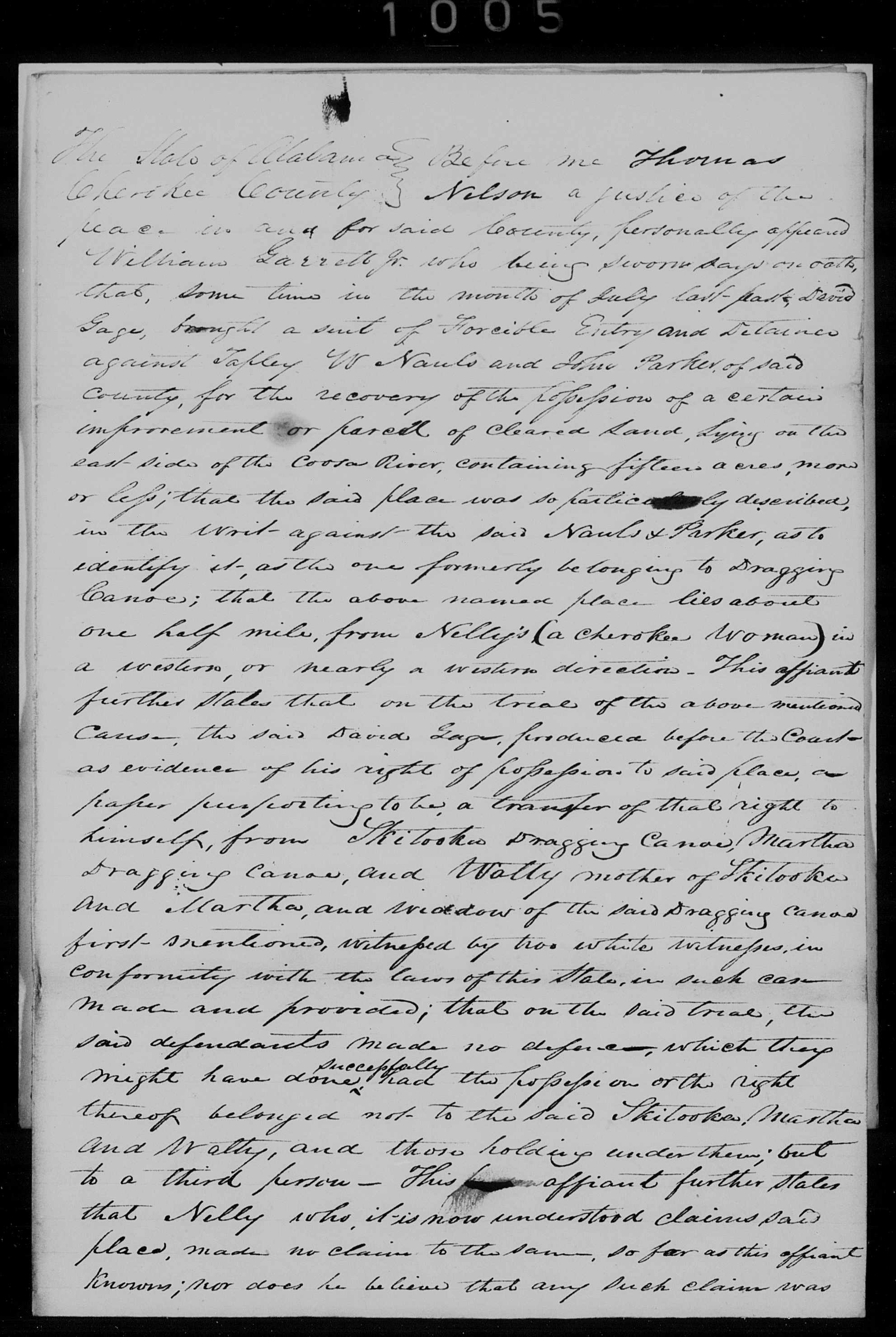
Image 133, Notice that Benton County (Calhoun) is also claiming the area.
Image 135
Image 136
Image 138
Image 139
Image 140

If you read these closely, you see the claim of Peggy running Dragging Canoe’s family off this property. In Cherokee culture, the woman is in charge of the estate. She is and will be responsible for the girls in the family. Not the sons. You see this in Peggy’s will. She left everything to the girls and their families. She even left some of it to her sister’s daughter. Dragging Canoe was not included in her will. He is a male and is to take care of himself.

One of the persons involved is Tarply W. Nalls. He is a white man. He is involved with others other than the Pathikllers. He is doing his best to take advantage of what is going on and the move west. I will post his response to his trying to buy or acquire parts of this property.

Another person is William Garrett, Jr. He is the son of William Garrett. William Garrett is the brother of John H, Garrett. John H. Garrett will dispose (move off) John Ridge’s tenet. This is after Ridge acquired Chief Pathkiller’s ferry at today’s Centre, Alabama.

Next Time

I will leave this for you to ponder over. Review the documents again. This is the view of Dragging Canoe’s family. The maternal side of the family is the dominant side for the Cherokee people. I will post next time Tarply W. Nalls’s response for attempting to purchase part of the improvement. I will show Nelly’s side of this dispute. I will introduce David Gage’s involvement with William Lasley. He is the son of James Lasley and Elizabeth Wickett Lasley. Notice that he is the interpreter on the documents. His father is white and his mother is a full-blood Cherokee.

  1. https://www.geni.com/people/David-Gage/6000000034236981239
    Managed by: Mark Randall Landt
    ↩︎
  2. From the collection of Historian Jim Lewis, Cherokee County, Alabama. ↩︎
  3. https://encyclopediaofalabama.org/article/treaty-of-cusseta-1832/ ↩︎
  4. National Archive Record Administration, Microfilm No. 574, Special file of the office of Indian Affairs, 1807-1904, Roll 51, File 183-184, Images 132-140. ↩︎

Trust in the Lord with all your heart, and do not rely on your own understanding; in all your ways know him, and he will make your paths straight. Proverbs 3: 5-6 CSV
John Riley’s Ferry-Walker’s Ferry-Gadsden, Alabama

05 Thursday Feb 2026

Posted by Jeffrey Sauls in Local History

≈ Leave a comment

Tags

alabama-history, cherokee-indians, Etowah County Alabama History, Gadsden Alabama, John Riley, northeast-alabama-history, trail-of-tears

We continue to uncover the history of John Riley. He is a notable person of Turkey’s Town. We explore his ferry and its connections to Gadsden, Alabama.

Our best research on this ferry is found in a report to the National Trail of Tears Association, 2009. Alabama Collection Camps, Forts, Emigrating Depots and Travel Routes Used During the Cherokee Removal of 1838-1839  1

Chapter Eight is about the ferries in Northeast Alabama on the rivers and streams. “Topography of the Removal Routes”, written by Mike Wren. Riley’s ferry/Walker’s ferry begins on page 251.

COOSA RIVER #9 

Township 12 South, Range 6 East, Section 3 

John Riley’s Ferry / Walker’s Ferry 

2

A Road called the Jacksonville Road crossed the Coosa River at this point. John Riley owned a Ferry on the Coosa River in what was described as Turkey Town Valley in Cherokee County.80 3Riley’s Ferry was the second most valuable on the Coosa River. 


John Riley filed a claim for $3,000 for dispossession of his ferry on the Coosa River opposite the Double Springs by William B. Walker, a white man. Silas Choate confirmed his statement. It is interesting that W. B. Walker also confirmed Riley’s statements. The Claim was not allowed apparently because it had already been valued.81 4Riley also filed a claim on February 12, 1838 for spoliation of 6 years of rent from 1832.825In 1842, Riley petitioned for reimbursement of the aforementioned ferry rent of $1,450 and also for $112 for a “Note of Hand Executed to Richard Riley on the 10th day of August 1821 by H. Walker and Robert Walker, citizens of the U. States…”83 6On March 16, 1842 Mrs. Susannah Riley also filed a claim that included “Fifty dollars, note of hand on William Walker, citizen of the U. States, Executed in the year 1835, prevented from collection by her Removal West and Interest on the same for seven years, Alabama Inst.”84 7

85 8

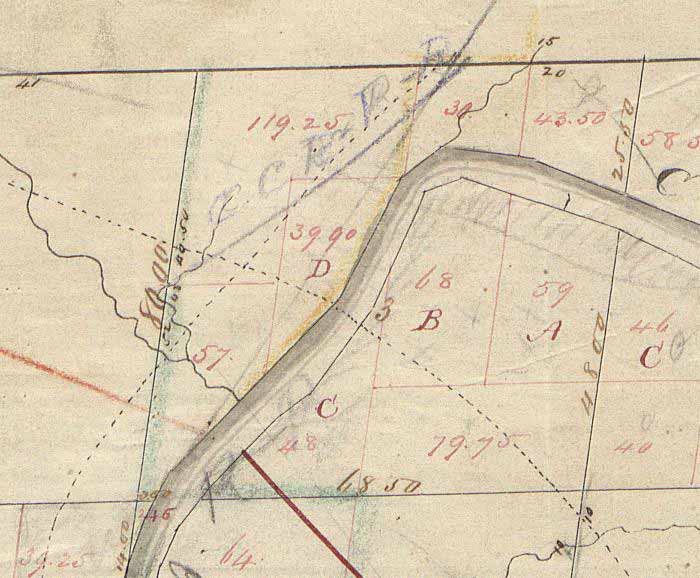
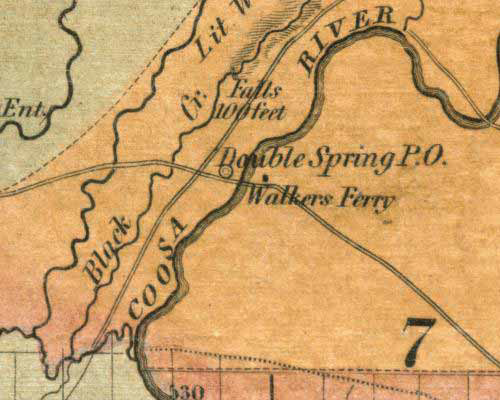
On LaTourette’s 1837 Map, the Ferry at the Double Springs Post Office is identified as Walkers Ferry. Double Springs is the present location of the City of Gadsden Alabama. The Jacksonville Road that crossed the Coosa River at Walker’s Ferry would today be U.S. Highway 431. There were no Walkers among the Original Patentees in Section 3.86 9Claim #958 in the Records of the 4th Board made by the Heirs of John Riley vs. US was for loss of a ferry from 1807 to 1819.87 10This likely refers to a different ferry. 

Mike does not tell us how this connects to Gadsden, Alabama, in the report. Notice on LaTourette’s map: Walkers Ferry is plotted on the east side of the river. William B. Walker lived on the east side of the river. William B. Walker is listed as the Postmaster in 1833 for Double Springs. John Riley is still living here at that time in Turkey’s Town. Who established the Post Office? Postal records have not been found telling us who established the PO.

What Happened to William B. Walker?

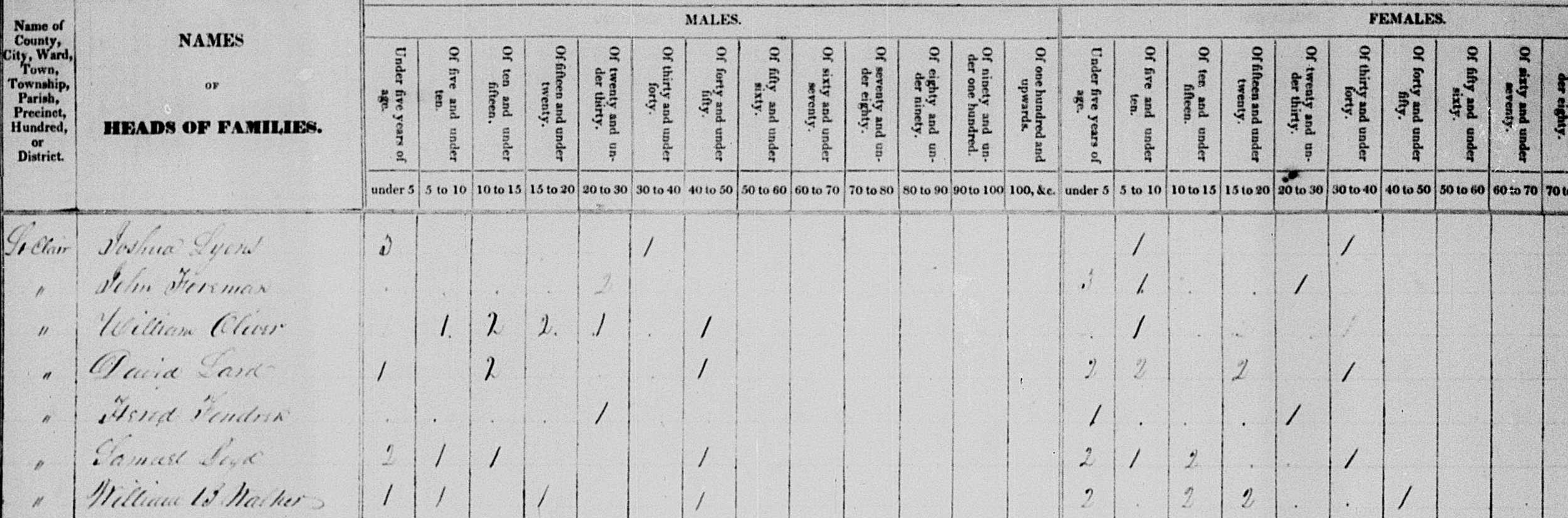
William B. Walker is listed on the 1830 US Census Record in Saint Clair County. He has a family. Where did they go?

William B. Walker 1830 US Census Saint Clair County, Alabama. From the website of FamilySearch.com

He is not on the 1840 census for Saint Clair County or Cherokee County, Alabama. Did they move off or did he die and his family move? The answers are unknown. Walker was the Postmaster for Double Springs, Alabama, as noted. He was paid $16.37 in September 1839 as the postmaster at Double Springs, Alabama.11 After the payment for the postmaster in 1839, all records of William B. Walker were lost or disappeared.

Ferry

Riley’s ferry will be called Walker’s Ferry by the early settlers. It shows up in the Saint Clair County records. The court minutes show who is in charge of the postal routes. They also show the authorization and fees for ferries. On page 203; “It is odrdered by the Court that Nathaniel Davis be appointed overseer of the road from William Walker’s ferry to the Benton County line. Road 2 grade.“12

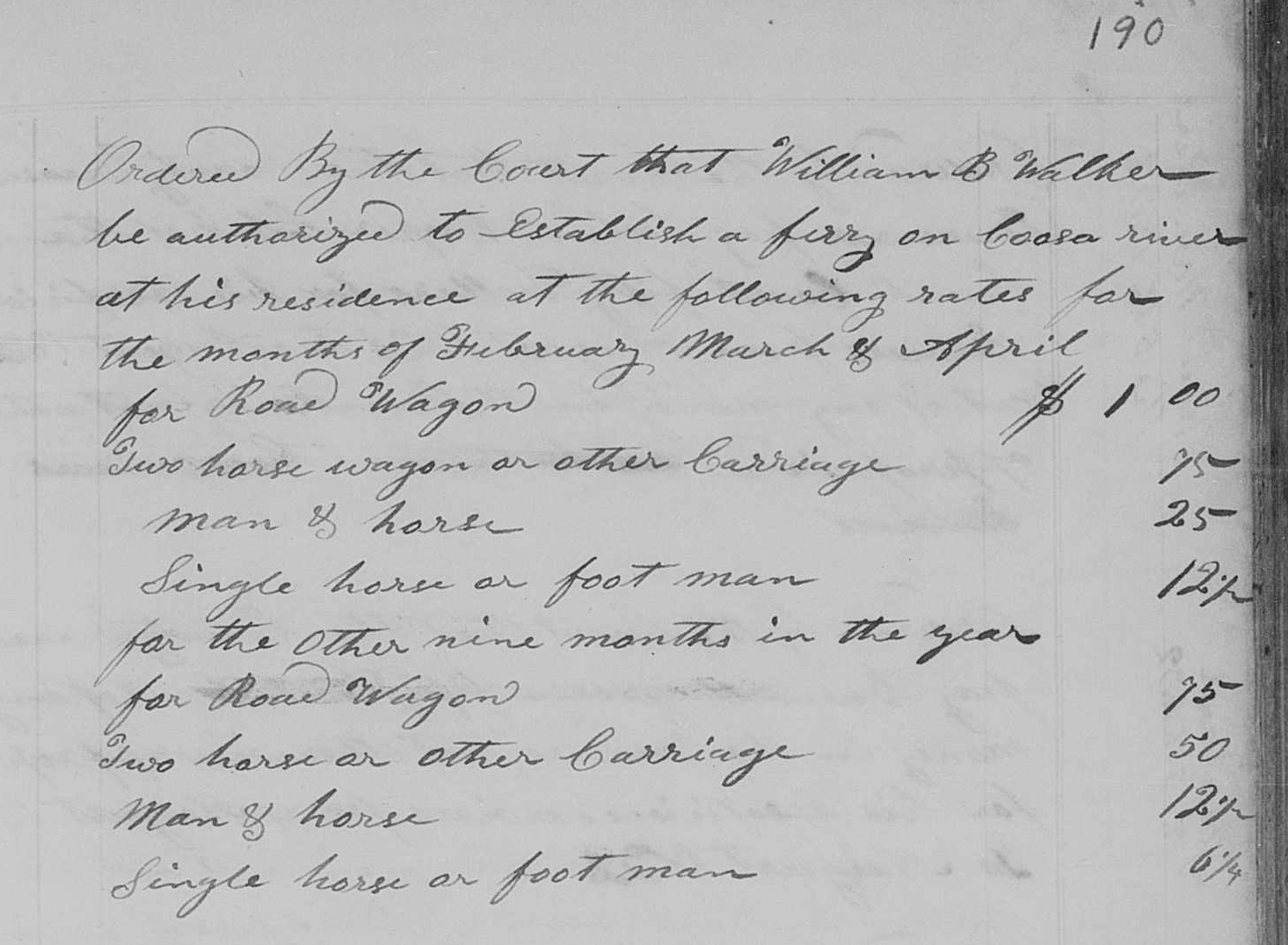
You can read the record of the ferry as Walker’s Ferry. It list the fees. This was recorded in 1832.

13

It will become Hampton’s Ferry then Ewing’s Ferry. The ferry landing and John Riley’s house will become the hub or center point for establishing a town. This town will be called Gadsden, Alabama.

Homestead

The 1928 Woman’s Club’s book records information about the beginning of Gadsden. This section was written by Mary E. Hughes (wife of Joseph R. Hughes, son of Gabriel). It was written in 1884 as the Woman’s Club noted.

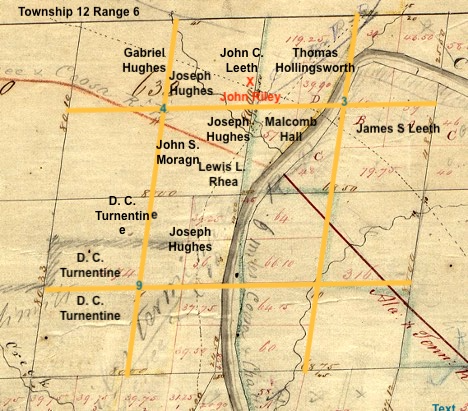
In 1844 these three men field entry to the Government for the land grants and received the patents in 1845. John S. Moragne entered sixty acres, Joseph Hughes entered twenty acres, and Lewis L. Rhea entered forty acres, which he sold to Joseph Hughes July 14, 1846. On these 120 acres the original survey of Gadsden was made. Page 15-16

The Steam boat landing was finally located at the foot of Broad street after much contention as other parties wanted it at Hampton’s (now Ewing’s) ferry. Having gained the victory, Messrs. Gabriel and Joseph Hughes and John S. Moragne laid off the town on their land in 1846 and deeded Captain Lafferty who located the land for them, a number of lots. They met one day by appointment to name their embryo city, at a building near the river not far from Barrett residence now stands and once decided to call the place Lafferty-and Lafferty it surely would have been but for the opposition of the Captain himself, who had met with them. . . they decited to name their town after the hero of the hour, General Gadsden. . . . Page 1814

Here is a listing of the patent purchasers who homesteaded the property that would become Gadsden, Alabama, in the 1840s. You can see Joseph Hughes, John S. Morgan, and Lewis L. Rhea in the center.

15

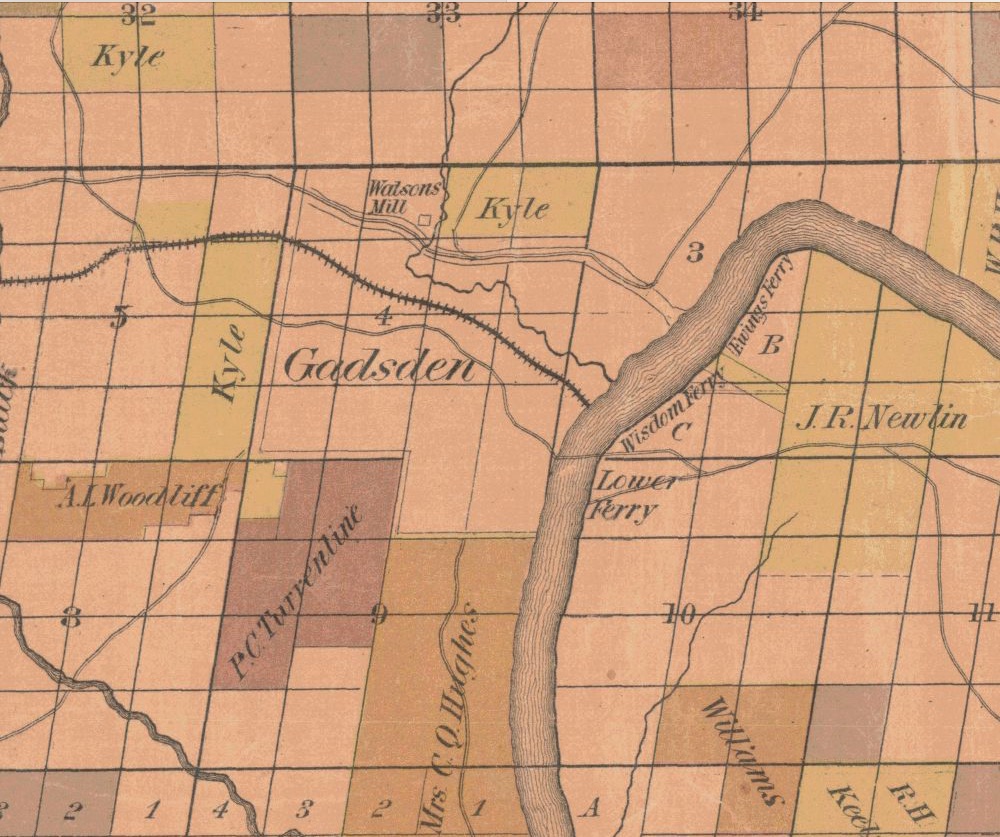
One last image of what would become Gadsden is the first map of Etowah County. Tallman drew it and it was published in 1877. The image comes from the University of Alabama’s website on Historic Maps of Etowah County, Alabama. You can see Ewing’s Ferry, the original Riley’s Ferry. You can see Wisdom’s Ferry, which is the Lafferty Landing and the ferry they created for it in 1846. Then there is the lower ferry, which is unnamed. You can see the location that is plotted out for Gadsden.

16

John Riley is a notable person of Turkey’s Town. His farm and ferry led to the establishment of Gadsden, Alabama.

  1. https://nationaltota.com/alabama-forts-and-camps/ ↩︎
  2. 79. Survey of Township 12 South of Range 6 East, of the Huntsville (AL) Meridian, fraction north of Wills Creek and the Old Cherokee Boundary Line. Plat certified June 10, 1840 by James W. Weakley, Surveyor General of the public lands in Alabama. Jonathan M. Cunningham, Deputy Surveyor. 
    http://www.glorecords.blm.gov/SurveySearch/
    ↩︎
  3. 80. Rice and McCoy/Rawlings and Massey’s Valuations, Cherokee County, Alabama, #62; Property Valuations, Entry 224; Records of the Bureau of Indian Affairs, Record Group 75; National Archives Building, Washington, DC. The Ferry was included within Riley’s entire Valuation. It simply noted “One Ferry on Coosa River, nette income on an avridge for the last 3 years $815.00. Amount allowed $8,150.00.”  ↩︎
  4. 81 John Riley’s Claim dated December 17, 1836. Folder of John Riley; Miscellaneous Claims Papers, 1836-1839, of the First Board of Cherokee Commissioners, Entry 236; Records of the Bureau of Indian Affairs, Record Group 75; National Archives Building, Washington DC. The Folder of also contains an affidavit dated October 7, 1837 from George W. Walker affirming Riley’s Claim. It is not known what George Walker’s relationship was to William B. Walker. The Folder also contains a statement from Hezekiah Oden dated December 11, 1837 that refers to Walker as Capt. William B. Walker. See also St Clair County Court Minutes Book (1828-1834) page 190 where during the August 1832 Term it is recorded “Ordered by the Court that William B. Walker be authorized to Establish a ferry on Coosa river at his residence at the following rates….”  ↩︎
  5. 82 Ibid. Riley wrote a letter to General Nathaniel Smith on Feb 14 about the loss of the rent. Commissioner Kennedy issued his opinion on May 7, 1838 disallowing any payment for loss of income.  ↩︎
  6. 83 John Riley Claim. Tahlequah District Claim #194. Folder 815. John Ross Collection. The Thomas Gilcrease Institute of American History and Art (a/k/a Gilcrease Museum), Tulsa OK. “Curtailment on spoliation Claim for a Ferry on the Coosa River, after passing the Cherokee Committee while setting on Claims at the Cherokee Agency in 1838. Curtailed by the U. States Commissioners.”  ↩︎
  7. 84 Susannah Riley Claim. Tahlequah District Claim #167. Folder 808. John Ross Collection. The Thomas Gilcrease Institute of American History and Art (a/k/a Gilcrease Museum), Tulsa OK. 
    John Riley’s wife, Susannah, was white and her maiden name was Walker. It is not known if there was any familial relationship between her and any of these white men named Walker.  ↩︎
  8. 85 John LaTourette, An Accurate Map of the State of Alabama and West Florida, NY: Colton & Co., 1837. http://alabamamaps.ua.edu/historicalmaps/alabama/1825-1850.html, Sheet 2 covers Cherokee, DeKalb and Jackson Counties. 
    Specifically see http://cartweb.geography.ua.edu:9001/StyleServer/calcrgn?cat=North%20America%20and%20United%20States&item=States/ Alabama/LatouretteSheet02.sid&wid=500&hei=400&props=item(Name,Description),cat(Name,Description)&style=simple/vie w-dhtml.xsl#  ↩︎
  9. 86. Bureau of Land Management, General Land Office Records, Eastern States Office, Springfield, VA. Pre-emption Certificate #6,072 for James S. Leeth of Cherokee County Alabama issued May 1, 1845 for fractions “A” and “B” of fractional Section 3 in Township 12 of Range 6 East. Pre-emption Certificate #6,359 for William Boyd of Benton County Alabama issued May 1, 1846 for fraction “C” and the south part of the southeast quarter of fractional Section 3 of Township 12 in Range 6. Pre-emption Certificate #6,811 for William Tillison and Francis M. Tillison, assignees of Thomas Hollingsworth (as tenants in common) issued June 1, 1845 for the northwest fractional quarter and the fraction “D” of fractional Section 3 in the fractional Township 12 of Range 6 East. All in the District of Lands subject to Sale at Lebanon Alabama. http://www.glorecords.blm.gov/PatentSearch/ ↩︎
  10. 87 Claim #958 (Heirs of John Riley vs. the United States) is not extant; Claims Papers, 1846-1847, of the Fourth Board of Cherokee Commissioners, Entry 250; Records of the Bureau of Indian Affairs, Record Group 75; National Archives Building, Washington DC. See Fourth Board Minute Docket 2 page 71; Minutes of the Fourth Board of Cherokee Commissioners, Entry 249; Records of the Bureau of Indian Affairs, Record Group 75; National Archives Building, Washington, DC.  ↩︎
  11. images, FamilySearch (https://www.familysearch.org/ark:/61903/3:1:3Q9M-CS8GP9R6-
    F?view=fullT ext : Jan 27, 2026), image 1917 of 1990; https://www.familysearch.org/ark:/61903/3:1:3Q9M-CS8G-P9R6-F?view=fullText
    ↩︎
  12. St Clair County Court Minutes Book (1828-1834) page 203, FamilySearch.com https://www.familysearch.org/ark:/61903/3:1:3Q9M-CS42-K93K-S?view=fullText&keywords=William%20Walker%2CWilliam%2CWalker%2Cferry&lang=en&groupId= ↩︎
  13. St Clair County Court Minutes Book (1828-1834) page 190, https://www.familysearch.org/ark:/61903/3:1:3Q9M-CS42-K93L-T?view=fullText&keywords=William%20Walker%2CWilliam%2CWalker%2Cferry&lang=en&groupId= ↩︎
  14. A Little Book About Gadsden, Alabama. Written and Published by the Department of Archives and History of the Woman’s Club of Gadsden, 1938. Page 14-15, 18 , Gadsden Public Library, Gadsden, Alabama.  ↩︎
  15. Survey of Township 12 South of Range 6 East, of the Huntsville (AL) Meridian, fraction north of Wills Creek and the Old Cherokee Boundary Line. Plat certified June 10, 1840 by James W. Weakley, Surveyor General of the public lands in Alabama. Jonathan M. Cunningham, Deputy Surveyor. 
    http://www.glorecords.blm.gov/SurveySearch/ Lables add by the writer. ↩︎
  16. http://cartweb.geography.ua.edu/lizardtech/iserv/calcrgn?cat=North%20America%20and%20United%20States&item=States/Alabama/Counties/etowah//Etowah1877a.sid&wid=1000&hei=900&props=item(Name,Description),cat(Name,Description)&style=simple/view-dhtml.xsl ↩︎

Trust in the Lord with all your heart, and do not rely on your own understanding; in all your ways know him, and he will make your paths straight. Proverbs 3: 5-6 CSV
Subscribe

  • Entries (RSS)
  • Comments (RSS)

Archives

  • February 2026
  • January 2026
  • December 2025
  • November 2025
  • October 2025
  • September 2025
  • August 2025
  • July 2025
  • June 2025
  • May 2025
  • April 2025
  • March 2025
  • February 2025
  • January 2025
  • December 2024

Categories

  • Local History

Meta

  • Create account
  • Log in

Website Built with WordPress.com.

  • Subscribe Subscribed
    • New Seneca Turkey's Town
    • Already have a WordPress.com account? Log in now.
    • New Seneca Turkey's Town
    • Subscribe Subscribed
    • Sign up
    • Log in
    • Report this content
    • View site in Reader
    • Manage subscriptions
    • Collapse this bar
 

Loading Comments...