
Tags
alabama-history, cherokee-indians, Etowah County Alabama History, northeast-alabama-history, trail-of-tears, turkeytown
Turkey’s Town and the Trail of Tears. A dark history of the US. How did this affect Turkey’s Town? How were the people involved?
Turkey’s Town’s involvement was first seen in the Treaty Ratification of October 1816.
Turkey Town Treaty
At midnight on 4 October 1816, Andrew Jackson and David Meriwether dictated a letter to be sent to William H. Crawford, Secretary of War with a summation of the treaty and other comments. In this letter at image 113, they talked about the removal West of the Mississippi. Several Chiefs inquired about the effects on the nation.
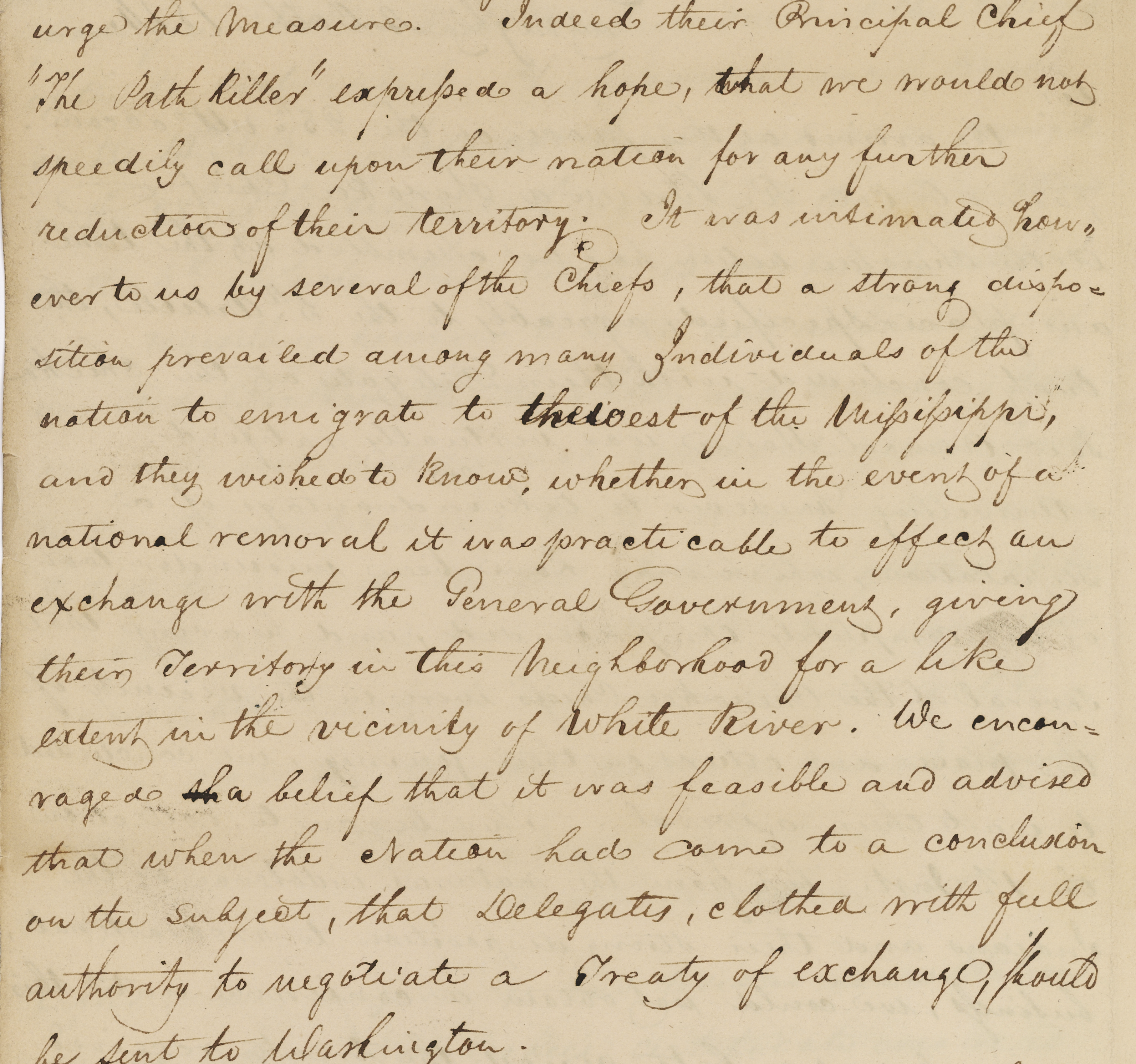
It was internalize to us however several of the chiefs that a strong disposition prevailed among many individuals of the nation to emigrate to the west of the Mississippi and they wished to know whether in the event of national removal it was practicable to effect an exchange with the General Government. .1
The Removal Bill
Americans elected Andrew Jackson of Tennessee as president in 1829. The Removal Bill of 1830 initiated the voluntary Indian removal. It was also known as the Indian Removal Act. The Indian Removal Act was passed in May 1830. It provided for lands in the Arkansas territory as a place to move to. So-called “West of the Mississippi River”. 2
Chief John Ross, Principal Chief of the Cherokee Nation, protested. The State of Georgia passed a bill in January 1830, claiming all of Northwest Georgia and the Cherokee Territory. This included Georgia State laws over the land.3 To add to the takeover of land, gold was found in Northwest Georgia. White men intruded by the hundreds searching for gold. 4 Georgia then sectioned off the land, and a lottery was held for 160-acre lots.
New Echota Treaty 1835
The Treaty of New Echota was signed on December 29, 1835, in New Echota, Georgia. Officials of the United States government and representatives of a minority Cherokee political faction, the Treaty Party, were involved.
The treaty set terms for the Cherokee Nation to give up its territory in the southeast. They were to move west to the Indian Territory. The treaty was not approved by the Cherokee National Council. Principal Chief John Ross did not sign it. Still, it was amended and ratified in March 1836 by the US Congress by one vote. This amendment and ratification made it the legal basis for the forcible removal. 5
The twenty-member council, “Treaty Party” that signed (by mark or signature).
Major Ridge, Te-gah-e-ske, James Foster, Robert Rogers, Tesa-ta-esky,
John Gunter, Charles Moore, John A. Bell, George Chambers, Charles F. Foreman, Tah-yeske,
William Rogers, Archilla Smith, George W. Adair, Andrew Ross, Elias Boudinot,
William Lassley, James Starr, Cae-te-hee, Jesse Half-breed,
Stand Watie, John Ridge. were the ones who provided instructions. 6
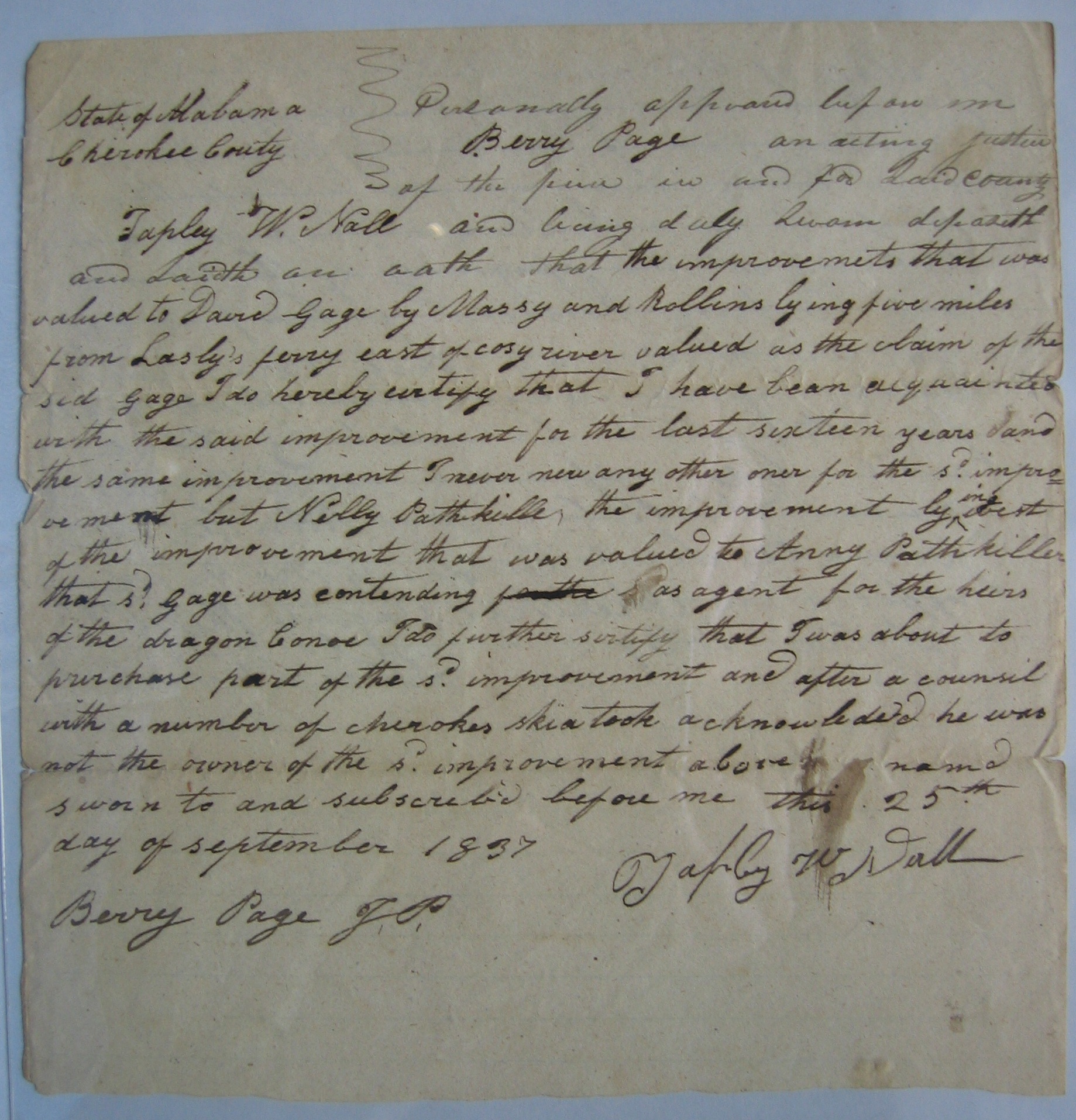
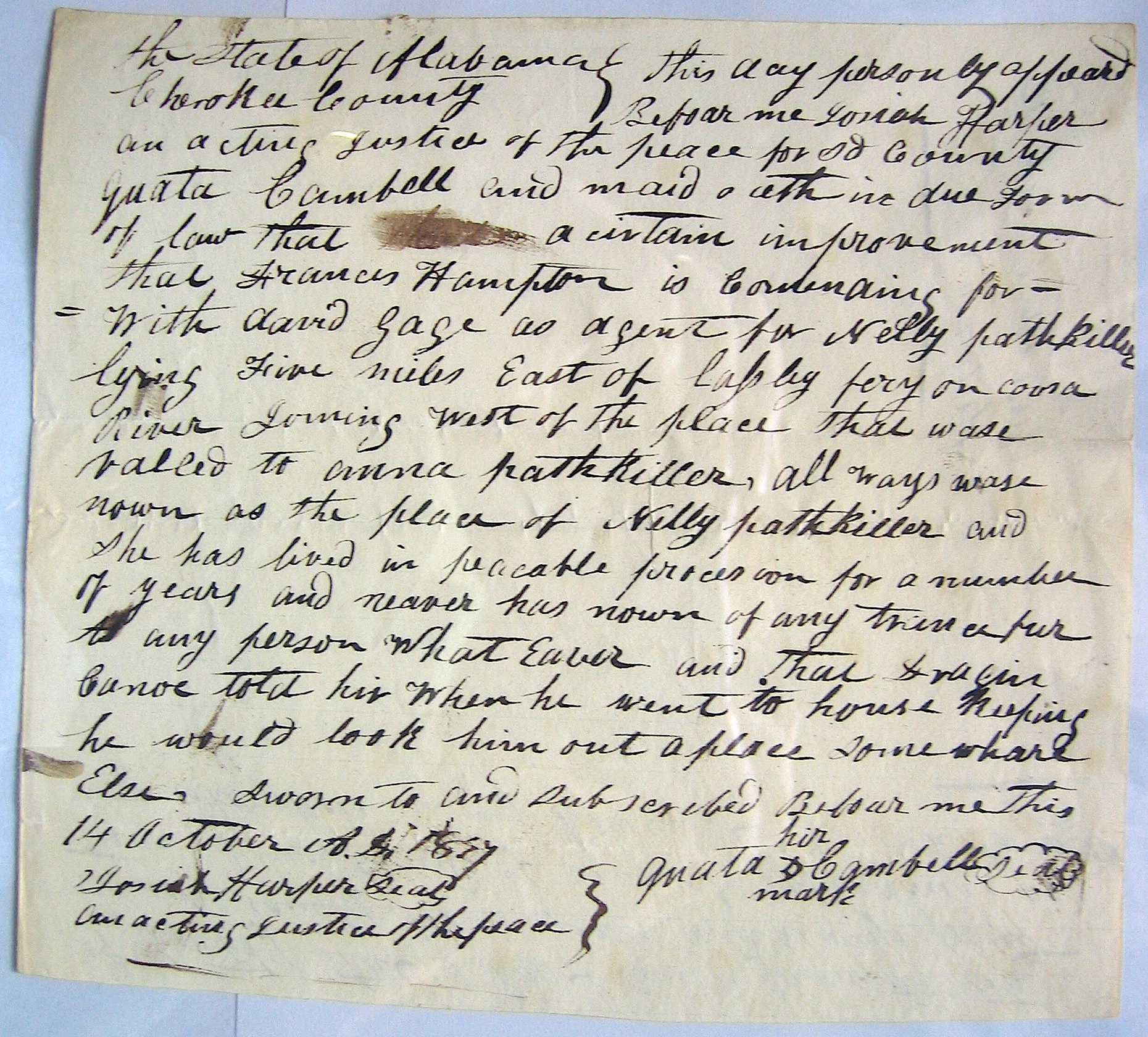
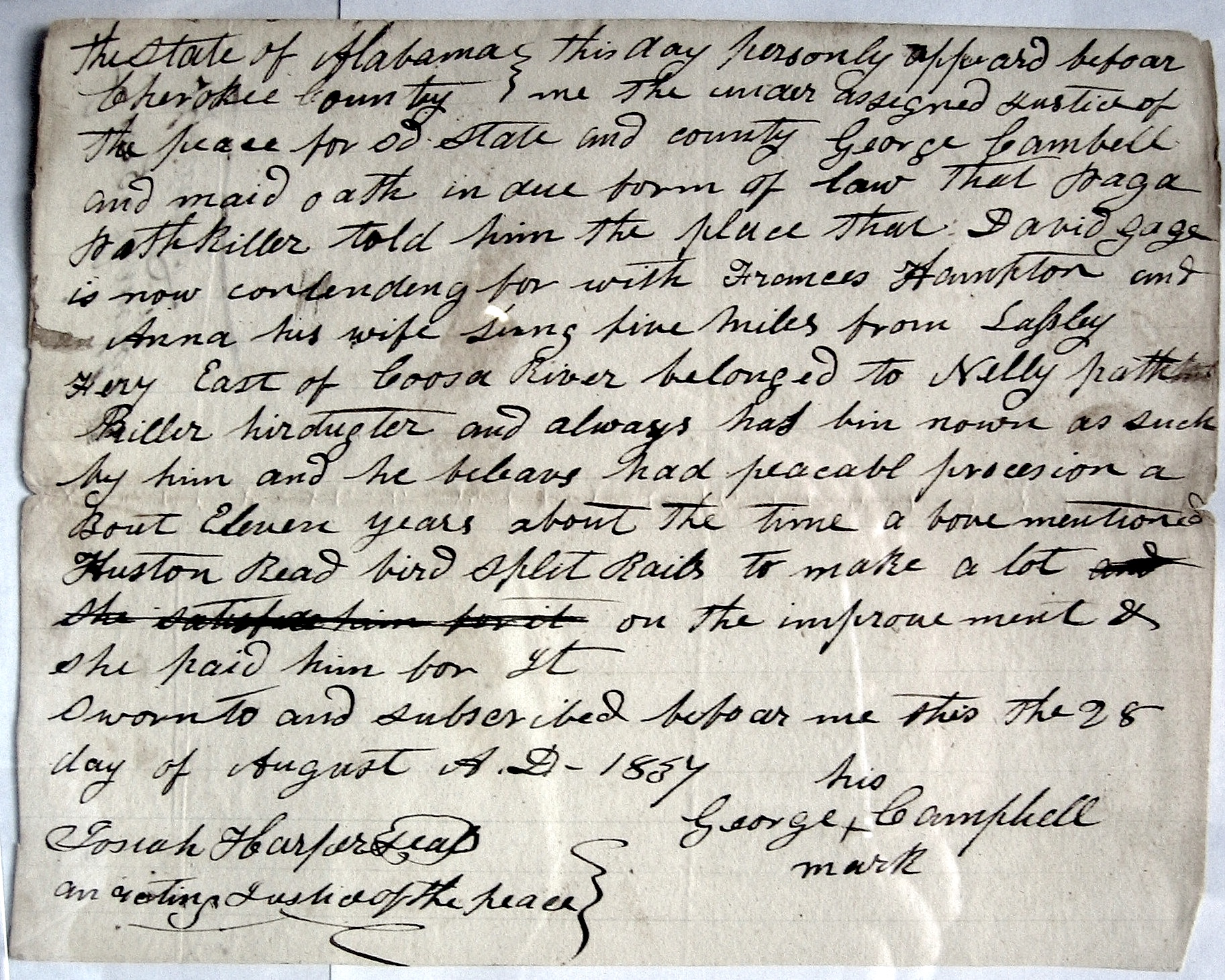
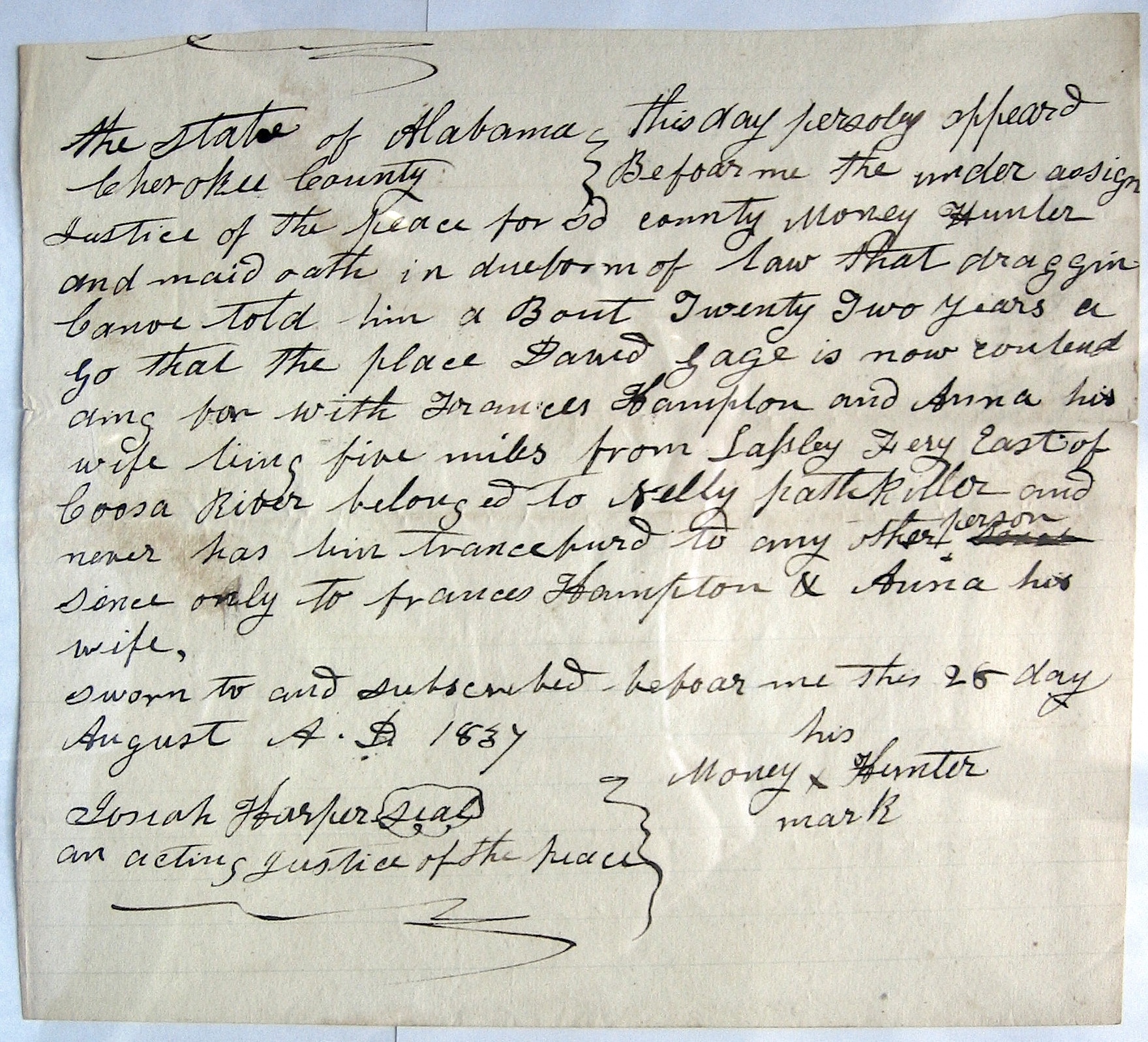
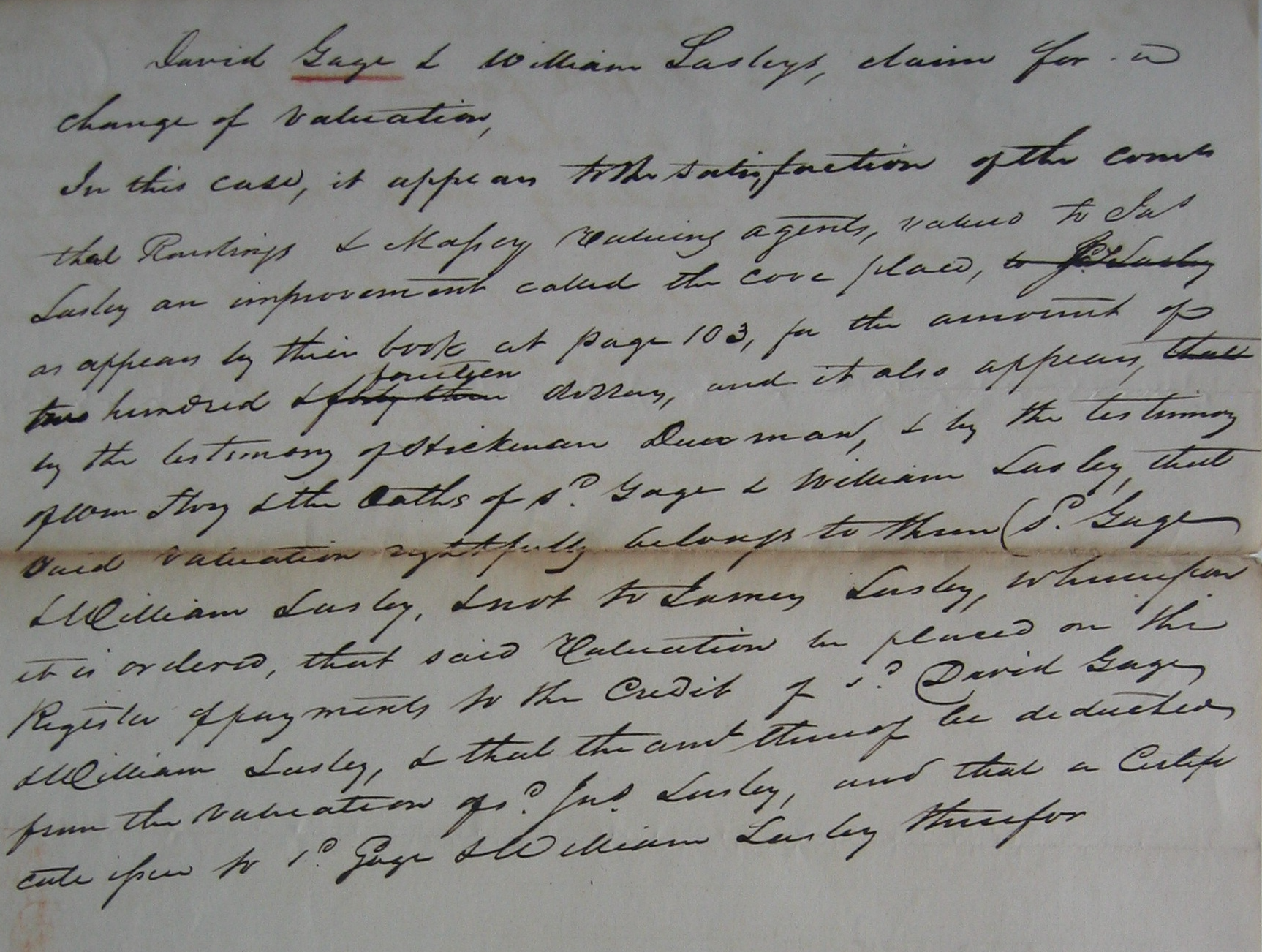
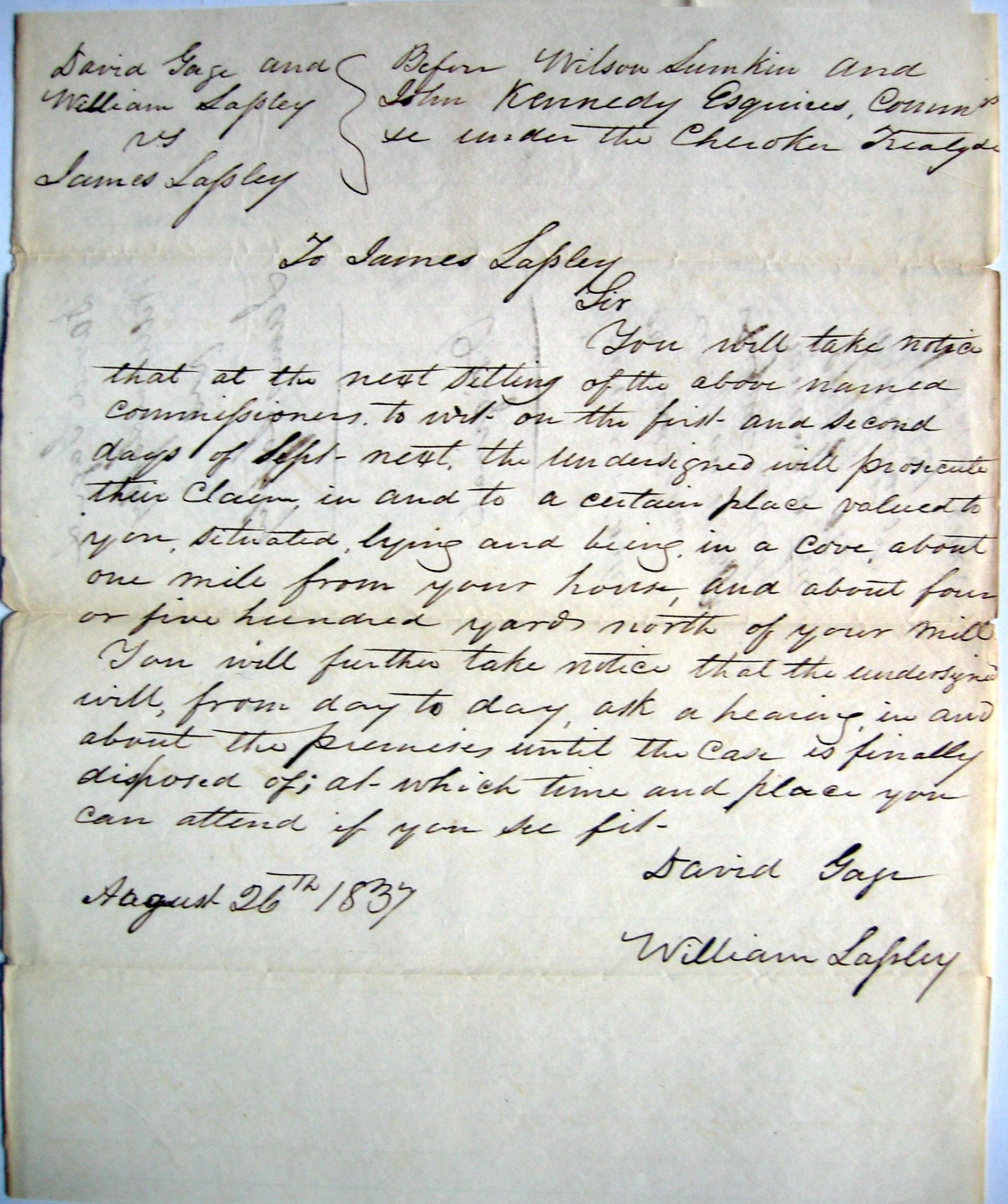
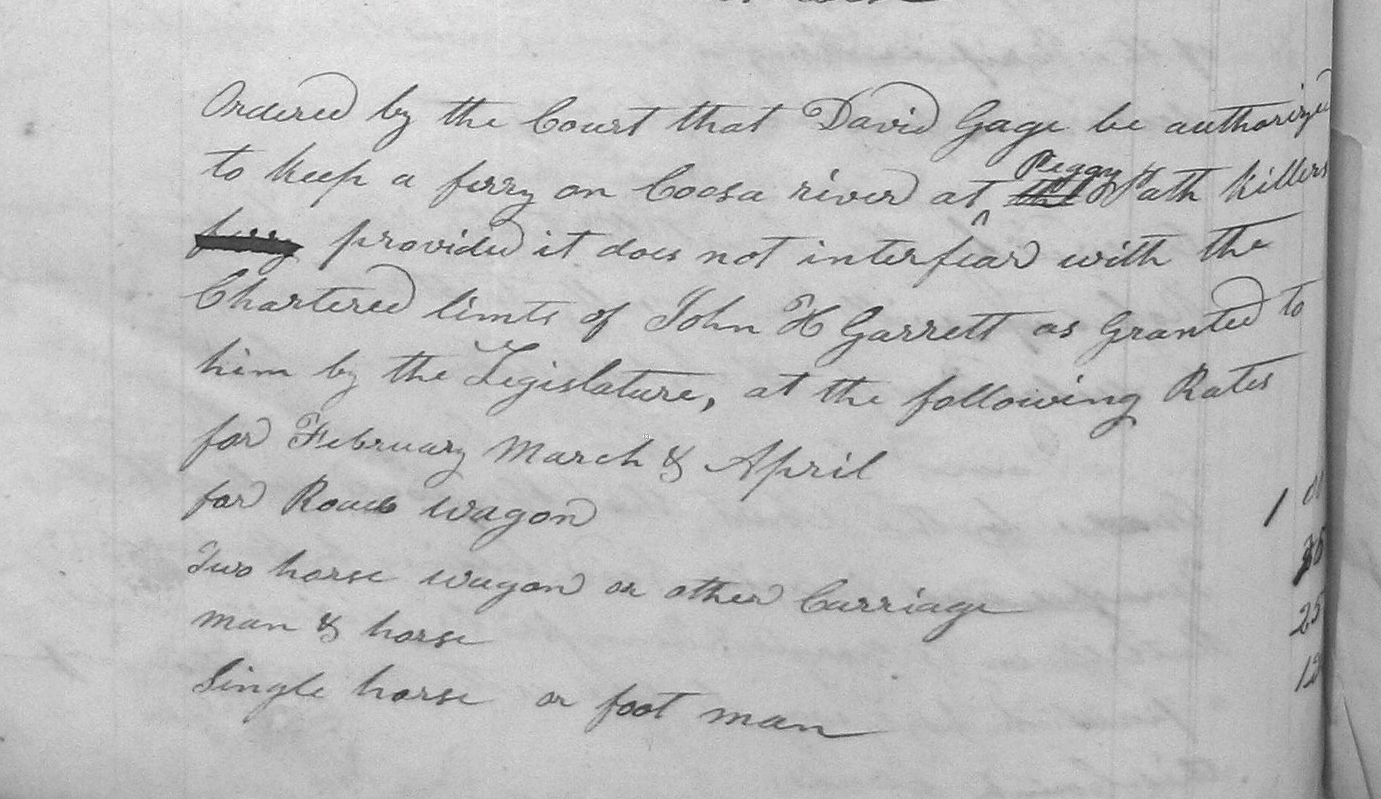
John Ridge, with this group, held 3/8 interest of Chief Pathkiller’s estate. This included the ferry, house and orchards at what is today’s Centre, Alabama. Review Chief Pathkiller’s ferries in this blog. John Ridge was the National Council’s Clerk (Secretary). William Lassley is the son of James Lasley. He is mentioned in the posts on James Lasley.
1835 Census
To know who would be potentially removed from Turkey’s Town, we need to review the 1835 census. A census was ordered to be taken of all Cherokees left in Alabama, Georgia, and Tennessee. This refers to the Henderson Roll. Below are the heads of households from Turkey’s Town. Rezin Rawlings took the census in Alabama. Recorded October 26, 1835. 7
page 15
N. Pathkiller, SE NO WAY, Writer, Nann, TE SEE, Johnson, Seeds, AT TA WO NO LE SKE, CHU WA STE TA, AH TA LO NE, Dirt Seller, Buffalo,
page 16
John E WAY NAH, SOR KE NEE, SE QUA TAH, TEN A YA CHEE, TA KEE, CHU QUA LOO KEE, Richard Ratliff Jr., George, Richard Ratliff Sr., James Lassley, Gun Fill, Pumpkin Pile, TU NE WAH, TOO NEY, Young Wolf,
page 17
Money Cryer, WAT TEE, James Carroll, John Ratliff, George Campbell, TE LU NA SKEE, Corn Tassel, Beaver Tail, John Riley, A NEY, Nelly, Auger Hole (Coosa),
Next Time
Who is on the detachment rosters? The Cherokee in Turkey’s Town were rounded up and forced to the stockade at Fort Payne. During June and July of 1838, they were forced from their homes.
- Image 113, National Archives, Record Group 11, General Records of the United States Government, Series Indian Treaties; RIT #83; Ratified Indian Treaty #83, Cherokee, Chickasaw Council House September 14, 1816, There are 231 images of this with correspondence of letters and a journal. https://catalog.archives.gov/id/100220646 ↩︎
- Indian Removal Act: Primary Documents in American History. Library of Congress. https://guides.loc.gov/indian-removal-act ↩︎
- John Ross and the Cherokee Indians, Rachel Caroline Eaton, A. M. 1914, Chapter VII, The Removal Bill, Image 60,Google Books, https://play.google.com/books/reader?id=0eUNAAAAIAAJ&pg=GBS.PA60 ↩︎
- Ibid, Image 64 ↩︎
- The Treaty of New Echota, https://en.wikipedia.org/wiki/Treaty_of_New_Echota ↩︎
- Laws and Treaties, Volume II, Charles J. Kapplar, Treaty with the Cherokee 1835, https://americanindian.si.edu/nationtonation/pdf/Treaty-of-New-Echota-1835.pdf ↩︎
- Cherokee Indian census of 1835 of the states of Georgia, Alabama, and North Carolina. Copy of the transcribed Alabama Section of the Old Book. Personal Copy of Jeffrey Sauls, received as a gift in 1992. ↩︎
Trust in the Lord with all your heart, and do not rely on your own understanding; in all your ways know him, and he will make your paths straight. Proverbs 3: 5-6 CSV
 New Seneca Turkey's Town