• Home
  • About
  • Alabama Chapter Trail of Tears Association
  • National Trail of Tears Association
  • Local History

New Seneca Turkey's Town

~ Uncovering the History of Turkeystown, a Cherokee Village/Town in Northeast Alabama

New Seneca Turkey's Town

Tag Archives: alabama-history

The Beloved Chiefs from Turkey’s Town, Chulioa or The Boot

19 Tuesday Aug 2025

Posted by Jeffrey Sauls in Local History

≈ Leave a comment

Tags

alabama-history, cherokee-indians, native-americans, New Seneca, northeast-alabama-history, trail-of-tears, turkeytown

Chulioa or The Boot1 is not a “Beloved Chief” to the Cherokee Nation. He is not a Chief. He is one of the most important people in Turkey’s Town. He is listed as one of the “Headman” of Turkey’s Town. This is how he is listed at the Grand Council meeting on 1 June 1792.

Present, the Little Turkey, great beloved man of the whole nation; the Badger, the beloved man of the Southern division; the Hanging Maw, beloved man of the Northern division; the Boot, the Black Fox, the Cabin, Path Killer, head-men of Turkey’s town.2

Chulioa was raised in a Creek village. The Reverend Daniel Butrick, born in Massachusetts, did not understand his title. Butrick did appreciate his importance.

3. See transposed below
4 See transposed below

“This man I believe is some like a prince regent.  He attends to business when the king is absent or in ill health, and is his Creek interpreter.  Though a Cherokee, he was brought up among the Creeks, and though he now lives with the Cherokees & is one of their principal Chiefs, yet he is also a chief, and attends councils of the Creek Nation.  He can neither talk nor understand English, and yet perhaps few men in any nation understand the art of pleasing & of rendering their company pleasant and agreeable better than he.”  5

Chulioa served as an advisor and Creek interpreter to Principal Chief Little Turkey6. He led Chief Little Turkey to a location for his village. Turkey’s Town was the first settlement of the Cherokee in the Creek territory. (Now Northeast Alabama.) Review, archive, 12 February 2025, post, Location by the People of Turkey’s Town. Settlement of Turkey’s Town is one of the most important events in Northeast Alabama’s history during the 18th century. The following is found in the Alabama Territories Papers.

There is a track of land lying on Wills Creek and between that creek and the Coosa River on the West side of the latter, and north of the Treaty line of Fort Jackson which they may be prevailed upon to part with, in treating for which they are willing to discuss and settle the subject of the boundary between them and the Cherokee. They however contend that their present boundary with the Cherokee is by the Suwannee path where it leaves the Western line of Jackson County to the old town on the Chatahotchie River and from thence by a drift line to the Mouth of a certain water course called by them, Little River where it unites with the Coosa. They have furnished me with a copy of certain question put by the Creeks to an old Cherokee Chief and the Cherokee Interpreter (who was their mutual interpreter on the first settlement of the Cherokee in the Creek Country) . . .7

This has to be Chief Little Turkey and Chulioa.

Chulioa played a very important role in the Creek War, 1813-1814. His service in the Creek War was significant to Chief Pathkiller and the US. Chulioa served as the Creek Interpreter. We see in Dr. Susan M. Abram’s Doctoral Dissertation titled Souls in the Treetops, Cherokee War, Masculinity and Community, 1760-1820. She received her Doctor of Philosophy from Auburn University in 2009. Footnote 27, page 118, Cherokee Muster Rolls, RG 94, AGO. Jackson personally oversaw the mustering in of Pvt. Chulio, who was Path Killer’s aid. He served as a private under Capt. James Brown for his first tour of duty. During his second tour, Chulio earned a promotion to 1st Lt. under Capt. Frog.  The footnote is attached to these sentences. Intelligence gathered by the Creek interpreter Chulio soon indicated that a considerable force of Red Sticks had gathered near Ten Islands on the Coosa River while others were about forty miles south of Tuckabatchee. Another group was at Oakchoi Town, not far from Turkey Town near the Creek-Cherokee border.

Chulioa should not be confused with another Cherokee warrior who was killed during the Creek War. The Boot. This Boot was in Captain McLemore’s Company. 8

Chulioa made his mark on the Treaty Ratified in Turkey’s Town in October 1816.9

Chulioa will be the go-to guy in Turkey’s Town. Rev. Butrick would go to him to gain a meeting with the headmen and Chief Pathkiller in 1822.

Friday 18th. With Br. John Arch started for Turkey’s Town where we arrived on Saturday evening, and called on the Boot.  He is the King’s Creek interpreter & one of his confidential consellors.  I told him the object of our journey, and that if he saw fit to notify a meeting we should be pleased to see the king – Path Killer, and all the people of the town together.  He seemed thankful and said he would lay the subject before the head men of his Town, and let us know their minds.10

Conclusion

Chulioa or the Boot is a very important person in Turkey’s Town. He is the link to how Chief Little Turkey would settle there. He was very involved with the Creek War. Next post we will see his family and their connections in the Cherokee Nation. We will see a very tragic part of the Trail of Tears.

  1. His name is rendered by English writers as Chuleoa, Chulioa, Chuli-o-a, Chulcoh, Tsu-le-o-a, Chutcoe, or generically as ‘the Creek interpreter’ ↩︎
  2. Indian Affairs, Volume 1, ASP IA Vol. 1, searchable online the Library of Congress American State Papers web site, pages 271-273, 26 June – 1 July 1792. ↩︎
  3. 19 Jan 1822, Journal of Reverand Daniel S. Butrick, pages 143-2, 143-3, American Board of Commissioners for Foreign Mission (ABCFM), 18.3.1 V3, Michael Wren personal copy. Original and transposed copy. ↩︎
  4. Ibid ↩︎
  5. Ibid. ↩︎
  6. See American State Papers Vol 1 pp 271, 276, 277, 328, 447, 657.  See also American State Papers Vol 2 pp 145, 153-154 (where is incorrectly called ShoeBoots), 283, 486-487, 489-490.  He was one of the headmen of Turkey’s Town and part of the Cherokee leaders at the signing of the Treaty of Holston of 1791 where he delivered an address.  See Lyman Draper Papers 15 U 5-56.  Specifically, see 35-36 & 39-46.   ↩︎
  7. Alabama Territory, Territorial Papers, pages 183-184, images 207-208, https://babel.hathitrust.org/cgi/pt?id=mdp.39015010692468&seq=208 page183-184 ↩︎
  8. Dr. Susan M. Abram’s Doctoral Dissertation titled Souls in the Treetops, Cherokee War, Masculinity and Community, 1760-1820. Doctor of Philosophy from Auburn University in 2009. Page 228 ↩︎
  9. National Archives, Record Group 11, General Records of the United States
    Government, Series Indian Treaties; RIT #83; Ratified Indian Treaty #83,
    Cherokee, Chickasaw Council House, September 14, 1816. There are 231 images
    of this with correspondence of letters and a journal. https://catalog.archives.gov/id/100220646 ↩︎
  10. 18 Jan 1822, Journal of Reverand Daniel S. Butrick, American Board of Commissioners for Foreign Mission (ABCFM), 18.3.1 V4, Unit 6, reel 754 1819-1845, Michael Wren personal copy. Original and transposed copy. ↩︎

Trust in the Lord with all your heart, and do not rely on your own understanding; in all your ways know him, and he will make your paths straight. Proverbs 3: 5-6 CSV
The Beloved Chiefs from Turkey’s Town, Chief John Ross

05 Tuesday Aug 2025

Posted by Jeffrey Sauls in Local History

≈ Leave a comment

Tags

alabama-history, cherokee-indians, Chief John Ross, northeast-alabama-history, trail-of-tears, turkeytown

Chief John Ross

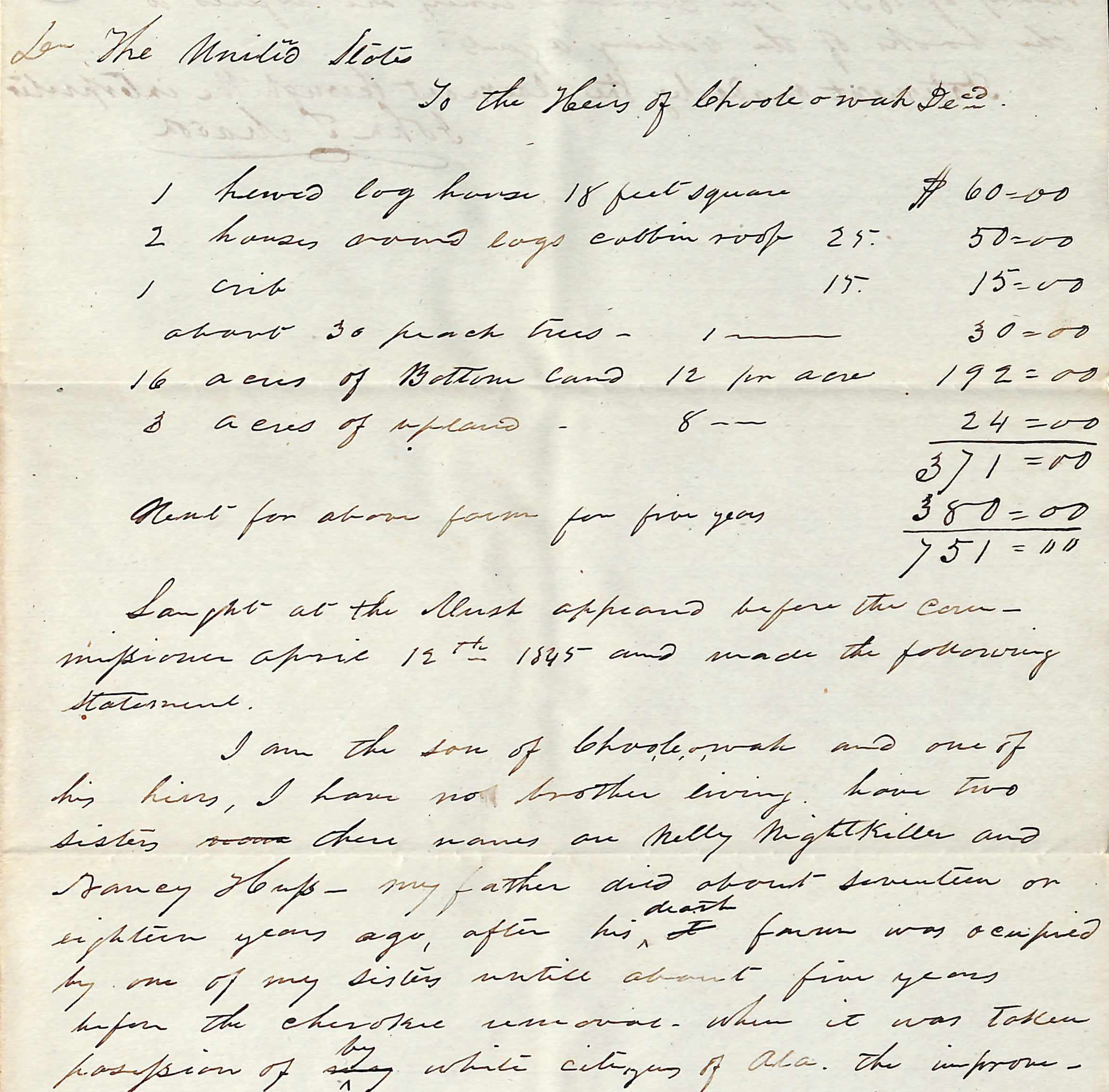
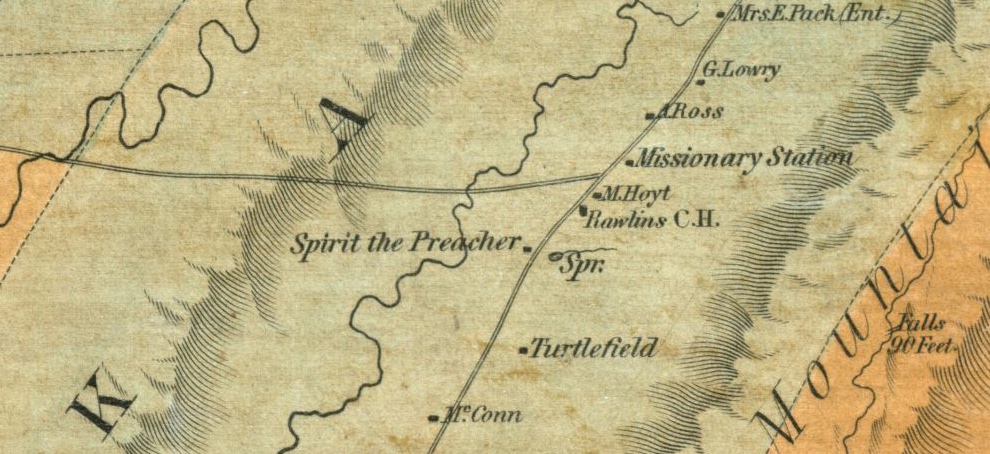
 The last of the Principal Chiefs who is from Turkey’s Town. Chief John Ross was born there on 3 October 1790. John Ross was born in “Tahnoovayah.”1 Notice the similarity to the spelling in the above 1842 claim, “Dah-noo-ney-ya”. He would become one of the most, if not the most, beloved Chiefs of the Cherokee Nation. His family moved to Turkey’s Town in 1788. They would leave and move back to the Chickamauga Creek site by 1800. This information is supported by Myth and History: The John Ross House through Time. It was published by The National Park Service and The John Ross House Association, Inc. 2007. It was written by William J. Bishop, Vice-President Trail of Tears Association, Georgia Chapter, on pages 33, 56-57;2

McDonald, living “about 25 miles south west from Chickamagga,” could unwittingly be a prime source of the “earliest and best Intelligence that can be had from that quarter,” Martin said. “He has great influence with the Indians on that quarter, deals at Pensacola, corresponds with Mr. Gilvry, in the Creek Nation and one Mr. McClatchey at the mouth of St. Mary’s, a British Merchant who furnishes some part of the Towns near him with goods.” 
Ross said that “about the year 1788, he removed together with his father in-law and their families to Turkey Town (“Tahnoovayah,” according to Eaton, or, according to Brown, “Kanagatugi”), and continued trade with the Cherokees. The Little Turkey was the Principal Chief of the Cherokee Nation and resided in that town.”

Chickamauga move

It does seem to make sense that, following the peace treaty with the Americans, McDonald would want to return back to the site of his original homeplace, where he had raised his children for nearly a decade – much longer than any period of time he had spent in any other Cherokee town. Cementing this idea, correspondence from McDonald’s wife in 1809 is shown as being sent from “Chickamauga,” rather than from Poplar Spring, as Rossville was then known (Cherokee Agency at Tennessee official records, U.S. Archives, M-208, Roll 4). Further, we know that McDonald was in fact living at Chickamauga Creek when he finally did sell his holdings to the founders of the Brainerd Mission 17 years later, in 1817 (Phillips, 1998, p. 27). 

(We do know for a fact, however, that McDonald was living on Chickamauga Creek in 1800, as previously demonstrated. So if Hawkins’ eyewitness account can be trusted to mean that the McDonald trading post at Rossville was non-existent in the summer of 1799, then in order to believe that such a trading post did exist prior to McDonald’s establishment at Chickamauga Creek we are necessarily left with only a one-year window. His supposed residence at what is now Rossville, then, would have been exceptionally brief.) 

We can be reasonably assured that Ross was living somewhere east of Lookout Mountain by June of 1802 because he sent a letter (Ross, 1802) from “Chickamoga” to the Tennessee Agent, Major William Lovely, regarding, again, some horses that had been stolen .

Commissary in Turkey’s Town

 We can see his grandfather’s influence in Turkey’s Town. During his time there, he turned the place into a commissary. He bargained trades, goods, and munitions from the Spaniards.  Myth and History: The John Ross House through Time; pages 27-57, John McDonald and the Chickamauga Page 37

James Carey related the following information to Gov. Blount in Nov., 1792 (Coker, 1986, Reel 7): The contents of the letter was to invite Watts and the Bloody Fellow, in the name of Governor O’Neal, to come down to Pensacola with ten pack horses; that they should have from Governor O’Neal arms and ammunition, as many and as much as they wanted, and that Panton himself would supply their nation with goods in plenty. Mr. Panton, during his stay in the nation, made the house of his countryman, McDonald, his headquarters, from whence they together paid a visit to the Little Turkey, and spent several days, Mr. McDonald acting as interpreter between Mr. Panton and the Turkey. 

After this visit, Panton wrote to Gov. O’Neill, advising him on the best way to conduct the proposed meeting. The Cherokees, he said, should be supplied with much-needed arms, horses, and guns, and generous presents should be given. He specifically pointed out that “Mr. McDonald, the old British superintendent,” should be welcomed personally. He knew McDonald was very dissatisfied with the American treatment of the Cherokee and with Gov. Blount’s efforts to tamper with Indian trade. Panton, like Martin on the American side, knew that McDonald with his influence over the Cherokee could be either “very serviceable” or “very dangerous.” 

Myth and History: The John Ross House through Time is a very well-documented source of the Ross house in Rossville, Georgia. It clears up the history of the house. It has a very well-documented history of the Chickamauga Cherokees. Web link below.

https://www.nps.gov/trte/learn/historyculture/upload/Myth-and-History-The-John-Ross-House-508.pdf

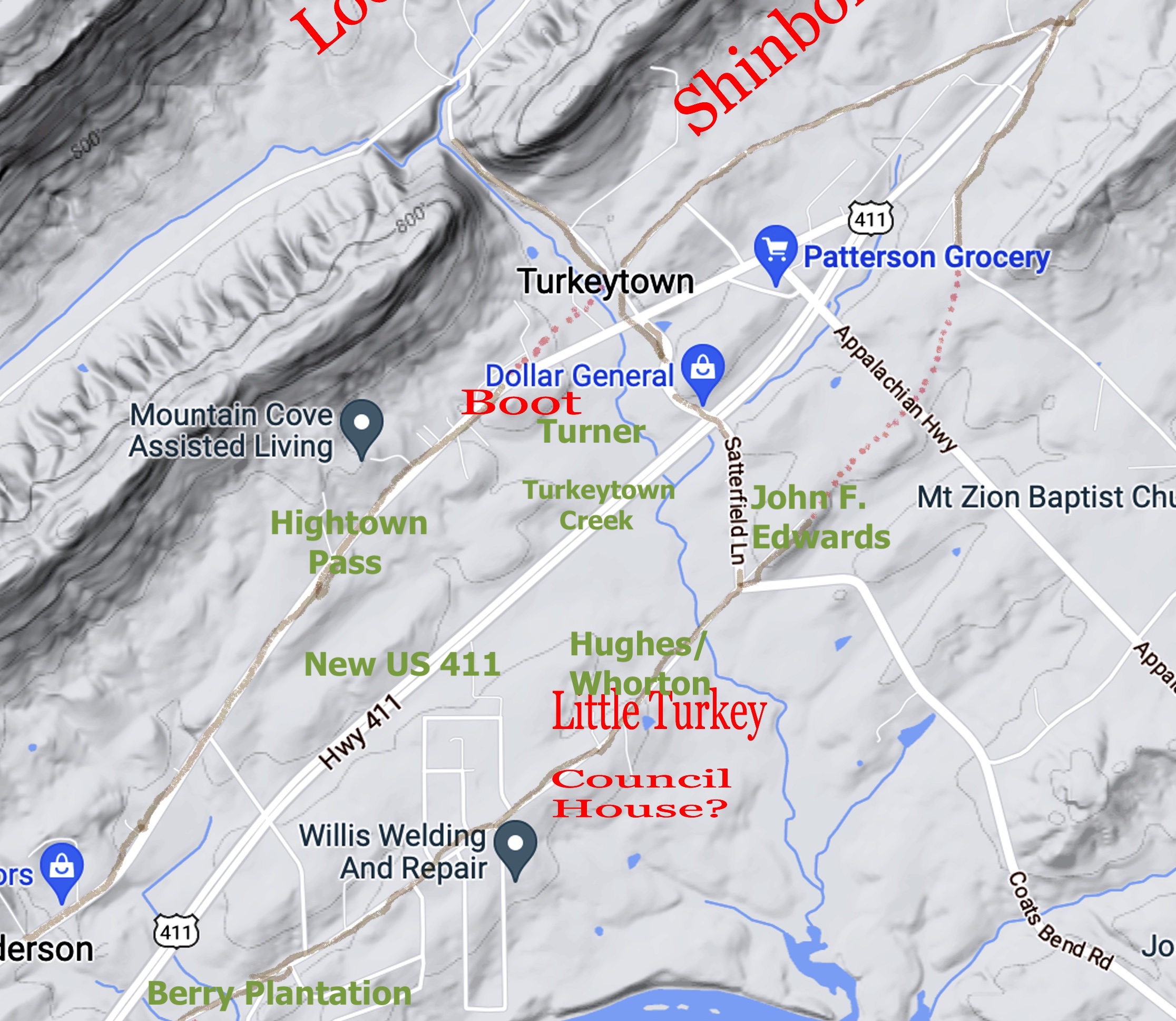
Chief John Ross did not live in Turkey’s town while he was Chief. There are many books written about him, so I will not repeat his story. The exact location of the McDonald/Ross home and trading post in Turkey’s Town is not known. It must have been on the main road through the Town. This would be the High Town Pass or Hightower Pass. There are no statements about their location on any of the Claims. There are also no notes of their location submitted by the people of Turkey’s Town after removal. They do not comment on the Ross or McDonald trading post or stand.

Chief John Ross became the Principal Chief in October 1828 by election of the National Council. He would lead them through the Trail of Tears.3 He sued the State of Georgia for land rights and laws. Worcester v. Georgia. He won in the Supreme Court of the United States in 1833. President Andrew Jackson did not honor the verdict.4 The New Echota Treaty of 1835 fixed the removal West.5 They had two years to move. In 1838, the forced removal took place, the Trail of Tears. Ross also led them through the American Civil War. He died in 1866.

Conclusion

This concludes the Chiefs. Before we move to the next chapter. I want to introduce you to a couple of people. One we have talked about before. One you do not know. Boot (Chulioa), you have met. He is Cherokee, but he was raised among the Creek. He helped Chief Little Turkey settle New Seneca. I will discuss him in detail next. Then I will introduce you to Charles Chief Pathkiller’s nephew.

  1. Eaton, Rachel Caroline. John Ross and the Cherokee Indians. Menasha, Wis., George Banta publishing company, 1914. Pdf. https://www.loc.gov/item/14018822/, Image 23, page 3 ↩︎
  2. https://www.nps.gov/trte/learn/historyculture/upload/Myth-and-History-The-John-Ross-House-508.pdf ↩︎
  3. Eaton, Rachel Caroline. John Ross and the Cherokee Indians. Menasha, Wis., George Banta publishing company, 1914. Pdf. https://www.loc.gov/item/14018822/, Chapter VII ↩︎
  4. Ibid, Chapter VIII ↩︎
  5. Ibid. ↩︎

Trust in the Lord with all your heart, and do not rely on your own understanding; in all your ways know him, and he will make your paths straight. Proverbs 3: 5-6 CSV

The Beloved Chiefs From Turkey’s Town: Chief Pathkiller and the 1816 Treaty of Turkey Town.

15 Tuesday Jul 2025

Posted by Jeffrey Sauls in Local History

≈ Leave a comment

Tags

alabama-history, Brainerd Mission, cherokee-indians, Chief Pathkiller, native-americans, northeast-alabama-history, Pathkiller, trail-of-tears, Treaty of 1816, turkeytown

The aftermath of the Creek uprising/Creek War 1813-1814 led to another boundary settlement with the Indian tribes. The consequences of the war for the Creeks set their boundaries. The Treaty of 14 September 1816 involved the United States and the Chickasaw, Choctaw, and Cherokee nations. This was held at the Council House of the Chickasaws.

In the year after the war, the US Government sent a delegation of surveyors to Fort Strother. This was located at the Ten Islands, Coosa River. Two of the surveyors die as they are setting up for the survey. General John Sevier1 is one, and Major John Strother2 is the other.3 These two men were very important to Jackson’s Creek War Campaign. There were several affidavits taken. Letters are sent back and forth from Gen. Andrew Jackson and William H. Crawford, Secretary of War. All the letters and affidavits were prep work to set up the treaty in September. The United States was claiming new lands to be ceded to them because of the war. 4

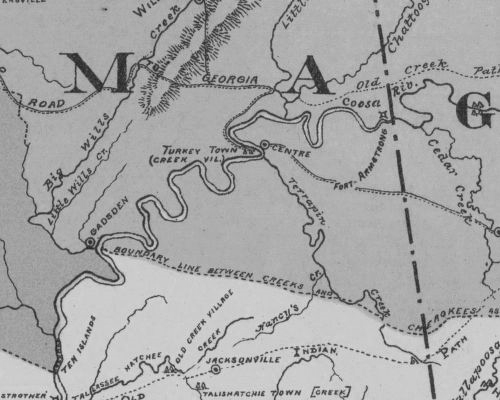
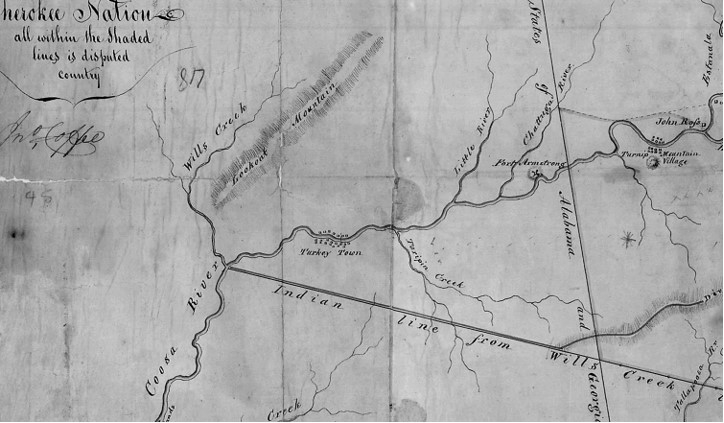
Map by which the Creek Indians gave their statement at Fort Strother on the 22nd Jany, 1816, Alabama Georgia, https://www.loc.gov/item/2007626786/.. Map is used to set new boundaries. Library of Congress Geography and Map Division Washington, D.C. 20540-4650 USA dcu

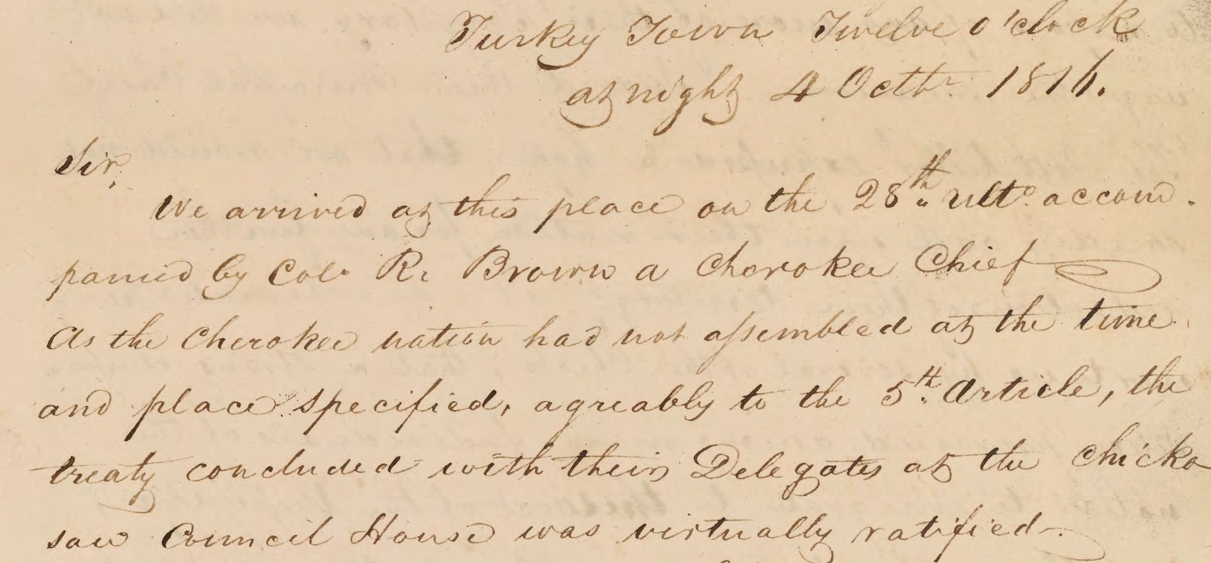
The delegation of the Cherokees did not like the boundaries that were set. This delegation did not include Chief Pathkiller. They stated they were not prepared or notified as to the nature of the meeting. The delegation left the meeting. They set a new date to be presented to the whole nation and Chief Pathkiller. The Cherokees deferred it to a meeting at Turkey’s Town for ratification. They met at the Turkey Town Council House on 4 October 1816. The United States delegation included Major General Andrew Jackson and General David Meriwether. Jesse Franklin, Esq., served as Commissioner. James Gadsden was the Secretary to the Commissioner. Return Meigs and Richard Taylor, as well as A. McCoy, acted as interpreters. Signing for the Cherokee’s; Pathkiller, The Glass, Sour Mush, Chulioa, Dick Justice, Richard Broom, Boot, and Chickasawlua.5

General Andrew Jackson’s delegation arrived at Turkey’s Town on 28 September 1816. All of the Cherokees had not arrived. They would assemble on 4 October. The speech was given by Jackson. He reviewed the information from the meeting at the Chickasaw Council House. Chief Pathkiller did not want to give up any more territory. 6

Image 112, 7

At midnight on 4 October 1816, Andrew Jackson and David Meriwether dictated a letter to be sent to William H. Crawford, Secretary of War with a summation of the treaty and other comments. In this letter at image 113, they talked about the removal West of the Mississippi. Several Chiefs inquired about the effects on the nation.

 It was internalize to us however several of the chiefs that a strong disposition prevailed among many individuals of the nation to emigrate to the west of the Mississippi and they wished to know whether in the event of national removal it was practicable to effect an exchange with the General Government. . .8

The US will gain territory. This will set in place, along with the treaties of 1817 and 1819 the creation of the State of Alabama. The boundaries are best viewed on John Melish’s 1819 map of the State of Alabama. https://www.loc.gov/item/gm71005414/

Mission Schools

A US citizen, Reverend Cyrus Kingsbury observed the signing of the ratification of the treaty on 4 October 1816. He had asked permission to attend to make a plea to set up schools in the Cherokee Nation. He wrote to Reverend Samuel Worcester. Both were a part of the American Board of Commissioners for Foreign Missions.  Kingsbury advised Worcester about the event and his progress in establishing a Mission School.

Kingsbury to Worcester;

It was now twelve o’clock at night and they had been in session two to three days, But they concluded to give me an answer that night, after a short consultation one of the principal Chiefs, took me by the hand very affectionately, said I had appeared in their full council they had listened to what I said and understood it. They were glad to see me that they wished to have the school established.9

This would give the consent to move ahead for schools. It would create what became the Brainerd Mission. This was the base of operations for the American Board of Commissioners for Foreign Missions (ABCFM). They ministered to the Cherokee people. It was located near the Tennessee River along a track of land at the Chickamauga Creek. Nowadays this is Chattanooga Tennessee. From this Headquarters, they would place mission schools at Wills Town, and Creek Path in what is now Alabama. They sought permission to put a school in Turkey’s Town. That was approved, but did not happen.

From the Bio on the website; The Brainerd Mission, University of Tennessee, Chattanooga.

The ABCFM tasked Reverend Cyrus Kingsbury with founding the mission. He received permission from both the President of the United States and the Cherokee Nation in 1816 to start the school. For land, Kingsbury purchased a plantation in what was known as ‘Chickamauga Territory’. He paid 500 dollars for 25 acres of land. The mission officially opened in March of 1817 as the Chickamauga Mission. However, as Chickamauga territory was so expansive, the name was deemed too unspecific. In 1818 the name was changed to Brainerd Mission, in honor of prominent missionary David Brainerd.10

Image in the Penelope Johnson Allen Collection, UT Chattanooga,11

The Brainerd Mission closed in August 1838. This happened due to the forced removal of the Cherokee people on the Trail of Tears.  All but two of the missionaries went west with their Cherokee congregation.12 One of the missionaries to survive on the Trail of Tears was Rev. Daniel Butrick. He has been quoted in this work. His journal and book are valuable to this work.13

Conclusion

A treaty is ratified. Permission for schools is granted. But lots of questions persist. General Jackson came with a delegation of Commissioners. Who was his escort? How many soldiers made up this escort? Were they the US Army or the Tennessee Volunteers? Captain John Hutchings is in charge of the supplies14. Lots of people are on the banks of Turkeytown Creek. Where did they camp?

We will leave Chief Pathkiller here. The “King” and his accomplishments are significant to the Cherokee Nation. They became more progressive during his reign. Henry Thompson Malone provides an excellent overview of this in his book. The book is titled Cherokees of the Old South A People in Transition. Refer to Chapter 6, A Republic is Born, on pages 74-90. Some of the nation’s accomplishments during his reign and while he was the Second Beloved Man. The National Council adopted a written legal code on 11 September 1808. District Judges and a council preside over hearings on local matters. A National Superior Court. A National Constitution. The establishment of mission schools is described above. The above treaty of 1816. Chief Pathkiller will be involved with the Treaty of 1817 and 1819.

Several recorded that due to his age, he was just a figurehead. The emerging mixed-bloods were taking charge of the nation. One example is his second, Charles R. Hicks. Chief Pathkiller, the last of the full-blood Cherokee Chief of the Nation, was still an influence.

Next we will briefly discuss Chief John Ross. The Beloved Chiefs From Turkey’s Town.

  1. https://northcarolinahistory.org/encyclopedia/john-sevier-1745-1815/ ↩︎
  2. https://www.ncpedia.org/biography/strother-john ↩︎
  3. Jackson’s White Plumes, An Historic and Genealogical Account of Selected Cherokee Families who Supported Andrew Jackson during the Creek Indian War of 1813-1814, Charlotte Adams Hood, Lavender Publishing Company, Bay Minette, Alabama, 36507,1995, pages 65-67 ↩︎
  4. National Archives, Record Group 11, General Records of the United States Government, Series Indian Treaties; RIT #83; Ratified Indian Treaty #83, Cherokee, Chickasaw Council House September 14, 1816, There are 231 images of this with correspondence of letters and a journal. https://catalog.archives.gov/id/100220646 ↩︎
  5. Ibid, Images 1-10.
    ↩︎
  6. Ibid, Images 110-112 ↩︎
  7. Ibid, Image 112 ↩︎
  8. Ibid, image 113 ↩︎
  9. American Board of Commissioners for Foreign Missions Boston MA
    Unit 6 – Missions on the American Continents and to the Islands of the
    Pacific18.3.1 (Cherokee Mission) Vol 3, item 1,Records at Houghton Library, Harvard University. From Microfilm Reel 738 ↩︎
  10. https://findingaids.utc.edu/agents/corporate_entities/17 ↩︎
  11. https://digital-collections.library.utc.edu/digital/collection/p16877coll7/id/32/rec/6 ↩︎
  12. Ibid ↩︎
  13. Cherokee Removal: Journal of Reverend Daniel S. Butrick, Trail of Tears Association-Oklahoma Chapter; Fulll Title: Cherokee Removal: Journal of Reverend Daniel S. Butrick May 19, 1838 – April 1, 1839, various pages from the miscellaneous files of Reverend Daniel Sabin Butrick, 1822, Michael Wren personal collection. ↩︎
  14. National Archives, Record Group 11, General records of the United States Government, Series Indian treaties; RIT #83; Ratified Indian Treaty #83, Cherokee, Chickasaw Council House September 14, 1816, Image 39 ↩︎

Trust in the Lord with all your heart, and do not rely on your own understanding; in all your ways know him, and he will make your paths straight. Proverbs 3: 5-6 CSV

The Beloved Chiefs From Turkey’s Town, Chief Pathkiller, The King

01 Tuesday Jul 2025

Posted by Jeffrey Sauls in Local History

≈ Leave a comment

Tags

alabama-history, cherokee-indians, Chief Pathkiller, native-americans, northeast-alabama-history, Pathkiller, trail-of-tears, turkeytown

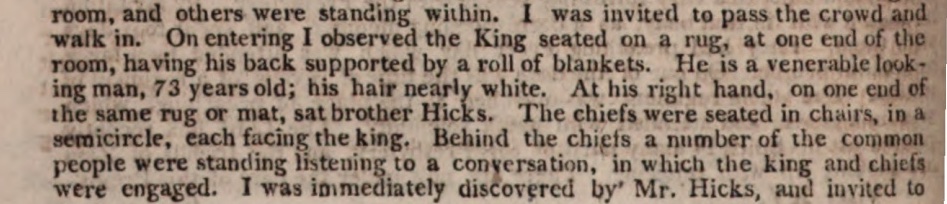
A description of Chief Pathkiller at Charles R. Hick’s house on 2 November 1818 by Rev. Ard Hoyt.1

King

The term “King” was applied to the principal Chiefs of the Cherokee by Europeans and Spaniards. The Cherokees did not have a title for the “Beloved Headman”. The title of Principal Chief is used today for the leader of the nation. Since there was no word, the Europeans and Spaniards used Chief and King. This was a way for them to relate to the leadership of the nation. The white people then used “King” or “Principal Chief” as the title for Chief Pathkiller.

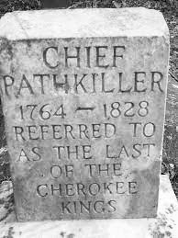
The above journal is one example. There are several references using “King”. Reverend Daniel Butrick refers to Chief Pathkiller as the King in his journal in 1822. The grave stone had “Path Killer The last King of the Cherokees.”

Chief Pathkiller had influence, but, was the leader of the nation only in title. After Chief Black Fox died in 1811 Chief Pathkiller became Principal Chief. In late 1811 the Cherokee Nation adopted a National Council. Dr. Susan Abram, in her doctoral thesis, wrote;

The Cherokee National Committee, which conducted the nation’s affairs in this volatile atmosphere, informed Meigs of its newly appointed membership, on 18 November 1811. The group was composed predominately of younger headmen, including Charles Hicks, The Ridge, Seekickee, John McIntosh, John Walker, John Lowry, George Lowry, John McLamore, Duck, Wasausee, Sour Mush, and Chulioa. John Ross served as the thirteenth member of the committee and its clerk. Most of these men, while relatively young, had served their people for many years as warriors, headmen, lighthorse regulators, and Cherokee representatives to the Cherokee Indian Agency. The committee, which answered only to the “old Chiefs” of the Cherokee National Council, dealt with the nation’s everyday business, collected the annuity, and would soon become instrumental in determining the Cherokee course of action in the time of war soon to come.2

Chief Pathkiller is now the “King” or Principal Chief of the nation, and they are in transition. The progressiveness of mixed blood is now an influence on the nation. The Cherokee have settled into the practice of farming. At the beginning of Chief Pathkiller’s tenure, war is brewing. The Shawnee from the north urges the Southern Indians. They want them to join a coalition to fight the “whites”. The Cherokee walk away and want no part of the war. They see no benefit in fighting. The Chickasaw and Choctaw walk away as well. The Americans and British have their own conflict starting again. The Shawnee go home. This leaves the Creek with a civil war of their own. The Red Stick faction is created.

The War Within a War

The British and Americans were at war with each other again. (War 1812). This weighed heavy on Chief Pathkiller and the decision makers of the Cherokee. Which side to take was not an easy choice. Just south of them was going to make the decision for them.

On July 23, (1813) Cherokee principle chief Path Killer had several head men from the Creek Path area to write to Meigs of the “rebellion in the Creek Nation” and that the Red Sticks were “endeavouring to brake [sic] the chain of friendship between the U.S. & that Nation.” They further relayed that the national Creeks had sought assistance against possible attacks by the Red Sticks on Coweta and Cusseta. They warned Meigs that, in their estimation, their situation was dire: 

It appears that the situation of our villages on the borders of the Creek Nation is not altogether safe, as we have been advised by the Big Warrior & his friendly Chiefs, to furnish ourselves with guns. To be guarded against the rebellious Creeks, that they should be suppressed, in case an attempt to invade our Country. A number of Creeks of the Natchez tribe have come to Turkey’s Town for refuge from the merciless rebels their friendly disposition towards the US. Appears to be usually firm, their number consists of nearly 200 men besides their women & Children. We hope the White People will not think that we have suffered those Indians to come amongst us with any hostile intentions towards them, as they are part of those who have suffered their friends & relations to spill their blood in giving satisfaction to the US. For the murder which was committed on the Ohio.3

Friendly Creeks have moved into Turkey’s Town. They have sought refuge there. A fort is created around the residence of Chief Pathkiller. By September of 1813 the Cherokee have joined forces to combat the Red Sticks.

Chief Pathkiller would receive a commission as Colonel. He never left Turkey’s Town. He did not fight in a battle. His age would not allow him to. He would be about 68 years old (1745). By the end of October 1813 Turkey’s Town is threatened with being attacked. Chief Pathkiller sent a letter to Andrew Jackson. He explained the issues. Jackson sent a letter to William Blount, Governor of Tennessee.

Two runners arrived here yesterday, from the Path Killer bringing the information that the hostile Creeks, were assembling in considerable numbers within 15 or 20 miles from the Turkey Town. . . .it is probable we shall have a fight, if the creeks means to fight us.4

Turkey’s Town was never attacked. The first battle for the Tennessee Volunteers and Cherokees was at Tallasahatachee near the Ten Islands. Supplies and food was taken by the Volunteers from the Cherokee people living in Turkey’s Town. Not even the Chief or King Colonel Pathkiller was safe from the looting. Chief Pathkiller would have Chief Charles Hicks file claim for losses in 1814.

By the end of March 1814 the battle of Horseshoe Bend will take place, and the Red Sticks defeated. This will bring an end to the Creek uprising.

The recovery for Turkey’s Town would take place. The 1814 War Claims would seek retributions from the United States with the losses of the Cherokee people. In the section already posted about the location Chief Pathkiller’s claim is shown. Chief Charles Hicks also files claim for friendly Creeks from Coosahattchee. See Location by the Cherokee People.

The Aftermath

The Chickasaw and the Cherokee can not come to an agreement on boundaries. Next post. Chief Pathkiller and the Turkey Town Treaty of 1816.

  1. The Pansophist, and Missionary herald. v. 15 (1819). Journal of the Mission at Brainerd, page 42. https://babel.hathitrust.org/cgi/pt?id=nyp.33433068276272&view=1up&seq=64&q1=King ↩︎
  2. “SOULS IN THE TREETOPS:” CHEROKEE WAR, MASCULINITY,  AND COMMUNITY, 1760-1820 
    Susan Marie Abram, A Dissertation, Submitted to the Graduate Faculty of Auburn University 
    In Partial Fulfillment of the Requirements for the Degree of Doctor of Philosophy Auburn University 
    August 10, 2009, page 97 ↩︎
  3. Ibid, page 104 ↩︎
  4. Jackson’s White Plumes, An Historical and Genealogical Account of Selected Cherokee Families who Supported Andrew Jackson during the Creek Indian War of 1813-1814, Charlotte Adams Hood,1995, Lavender Publishing Company, page 32 ↩︎

Trust in the Lord with all your heart, and do not rely on your own understanding; in all your ways know him, and he will make your paths straight. Proverbs 3: 5-6 CSV
The Beloved Chiefs From Turkey’s Town, Chief Pathkiller, his family

17 Tuesday Jun 2025

Posted by Jeffrey Sauls in Local History

≈ Leave a comment

Tags

alabama-history, cherokee-indians, Chief Pathkiller, native-americans, New Seneca, northeast-alabama-history, Pathkiller, trail-of-tears

Mr. R. S. Cotterill states in the Preface of his book, “The Southern Indians”; 

“The Southern Indians . . .the records of their history are records by whites and are marred by prejudices and misunderstandings.1

The above statement is so true. When we review Chief Pathkiller on genealogical websites, the information is so confusing. It is full of speculations, misunderstandings, incorrect information, and made-up fill-ins. It is worth stating again that Pathkiller is not a surname. That everyone who is referred to as Pathkiller is not the King, or Principal Chief Pathkiller (Principal Chief 1811-1827). That they are not all related as family. What can be proven? The genealogical websites have very few historical source citations. Most of what is referred to is from a modern-day history article. Some are from history books. What can be proven?

Proven

Chief Pathkiller’s parents can not be proven. They are unknown. Shelia Ford, a descendant of Nancy Ward, led me to new information on Moytoy. “Nunnadihi Pathkiller, Pathfinder Moytoy is a fictional name for the real Pathkiller.” 2

“In the summer of 2018, the Cherokee Heritage Center removed all mention of an alleged Moytoy family from their website. They determined that the fictional Amatoya/Amadoya Moytoy had not existed. James Hicks, from whom the incorrect information appears to have come, had hypothesized that all Cherokee came from a single ancestor. He named that fictional ancestor Amatoya/Amadoya Moytoy with no evidence or documentation whatsoever.” 3

If Chief Pathkiller’s parents are unknown, what can be proven about his family?

Chief Pathkiller has at least three wives.

The first wife’s name is unknown. They had three sons and one daughter. These children show up in historic documents and are not guesses. The first son is Bearmeat. It must be stated again that not everyone whose name is Bearmeat is the son of Chief Pathkiller. There are discussions on genealogical websites. They include correspondence of Chief Pathkiller talking about his son in the Creek War (1813-1814). Several of them state this must be Pathkiller II or Junior. There is no Pathkiller II or Junior as a son.

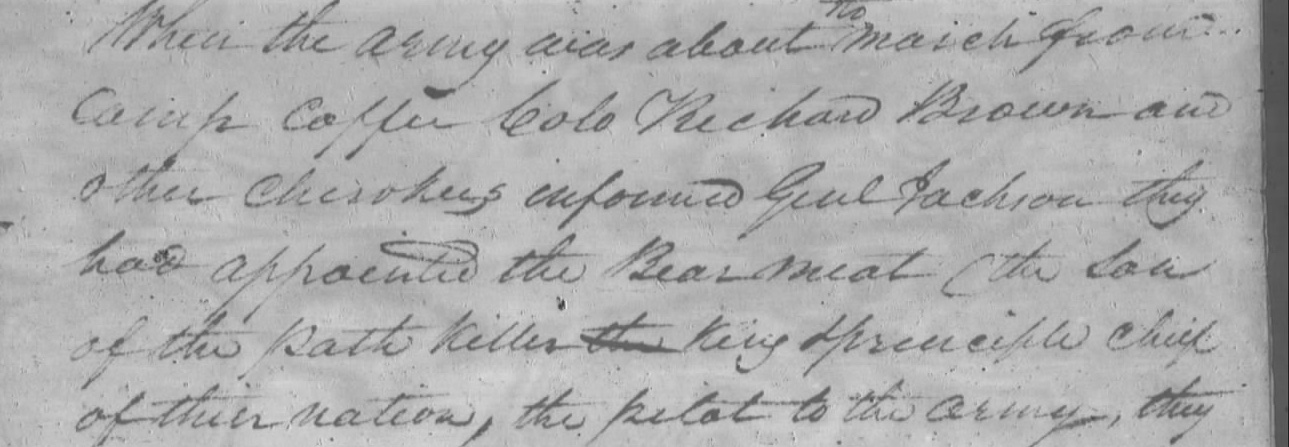
Bearmeat served under Gen. Cocke with Gen. Andrew Jackson in the Creek war. Bearmeat served as a scout for General Cocke. Gen. Cocke wrote a letter commending Bearmeat. “the son of the old Path Killer known by the name of Bear meat,.”4

Major Robert Searcy in a letter to Gen. John Coffee commends Bearmeat as well; “Bearmeat the son of the Path Killer king & principle Chief of their nation.”5

Bearmeat settled in the Creek Path (Guntersville, Alabama). He would have his own town Southwest of Creek Path.

Whitemankiller is another son. He is reported in Richard Blount’s journal while surveying the Georgia-Alabama boundary. “1 September 1826 met a Cherokee named Whitemankiller, wife, and daughter. . . Charles Hicks had sent a runner to his father Pathkiller.”6

James Lasley states the names of Whitemankiller’s children with their mothers in a deposition about their reservation. Lasley stated that Whitemankiller died in 1823 on his reservation at Turnip Mountain, Coosa River, Georgia. Whitemankiller’s family was disposed of the 320 acres in 1834-35. Lasley states his death date is “best of my recollection”. The dates conflict. This creates a plausible date of after 1826 and before the forced removal from the land of 1834.

 “ Soo-wagi . . . Tahnuh-cas-tat-he, Oo-nee-skoo-koo and Thi-ah-muh-nuh children of White Man Killer and Joh-Ke-die;: Tee-sak-ni whose mother is deceased and Jackson, Mary heir of Buck Deceased;: Scott and Choo-wah-nas-kee and Peter children of Whit Man Killer and Yoo-yas-ki also decease.”7

A final son Tah-ka-ha-kee is listed on the Rice and McCoy/Rawlings and Massey’s Valuations, Claims, Cherokee County, Alabama, claim #44, property valuations, entry 224; Records of the Bureau of Indian Affairs, Record Group 75; National Archives Building, Washington, DC.

“Of the remaining portion, Crying Snake received 1/8th, Hughston (Houston) received 2/8th, Tarkaga (Tah-ka-ha-kee) received 1/8th, and the final 1/8th went Nancy (Pathkiller), Crying Snake’s mother.”8 John Ridge received the other 3/8. This is with Chief Pathkiller’s estate on the Coosa River (Centre, Alabama, Garrett Ferry).

Tah-ka-ha-kee is not mentioned in any of Peggy’s estate.

Unknown named daughter, sister to Bearmeat

 Ahnoah stated in her Chatoogga District Court deposition that Bearmeat was her uncle. Cherokee culture would place Bearmeat as the brother of Ahnoah’s mother.                                                                                                  

Plaintiffs witness May 26th 1830 Ahnoah Deposeth and saith that she was living in the neighborhood of Gunters Landing when her uncle the Bears Meat told her that the Pathkiller wanted her the Deponent to come and live where the Pathkiller was clearing a place on the Couse River on the West Bank at Pathkillers Ferry so called; the Pathkiller told her that he would get some young men to build some houses, and bout one year after the Pathkiller brought the Hammer there with his mother the Pathkillers wife.9

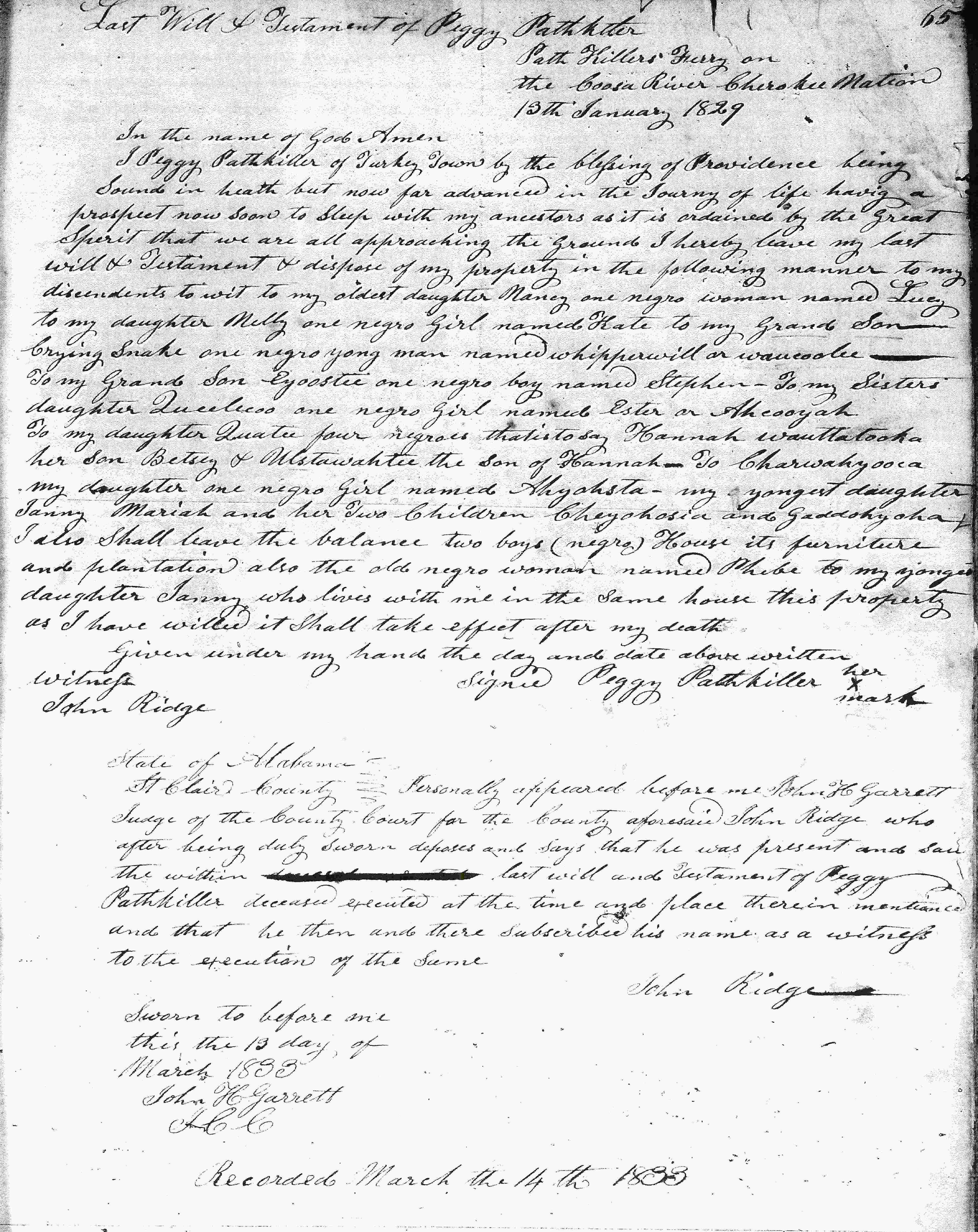
Wife Peggy a Cherokee woman

Peggy is one of Chief Pathkiller’s wives. She has a will drawn up for her in 1829. Did issues over Chief Pathkiller’s estate at the new ferry cause this? Were improvements at the new ferry a factor in needing “White man’s court?” A lot of the genealogical websites have her death date based on this record. The “will” was submitted on 13 March 1829. Chief Pathkiller died in 1827. Issues with his estate (Garrett Ferry, Centre, Alabama) went to court in May 1830. Peggy’s will was probated on 14 March 1833.10

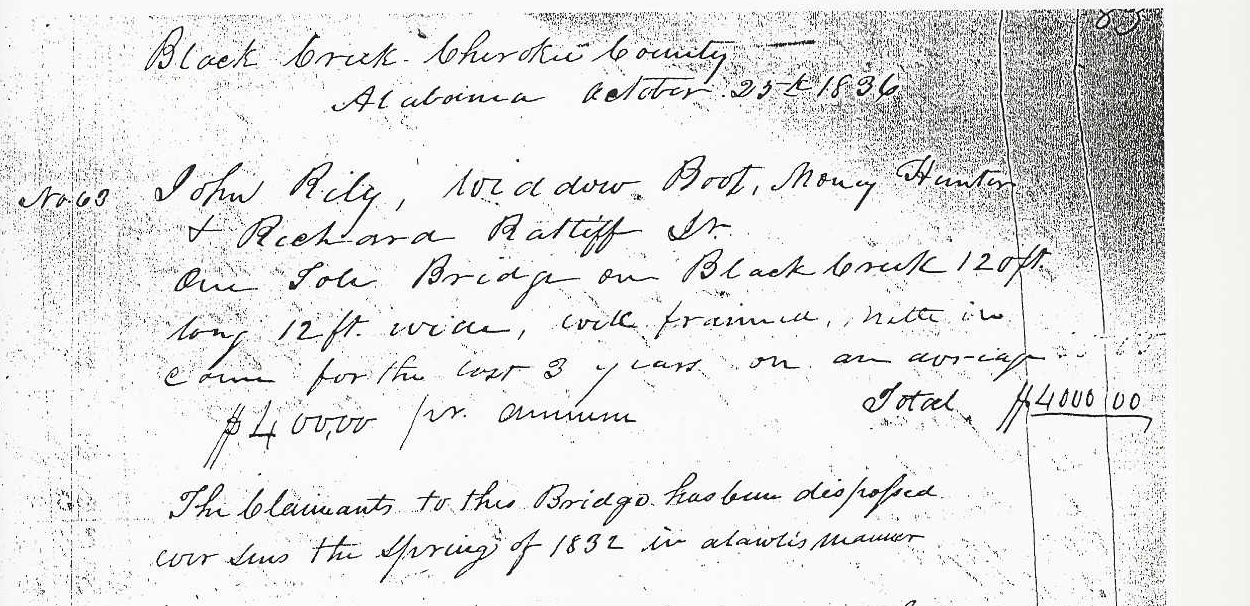
Peggy is listed as part-owner of a ferry near Turkey’s Town. It states they were “dispossessed since the spring of 1832”. She died sometime between this time and March 1833. She is buried somewhere on the property.

George Chambers, John Ratliff, Daniel Griffin Jr., and Peggy Pathkiller Sr were joint owners of a Ferry on the Coosa River in Turkey Town Valley, Cherokee County.  The Valuations gave an average annual income of $100.00.  Included with this Valuation were a 16’x14’ house and a 10-acre field of bottom land under fence.  The Claimants were dispossessed since spring of 1832.11

Five Daughters

We have discussed Nancy. To review. Nancy is listed in Peggy’s will “to my oldest daughter Nancy“. Nancy’s sons Crying Snake and Eyoostee, also known as Houston are listed in the will; “To my grandson Crying Snake. To my grandson Eyoostee.”

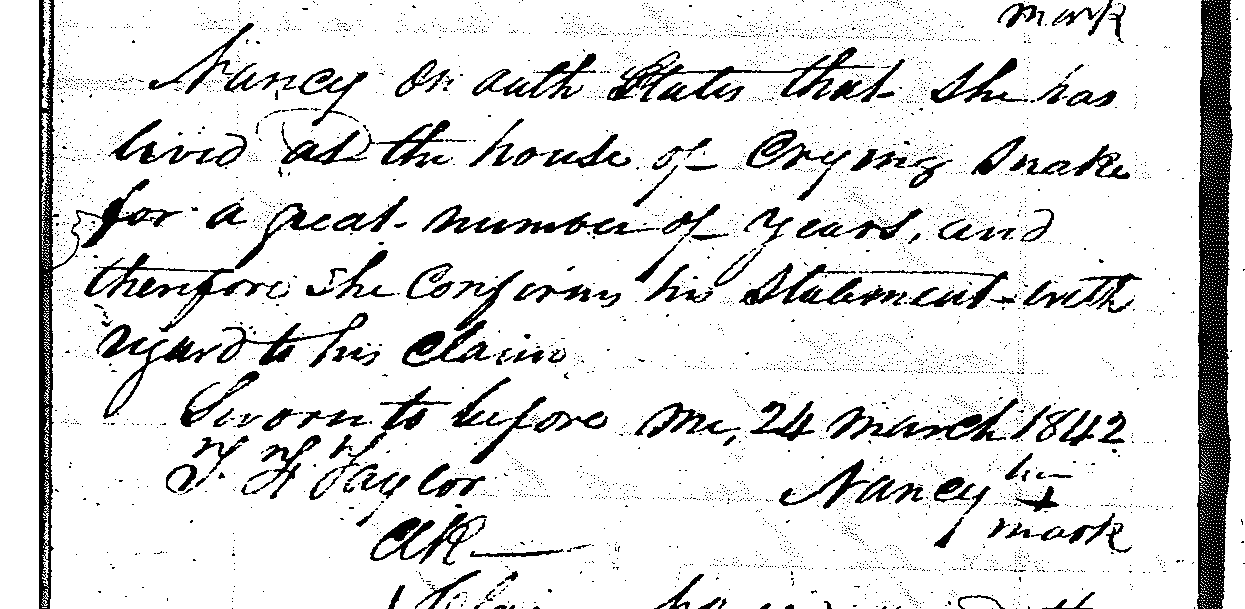
Nancy on oath states that she lived at the house of Crying Snake for a great number of years, and therefore she confirms his statement with regards to his claim.12

Register of Payments, Book A. Page 14; Crying Snake and Nancy are paid for their portions of Pathkiller’s ferry; #12, Crying Snake, Alabama, Ferry on the Coosa, share of C. Snake $796. 87 ½   Sent West Jany 1839; #13, Nancy. Crying Snake’s mother.   Ferry on Coosa, Share for Nancy $796. 87 ½  Sent West Jany 1839.
 
St Clair County; Special Orphans Court, October 1833, page 241; October 31st 1833. . .  settlement had on the Estate of Peggy Pathkiller Deceased the papers and vorchers being filed in office. . . Nancy one of the heirs receipt $455.00. Crying Snake one of the heirs receipt $450.00.  Eustee one of the heirs receipt $300.00. 13

Nancy Pathkiller, Crying Snake, and Houston are listed in the Captain John Benge14 Detachment. They left Fort Payne in September 1838. They arrived in the West in January 1839 on the “Trail of Tears”.

Nelly or Nella is listed in Peggy Pathkiller’s will; “to my daughter Nelly. . .”15

Special Orphans Court, October 1833, page 241; October 31st 1833. . . settlement had on the Estate of Peggy Pathkiller Deceased the papers and vorchers being filed in office. . . Nelly one of the heirs receipt $375.00 16

Nelly is possibly the N. Pathkiller of Turkey Town listed in Forman’s 1835 Cherokee Census.  She is listed on page 80; 5 fullbloods, one farmer, 3 readers of English, 1 weaver, 1 spinster (spinner).Nelly is listed in the Benge Detachment for the “Trail of Tears”.  Nelly has a daughter named Anna. Anna married Frances Hampton.

Quatee is listed in Peggy Pathkiller’s will; To my daughter Quatee. .  .17

Special Orphans Court, October 1833, page 241; October 31st 1833. . . settlement had on the Estate of Peggy Pathkiller Deceased the papers and vorchers being filed in office. . . Quata one of the heirs receipt & George Campbell one of the heirs} $1200.00.18

Quatee married George Campbell. George Campbell is listed on the Lieutenant Edwards Deas detachment. They left for the West on 6 June 1838. Their departure point was near Ross Landing on the Tennessee River.19

Charwahyooca is listed in Peggy Pathkiller’s will; to Charwahyooca my daughter. . .20

Special Orphans Court, October 1833, page 241; October 31st 1833. . . settlement had on the Estate of Peggy Pathkiller Deceased the papers and vorchers being filed in office. . . Charwahyooca and Richard Ratliff receipt $300.0021

She married Richard Ratliff Jr. Richard Ratliff Jr. is listed on the Lieutenant Edwards Deas detachment. They left for the West on 6 June 1838 near Ross Landing on the Tennessee River. 22

I will share more on the Ratliff family. Not because they married into Chief Pathkiller’s family, but their involvement in the Turkey’s Town Story.

Jenny is listed in Peggy Pathkiller’s will; my youngest daughter Jenny. . .I also Shall leave. . .House its furniture and plantation. . .who lives with me in the same house this property. . .23

Special Orphans Court, October 1833, page 241; October 31st 1833 . . . .settlement had on the Estate of Peggy Pathkiller Deceased the papers and vouchers being filed in office. . . Jenney one of the heirs receipt $1188.60 24

Jenny “Jane” Pathkiller was listed in the Captain John Benge Detachment. They left Fort Payne in September 1838. They arrived in the West in January 1839 on the “Trail of Tears”. 25

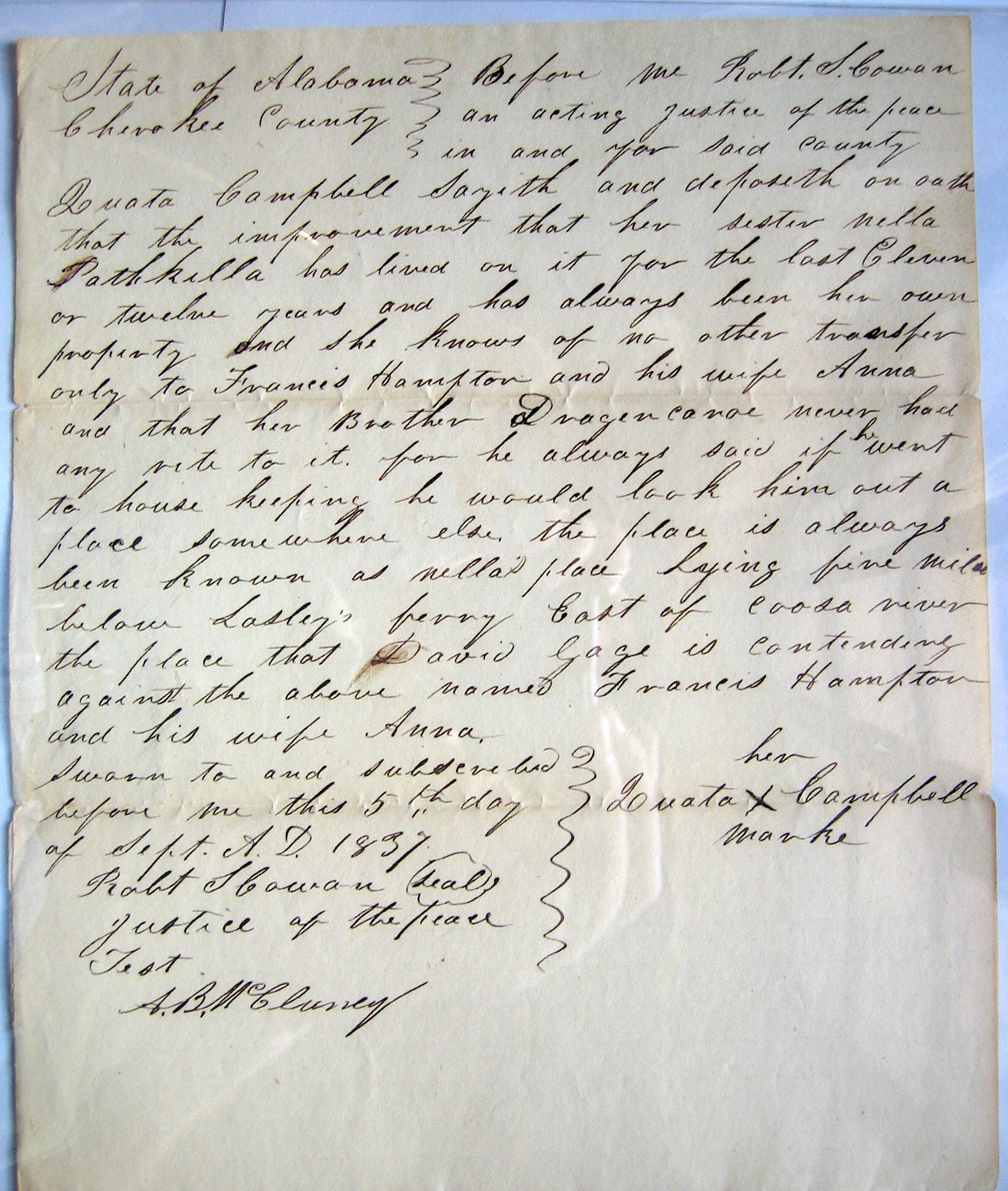
Dragging Canoe. He is not to be confused with the Chickamaugan Chief who died in 1794. He is the only male sibling of the women above. The girls named him in affidavits about Anna Hampton’s improvement claims in 1837 as their brother. Anna is the daughter of Nelly.

26

Dragging Canoe died before August 1829. The heirs with the Administrators of his estate sued in the Cherokee Supreme Court his mother, Peggy. This was over slaves Simon and Phoebe with her children, and some other property. St Clair County, Alabama Orphans’ Court Records show that James G Carrol received the appointment as Administrator. He was responsible for the estate of Dragging Canoe. Dragging Canoe was a Cherokee. The appointment was made in the 1833 term (page 207). Also appointed were David Gage, Thomas Machen, and James C Street.27 They were appraisers of the estate. There are no copies of the estate records on the internet.

Dragging Canoe may have been murdered. Chief Pathkiller complained to Rev. Daniel Butrick in 1822 about the murder of a son. His complaint was that the US President had done nothing about it. Butrick’s Journal. This will be discussed further in a discussion on Charles, Chief Pathkiller’s nephew. Charles was murdered in 1821.

Dragging Canoe was married to Watty, a Cherokee Woman. He had a son, Sky-ah-too-ka, and a daughter, Martha. Sky-ah-too-ka contested the improvements claimed by Anna Hampton. You can review this by looking back at the section, “Location by Chief Pathkiller’s family”.

Third Wife

Oo-loo-cha, a Cherokee Woman. 

“Ahama, or Hammer, the son of Oo-loo-cha”

“after the treaty of 1819, she (Oo-loo-cha) married Path-killer the chief of the nation and she abandoned her reservation and moved with him to Turkey-town”. 28

Conclusion

“My granny says that her granny was a Cherokee Princess.”

The information on the genealogical website for Chief Pathkiller is full of folklore, family traditions, and wishful thinking. The sources are written histories. Some are just stories. One needs to ask, “How do you know this?” “What is the source?” I hope what you have read here helps explain the proven family of Chief Pathkiller.

We will continue the discussion on Chief Pathkiller. The Beloved Chiefs from Turkey’s Town, Pathkiller, the Last King of the Cherokees. Next time.


  1. The Southern Indians, The Story of the Civilized Tribes Before Removal”, R. S. Cotterill, Norman and London, the University of Oklahoma Press, 1954, page IX Preface.
      ↩︎
  2. https://www.familysearch.org/en/tree/person/collaborate/LY36-VTS ↩︎
  3. https://www.indianreservations.net/2017/10/moytoy-of-tellico-emperor-of-cherokee_22.html#google_vignette ↩︎
  4. Hargrett Rare Book and Manuscript Library, The University of Georgia Libraries, Telamon Cuyler Collection, Box: 77, Folder: 30, Document: 02. ↩︎
  5. Fold3 Ancestry.com, Correspondence and Miscellaneous Records; page 271-274, Records of the Cherokee Indians Agency in Tennessee 1801-1835, Record Group 75, National Archive ↩︎
  6. Richard Blount’s Papers, Alabama State Archives, digital.archive.gov site, page 9 August 30-September 6, 1826 ↩︎
  7. 4th Board Claims, Entry 250, Image 199; Records of the Bureau of Indian Affairs, Record Group 75; National Archives Building, Washington DC. ↩︎
  8. Rice and McCoy/Rawlings and Massey’s Valuations, Cherokee County, Alabama, #44; Property Valuations, Entry 224; Records of the Bureau of Indian Affairs, Record Group 75; National Archives Building, Washington, DC. Annual Income $1,460.00 based on certificates of David Vann, James Lasley, Wm Childers and John Fields. Of the amount allowed Ridge received 1/8th of the whole for ferrying, 1/2 of the remaining balance, 3/8 of the other half. Of the remaining portion, Crying Snake received 1/8th, Hughston (Houston) received 2/8th,Tarkaga (Tarkahagee) received 1/8th, and the final 1/8th went to Nancy (Pathkiller), Crying Snake’s mother. This is the present-day Garrett Ferry site 1 mile South of Centre on the Coosa River. Now County Road 20.  ↩︎
  9. Penelope Allen Johnson Collection, University Tennessee Knoxville, Series V, Box 1, FOLDER 201 ↩︎
  10. https://www.pellcitylibrary.com/wp-content/uploads/2022/03/Native-Americans.pdf Pell City Library, Court Records Links, Estate Book B, Page 65, Page 23 in the library document. ↩︎
  11. Rice and McCoy/Rawlings and Massey’s Valuations, Cherokee County, Alabama, #49; Property Valuations, Entry 224; Records of the Bureau of Indian Affairs, Record Group 75; National Archives Building, Washington, DC.  The $1,100 total allowance was divided among the four partners.  ↩︎
  12. Manuscript Collection #1787, Box 16, Folder 1 Tennessee State Library and Archives Microfilm Collection 815, Reel 6, Flint District Claims, Claim #10, Crying Snake’s portion of claim is missing from the file. ↩︎
  13. https://www.pellcitylibrary.com/wp-content/uploads/2022/03/Native-Americans.pdf Pell City Library, Court Records Links, Orphan Court March fifth 1833, Orphan Court Book, page 241, 1827-1844. Page 19 in the library document. ↩︎
  14. Hargett, J. L.. Muster roll of John Benge detachment. 4026.707. John Ross Papers. September 28, 1838. Tulsa: Gilcrease Museum, https://collections.gilcrease.org/object/4026707 (02/19/2018). ↩︎
  15. https://www.pellcitylibrary.com/wp-content/uploads/2022/03/Native-Americans.pdf Pell City Library, Court Records Links, Estate Book B, Page 65, Page 23 in the library document. ↩︎
  16. https://www.pellcitylibrary.com/wp-content/uploads/2022/03/Native-Americans.pdf Pell City Library, Court Records Links, Orphan Court March fifth 1833, Orphan Court Book, page 241, 1827-1844. Page 19 in the library document. ↩︎
  17. https://www.pellcitylibrary.com/wp-content/uploads/2022/03/Native-Americans.pdf Pell City Library, Court Records Links, Estate Book B, Page 65, Page 23 in the library document. ↩︎
  18. https://www.pellcitylibrary.com/wp-content/uploads/2022/03/Native-Americans.pdf Pell City Library, Court Records Links, Orphan Court March fifth 1833, Orphan Court Book, page 241, 1827-1844. Page 19 in the library document. ↩︎
  19. Cherokee Registry Trail of Tears-Deas detachment, Cherokeeregistry.com ↩︎
  20. https://www.pellcitylibrary.com/wp-content/uploads/2022/03/Native-Americans.pdf Pell City Library, Court Records Links, Estate Book B, Page 65, Page 23 in the library document. ↩︎
  21. https://www.pellcitylibrary.com/wp-content/uploads/2022/03/Native-Americans.pdf Pell City Library, Court Records Links, Orphan Court March fifth 1833, Orphan Court Book, page 241, 1827-1844. Page 19 in the library document. ↩︎
  22. Cherokee Registry Trail of Tears-Deas detachment, Cherokeeregistry.com
      ↩︎
  23. https://www.pellcitylibrary.com/wp-content/uploads/2022/03/Native-Americans.pdf Pell City Library, Court Records Links, Estate Book B, Page 65, Page 23 in the library document. ↩︎
  24. https://www.pellcitylibrary.com/wp-content/uploads/2022/03/Native-Americans.pdf Pell City Library, Court Records Links, Orphan Court March fifth 1833, Orphan Court Book, page 241, 1827-1844. Page 19 in the library document. ↩︎
  25. Hargett, J. L.. Muster roll of John Benge detachment. 4026.707. John Ross Papers. September 28, 1838. Tulsa: Gilcrease Museum, https://collections.gilcrease.org/object/4026707 (02/19/2018). ↩︎
  26. Records of the Bureau of Indian Affairs, Record Group 75; National Archives Building, Washington DC, E236 Misc Claims Papers Image 584 ↩︎
  27. https://www.pellcitylibrary.com/wp-content/uploads/2022/03/Native-Americans.pdf Pell City Library, Court Records Links, Orphan Court March fifth 1833, Orphan Court Book, page 207, 1827-1844. Page 18 in the library document. ↩︎
  28. Hammer filed a claim several times to be paid by the US government for the improvements after he was in the Arkansas territory. Minute Docket 4th Board of the 
    Cherokee, claim #24 Reservation 141, September 21, 1846, Records of the Bureau of Indian Affairs, Record Group 75; National Archives Building, Washington DC ↩︎

Trust in the Lord with all your heart, and do not rely on your own understanding;
 in all your ways know him, and he will make your paths straight. Proverbs 3: 5-6 CSV

The Beloved Chiefs From Turkey’s Town, Chief Pathkiller

03 Tuesday Jun 2025

Posted by Jeffrey Sauls in Local History

≈ Leave a comment

Tags

alabama-history, cherokee-indians, Chief Pathkiller, native-americans, northeast-alabama-history, Pathkiller, trail-of-tears, turkeytown

Chief Pathkiller, Proven, Not Proven

We continue to discuss the proven and not proven for Chief Pathkiller. We must discuss Robert Moore and Nancy Ann “Polly” Pathkiller’s story.

Some confusing information comes from a blog, THE LEGEND OF PATHKILLER, by Lee Standing Bear Moore and Takatoka;

During a war between the white man and American Indians between 1790 and 1803, in what would become the state of Kentucky, a band of Overhill Cherokee warriors of the Red Paint clan captured a group of white soldiers and brought them to their Chief Pathkiller. 

One of the captives was a young soldier by the name of Moore.  (His name may not have been Robert Alec Moore.) Chief Pathkillers’ pretty young daughter, who was attracted to the handsome Moore, put together a plan to free Moore. Pathkiller’s daughter gave up her Indian identity and married Moore.  Nancy Ann “Polly” Pathkiller-Moore and Robert A./Alec Moore had eight children
1

There are several issues with the story. Chief Pathkiller, Principal Chief of the nation, can not be proven as living in Kentucky. His daughter, Nancy, with Peggy, can only be proven to have lived in Turkey’s Town with her son, Crying Snake.

No source citations are provided with the Moore family story. However, the majority of the Genealogy websites use this information. Nancy, the daughter of Chief Pathkiller and his wife Peggy, did NOT marry Robert Moore. Notations of this Moore family in ancestry.com list Nancy Ann “Polly” Pathkiller dying in 1833, other sites state 1832.

Nancy, daughter of Chief Pathkiller, and wife Peggy, is still living at the time of the stated death. She is a witness for her son Crying Snake, on a claim in 1842. Until the Trail of Tears in 1838 she is living in Turkey’s Town. She states, “she lived at the house of Crying Snake for a great number of years.”  Nancy Pathkiller, Crying Snake, and Houston (Eyoostee) are listed in the Captain John Benge Detachment. They leave Fort Payne in September 1838. They arrive in the West in January 1839 on the “Trail of Tears”. 2

3

Listed in Peggy “Pathkiller’s” will;, Saint Clair County, Alabama, to my oldest daughter Nancy. Nancy’s sons are listed; To my grandson Crying Snake. To my grandson Eyoostee. 4

Other Documentation shows that Nancy is living passed the date of 1832. Register of Payments, Book A. Page 14; Crying Snake and Nancy are paid for their portions of Peggy’s ferry; 

#12, Crying Snake, Alabama, Ferry on the Coosa, share of C. Snake $796. 87 ½   Sent West Jany 1839; #13, Nancy. Crying Snake’s mother.   Ferry on Coosa, Share for Nancy $796. 87 ½  Sent West Jany 1839. St Clair County; Special Orphans Court, October 1833, page 241; October 31st 1833. . . This property claim was for the ferry where Chief Pathkiller died. (Centre, Alabama) 5 6  settlement had on the Estate of Peggy Pathkiller Deceased the papers and vorchers being filed in office. . . Nancy one of the heirs receipt $455.00. Crying Snake one of the heirs receipt $450.00.  Eustee one of the heirs receipt $300.00 7

The family never mentions a man named Moore. None of Nancy’s claims speaks of a Moore. Crying Snake and Eyoostee (he is also known as Houston) never speak of the Moore family. Clearly Nancy the child of Chief Pathkiller and Peggy never married a man named Moore.

Pathkiller I and Pathkiller II

Adding to the confusion are the incorrect dates on the foot stone at the burial site in Centre, Alabama. The dates of 1764-1828 are wrong. This has led many to add a Pathkiller Jr (Pathkiller II) and family. For example, the marriage of Susan “Sookie” Martin to Chief Pathkiller, the Chief of the nation. This does not disprove that Susan Martin married a Pathkiller. Yet, the likelihood of a Pathkiller Jr. son of Chief Pathkiller, is not culturally correct. No historical records of a son named Pathkiller Jr or Pathkiller II can be found. Except Pathkiller Junr as previously noted.  

The dates on the tombstone in Centre Alabama come from the Garrett family. Laura C. Blair and the Perry Funeral Home and Monument Company placed the stone in 1980. 8

Photo taken by this Researcher, Jeffrey Sauls. Foot stone at Garrett Cemetery, Centre, Alabama

She may have obtained the dates from Will I Martins’ Article from the Gadsden Times-News. First printed December 1951 and reprinted in the Coosa River News, 18 January 1952, page 1; 

“Last of the Cherokee Chiefs Buried at Centre”. 

            Fifth paragraph;

            A few years ago, Mrs. Jane Ingram, mother of Bob Ingram, sports editor of the Gadsden Times, wrote a history of Cherokee County for the Alabama Department of Archives and History and in it she gave some information about Chief Pathkiller that was authentic and very interesting.

            She said he was the last of the great chiefs of the Cherokee tribes. He was born in 1764. . . .      . . . lived in his old home near his ferry until his death 1828. He was buried in the family cemetery.

Mrs. Ingram does not give references for the dates. They are incorrect.

Eighth paragraph of Mr. Martin’s article;
            His grave was unmarked until a few years ago when Hugh Cardon. . conducted a drive to raise funds for replacing a monument at the grave of the great and good Indian leader

The confusing statement of Will I Martin; “His grave was unmarked until a few years ago. . .raise funds for replacing a monument. . .” is interesting. This article has several errors. It is a very poor source.

The Chief had a marker of some kind.

The Jacksonville Republican Newspaper in 1867 holds a reprint. This reprint is from an article that ran in the Gadsden Times-News in the first year of its publication, 1867. The article tells the story of the “Legend of Nahcullola or Black Creek Falls”. The story refers to Chief Pathkiller being “Laniska a young chief brave of heart and swift of foot, already distinguished in war and in peace.” (A name unsupported by any evidence in History. Chief Pathkiller would be in his 40s when he came to what is Turkey’s town in the mid-1780s). The footnotes are important references in this article. 

After a long life he was gathered to his fathers. He now sleeps on the banks of the Coosa, a few miles above Nahcullola. A rude stone marks the spot and on it is the simple inscription – –

PATH KILLER, The Last King of the Cherokees. Path Killer’s Grave is in Cherokee County, on the North bank of the Coosa near Mrs. Garrett’s ferry. 9

The statement in 1867 indicates there is a rude stone that marks the grave. Chief Pathkiller had an original stone marker placed at his grave before 1867. “Path Killer The last King of the Cherokees”. The contrast in the statements on the stones should be noted. The present-day stone states; “Referred to as the Last of the Cherokee Kings”. This evidence should prove the present-day stone is possibly the 3rd stone marking the Chief’s grave.   

Hugh Cardon also made this statement in the Coosa River News, 31 July 1936, page 2;

Tradition records that Pathkiller is buried on the Coosa River overlooking Turkey Town which appeared in the “Sentinel”, published in Cedar Bluff in 1841. 10

These early statements date back to 1841. They should provide solid evidence that Chief Pathkiller is buried in the Garrett Cemetery, Centre, AL. Is there further evidence that Chief Pathkiller is buried in the Garrett Cemetery? I will follow up on that. What about an estimated birth year and a death date?

Birth Year Estimate

There is only one historical document during the lifetime of Chief Pathkiller that gives us an estimated birth date.

A description of Chief Pathkiller at Charles R. Hick’s house on 2 November 1818 by Rev. Ard Hoyt;

On entering I observed the King seated on a rug, at one end of the room, having his back supported by a roll of blankets. He is a venerable looking man, 73 years old; his hair nearly white. 11

If the Rev. Hoyt is correct about the age, then the estimated birth year would be 1745.

Cherokee Historian Grant Forman describes the death date.

“Chief Pathkiller died, 8 January 1827 between 80-90 years of age”.  12

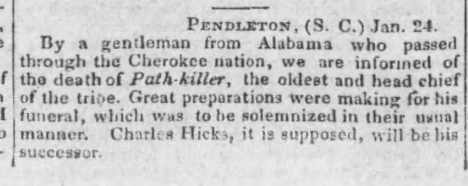
There are newspaper articles from the time period, of 1827 supporting the death date. 13

Also his death is recorded in “Records of the Moravian Among the Cherokees, vol. 7, pages 3582 and 3595; 3613-14 

14

But there is a grave for Colonel Chief Pathkiller in New Echota, Calhoun, Georgia.

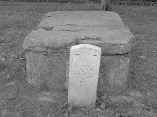
The state park of New Echota in Gordon County, Georgia, houses a burial site. It is marked by a US military stone. This stone was provided by the Veterans Affairs. The Women’s Club of Calhoun, Georgia, requested the stone with the assistance of US Congressman M. C. Tarver in 1931 15. The request did not have any citations. It only mentioned that Col Path Killer of Col Gideon Morgan’s Inf Reg, King of the Cherokees. The stone marking states Col Pathkiller, Morgan’s Cherokee Regt, War of 1812, 1742-1827. 16 The Chattanooga Daily Times, dated 27 Aug 1933, published in Chattanooga, Tennessee, features a photo on Page 30. It shows Robert Bruce Ross, the grandson of Chief John Ross, standing at the burial site of Col Pathkiller. The adjoining news article is about the arrest of the missionaries in Georgia. The tomb has a table rock encasement. No source citations were provided with the article or the application. 17 The military stone was ordered in 1931. The possibility of Chief Pathkiller being buried at this site is extremely low with the earlier proven information.

As of note. The grave site at the Garrett family cemetery is under consideration for certification as a Trail of Tears site. All paperwork is in process with the US Park Service Trail Division and National Trail of Tears Association. After certification, a formal correction to the dates will be placed at the grave site.

Proof Chief Pathkiller Died at His House

A court case at the Cherokee District Courthouse in Chattooga Town (North of present-day Gaylesville Al) provides information. It reveals where Chief Pathkiller was living when he died. Emphases added by this researcher.

Tah-ka-ha-kee & Crying Snake vs Robt Brown

     Plaintiffs witness May 26th 1830 

Ahnoah Deposeth and saith that she was living in the neighborhood of Gunters Landing when her uncle the Bears Meat told her that the Pathkiller wanted her the Deponent to come and live where the Pathkiller was clearing a place on the Couse River on the West Bank at Pathkillers Ferry so called; the Pathkiller told her that he would get some young men to build some houses, and bout one year after the Pathkiler brought the Hammer there with his mother the Pathkillers wife. 

How long did the Pathkiller settle at the ferry? Ans; He lived there until he died.

Did he ever move opposite? Ans; No 

Did he die where he was clearing? Ans; He died at the house.           

Which side of the river did the Pathkiller die? Ans On the East side 18

Conclusion

Nancy, the child of Chief Pathkiller and Peggy, never married a man named Moore. Chief Pathkiller died at his house (present-day Centre, Alabama). There is no Pathkiller I. There is no Pathkiller II. There is no son of Chief Pathkiller named Junior. Pathkiller Junr is a designation on a Treaty. It indicates that there are two Pathkillers who sign. One is younger than the other. It is not a family relationship.

Chief Pathkiller the King, Principal Chief of the Cherokee Nation 1811-1827 lived in Turkey’s Town. He was born about 1745 and died in his house on the Coosa River (present-day Centre, Alabama). The date was 8 January 1827. He was buried near his house.

We will continue to explore this, Chief Pathkiller. He had at least 3 wives at separate times. Who can be proven as his family? His first resident, ferry, and fort in Turkey’s Town. He was referred to as King. He was promoted a Colonel in the US Army. The Creek War. The Treaty that was ratified at Turkey’s Town in 1816. His involvement with the missionaries. The Beloved Chiefs From Turkey’s Town.

  1. “The Legend of Pathkiller”. Manataka American Indian Council website https://www.manataka.org this web does not exist anymore. It has been copied by several on Ancestry.com using the information to link their families. This story can be found at;
    http://betty-shirley.com/chief_pathfinder.htm The story can be found at Cave Springs blog as well from a 2012 post. http://cavespringga.blogspot.com/2012/08/the-legend-of-pathkiller-by-takatoka.html
    ↩︎
  2. Hargett, J. L.. Muster roll of John Benge detachment. 4026.707. John Ross Papers. September 28, 1838. Tulsa: Gilcrease Museum, https://collections.gilcrease.org/object/4026707 (02/19/2018). ↩︎
  3. Manuscript Collection #1787, Box 16, Folder 1 Tennessee State Library and Archives Microfilm Collection 815, Reel 6, 1842 Flint District Claims, Book 4, Claim #10, Crying Snake’s portion of claim is missing from the file. ↩︎
  4. https://www.pellcitylibrary.com/wp-content/uploads/2022/03/Native-Americans.pdf Pell City Library, Court Records Links, Estate Book B, Page 65, Page 23 in the library document. ↩︎
  5. Rice and McCoy/Rawlings and Massey’s Valuations, Cherokee County, Alabama, #44; Property Valuations, Entry 224; Records of the Bureau of Indian Affairs, Record Group 75; National Archives Building, Washington, DC. Annual Income $1,460.00 based on certificates of David Vann, James Lasley, Wm Childers and John Fields. Of the amount allowed Ridge received 1/8th of the whole for ferrying, 1/2 of the remaining balance, 3/8 of the other half. Of the remaining portion, Crying Snake received 1/8th, Hughston (Houston) received 2/8th , Tarkaga (Tarkahagee) received 1/8th , and the final 1/8th went to Nancy (Pathkiller), Crying Snake’s mother.  ↩︎
  6. John Ridge was paid $10,615.61 on Volume A, p. 318. Crying Snake was paid $796.88 on Volume A, p. 14. Nancy was paid $798.88 on Volume A, p. 14. Houston was paid $1,593.75 on Volume B, p. 249. Tarkagee was paid $796.88 on Volume B, p. 269. Register of Payments, Entry 247; Records of the Bureau of Indian Affairs, Record Group 75; National Archives Building, Washington DC.  ↩︎
  7.  https://www.pellcitylibrary.com/wp-content/uploads/2022/03/Native-Americans.pdf Pell City Library, Court Records Links, Orphan Court March fifth 1833, Orphan Court Book, page 241, 1827-1844. Page 19 in the library document.
      ↩︎
  8. Interview with Billy Mack Garrett by this researcher, February 2024. ↩︎
  9. JACKSONVILLE REPUBLICAN (Jacksonville, Alabama) · 14 Sep 1867, Sat · Page 4
    THE CHEROKEE ADVERTISER P. J. Smith, Editor, Centre, Alabama, Thursday, September 19, 1867, Volume- 2, No. 23.) Reprint articles from the Gadsden Times-News 1867. Newspaper.com  ↩︎
  10. Newspaper.com; “The Will of Peggy Pathkiller”; The Coosa River News, Centre Alabama, Friday, 31 July 1936, page 2. ↩︎
  11. The Pansophist, and Missionary herald. v. 15 (1819). Journal of the Mission at Brainerd, page 42. https://babel.hathitrust.org/cgi/pt?id=nyp.33433068276272&view=1up&seq=64&q1=King ↩︎
  12. “The Daily Oklahoman” (Oklahoma City, Oklahoma) · Sun, Apr 18, 1937, · Page 78. “The Great Human Cattle Drive”, Grant Forman, Newspaper.com  ↩︎
  13. The Susquehanna Democrat, Wilkes-Barre, Pennsylvania, 2 March 1827, Friday, page 3. The National Gazette, Philadelphia, Pennsylvania, 10 February 1827. ↩︎
  14. The National Gazette (Philadelphia, Pennsylvania) · 10 Feb 1827, Sat · Page 2, Newspapers.com ↩︎
  15. The Atlanta Constitution (Atlanta, Georgia) · 9 Nov 1930, Sun · Page 3, Newspaper.com ↩︎
  16. Headstone Application, https://www.fold3.com/image/318059724 ↩︎
  17. Did the Brainard Missionaries Advert Civil War, Chattanooga Daily Times (Chattanooga, Tennessee) · 27 Aug 1933, Sun · Page 30, Newspaper.com ↩︎
  18. Penelope Allen Johnson Collection, University Tennessee Knoxville, Series V, Box 1, FOLDER 201 ↩︎

Trust in the Lord with all your heart, and do not rely on your own understanding;
 in all your ways know him, and he will make your paths straight. Proverbs 3: 5-6 CSV
The Beloved Chiefs From Turkey’s Town, Chief Pathkiller

20 Tuesday May 2025

Posted by Jeffrey Sauls in Local History

≈ Leave a comment

Tags

alabama-history, cherokee-indians, native-american, northeast-alabama-history, Pathkiller, trail-of-tears, turkeytown

Estanaula, Tuesday, 26th June 1792

Present, the Little Turkey, great beloved man of the whole nation; the Badger, the beloved man of the Southern division; the Hanging Maw, beloved man of the Northern division; the Boot, the Black Fox, the Cabin, Path Killer, head-men of Turkey’s town.[1]

Chief Pathkiller

As we examine the Beloved Chiefs from Turkey’s Town. Chief Pathkiller’s information is the most confused. He is very important to the history of Turkey’s Town. He lived in Turkey’s Town for about 40 years. Today, there is a lot more information about this Chief. Yet, the internet is full of misunderstandings, misinformation, and confusion. 

I will try to sort this out. All of the genealogy websites have mixed, confused information about this Chief and his family. A lot of the information has been disproved, yet not removed or replaced with corrected information.  

Providing the most up-to-date information will take more than one post.  I will provide what can be proven. Where needed, I will state what is “believed” to be true from the leading researchers. This is not a genealogy site, but I will provide what has been proven about Chief Pathkiller’s family with sources. This site focuses on Turkey’s Town. Thus, I am not providing information about the Western Nation after the arrival of the family.  

We will explore who Chief Pathkiller is. His name. I will explain the errors in the information on the various websites. There is only one Chief Pathkiller, who was the Principal (Beloved) Chief of the Cherokee Nation (1811-1827). I will explain who Pathkiller Jr is. There are NO Pathkiller I and Pathkiller IIs. What are the most precise estimates of his birth, and when did he die? Where is he buried? We will revisit where he lived. What was his role in the Creek War and, Treaty of 1816? As the Chief of the nation, what is his role? His family can be proven. Who are they? He had a nephew who was murdered, named Charles. 

Chief Pathkiller, His Name

Pathkiller is not a surname. Pathkiller, as a surname, is a European influence on the history of the Cherokee people. 

Most of the genealogy records use a Cherokee name for Chief Pathkiller. This name, “Nunnadihi” translates to Path Killer. This was Major Ridge’s name when he was young. His name later evolved to “the Ridge” and eventually to “Major Ridge”. In Wilkins’ book about the Ridge Family, Major Ridge or Pathkiller is spelled “Nung-noh-hut-tar-hee.” This translates to “he who slays the enemy in the path.” In English, Path Killer. [2] This is further confused by misinformation transcribed into the website of Find-a-Grave. This is also on almost every genealogy website. Yet this is Major Ridge’s name. Chief Pathkiller does not have a historical record using a Cherokee name. It is listed as Path Killer or Pathkiller. In my opinion, assigning a name to Chief Pathkiller is disrespectful to the Cherokee People and the Chief.

Roane County, Tennessee, Pathkiller

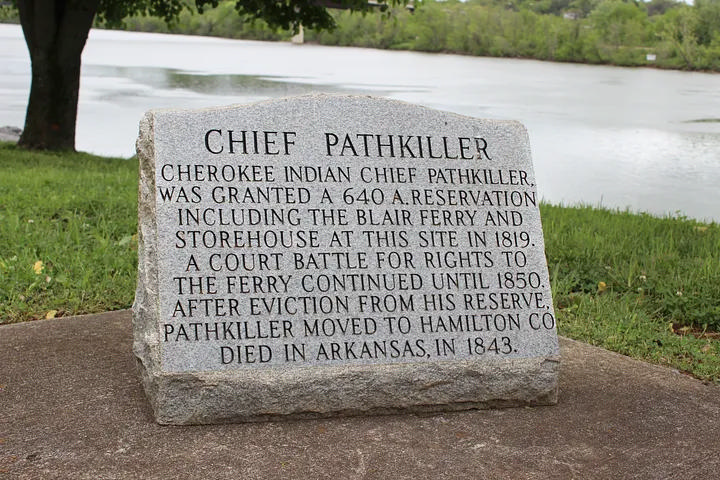
One of the confusing Pathkillers is the Pathkiller of Roane County, Tennessee. Many people have conflicted him with Chief Pathkiller of Turkey’s Town. This Pathkiller is stated to be the last hereditary Chief of the Nation and Colonel Pathkiller. This Pathkiller received a reservation of 640 acres, including a ferry on the Tennessee River. In a blog provided by “Tennessee State Library and Archives” it holds information on the court case involving this reserve. From the blog;

This Supreme Court case centered around a land dispute between Pathkiller and James Blair of Loudon County. In 1819, Pathkiller took advantage of a provision in the Calhoun Treaty and claimed a reservation of 640 acres that included the area known as Blair’s Ferry. Blair’s Ferry was on the Tennessee River in Loudon County.[3] Throughout this court case Pathkiller is referenced as: “. . .last hereditary chief of the Cherokee, and a Colonel under Andrew Jackson in the Creek War”. In this case, there is a daughter of Pathkiller named Sarah who married James T. Gardenhire. “Blair’s sons John and Wily continued battling for the property rights against Pathkiller’s daughter, Sarah, and her husband, James T. Gardenhire. After years of litigation, the Tennessee Supreme Court ultimately decided in favor of the Blairs, claiming that Pathkiller’s sale of the land to the Gardenhires had made his reservation claim null and void. The parties ultimately reached a compromise, and the Gardenhires agreed that they would “remove and give up all of said 640 acres with the ferry, and to remove any tenants that may be in possession of any part of the said tract…”[4]

No where in the reservation claim is this Pathkiller referred to as the Chief of the Cherokee Nation. He is not proven to be Colonel Pathkiller. This is also true in the granting of the reservation.(5) It is a statement made during the court case. But, not proven. It was recorded in the Tennessee State Supreme Court Case. This Pathkiller could be one of the other two Pathkillers listed in Col Gideon Morgan Jr’s regiment.

The account of this case appeared in the National Banner and Nashville Whig newspapers in full on 12 August 1830. Pathkiller in this case is not called Chief of the Nation. There is also no mention of him being related to Chief Pathkiller in Turkey’s Town.[6] There is no evidence to confirm this. The daughter named “Sarah, who married James T Gardenhire,” has no family connection to the Chief Pathkiller of Turkey’s Town. To add to this many genealogists list Susan “Sukey, Sooky” Martin as the wife of Chief Pathkiller in Turkey’s Town. This too is not proven. Others suggest she was married to his son, Pathkiller Jr or Pathkiller II.[7] [8] There is no Pathkiller II. It gets more confusing with the memorial marker (photo attached). Stating that this Pathkiller died in 1843.[9] This Pathkiller may be the Corporal or Sergeant with Col Gideon Morgan Jr’s Cherokee Regiment in the Creek War.[10]

A small memorial marker commemorating Path Killer sits on the western bank of the Tennessee River. The marker is located behind the Loudon Senior Citizens Center, 901 Main St., Loudon, Tenn. / Ross Rogers

Chief Pathkiller, Chief of the Nation 1811-1827, died in January 1827, so he did not file a case in 1830.  His daughter and granddaughter stated he lives in Turkey’s Town. Source with proof later in another post. They never mention moving or living on the Tennessee River. He did not die in Arkansas. He does not have a daughter named Sarah that can be proven. We will discuss his proven family and where he lived.

This Roane County Pathkiller can not be the hereditary chief of the Cherokee, with a death date of 1843. That would mean there are two Principal Chiefs of the Nation. Chief John Ross was Principal Chief from 1828 to 1866.[11] This Pathkiller did exist. He did move to Arkansas. Yet, this Pathkiller of Roane County, Tennessee, is not the Principal Chief of the Cherokee People. He has not been proven to have any family relationship to Principal Chief Pathkiller of Turkey’s Town. Nor any of his family. The only connection is the similarity of the name Pathkiller. There are many people with the name Pathkiller. Not everyone who has that name is kin. 

Pathkiller Junr

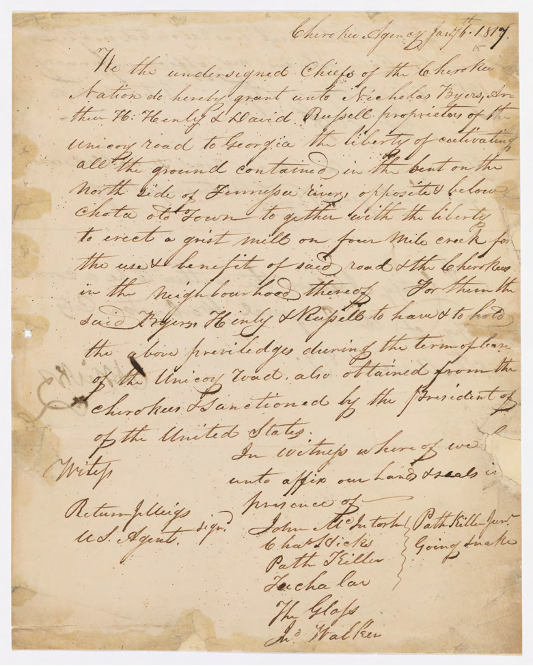
https://catalog.archives.gov/id/100595161 Image of the Treaty, January 6, 1817, NARA

Who is Pathkiller Jr (Pathkiller Junr)? It may be the Roane County, Tennessee, Pathkiller. Attached is a copy of the only document with Pathkliller Junr. An 1817 treaty dealing with the approval of the use of roads it has two Pathkillers. Pathkiller and Pathkiller Jr.[12] This leads to the question of whether the second Pathkiller is Pathkiller’s son. The Cherokee people did not have a culture of naming a son after the father. They did not use the suffix Jr. This is the interpreter’s choice in using “Junr.” Jr. to show two different Pathkillers, one being younger than the other. They are not displaying a family notation. In this treaty, the interpreters are Return J. Meigs, and Chief Charles R. Hicks. Meigs is the Agent and Chief Hicks is an interpreter, Chief Pathkiller’s second. Hicks is half Cherokee and half European. [13]

Conclusion

This Pathkiller of Roane County, Tennessee, is not the Principal Chief of the Cherokee People. He has not been proven to have any family relationship to Principal Chief Pathkiller of Turkey’s Town. Nor any of his family. Pathkiller Junr is a younger man with the same name. There is no son of Chief Pathkiller of Turkey’s Town named Pathkiller Jr.

We will continue the exploration of Chief Pathkiller and the misunderstandings in the next post. The Beloved Chiefs of Turkey’s town.


[1] Indian Affairs, Volume 1, ASP IA Vol. 1, searchable online the Library of Congress American State Papers web site pages 271-273, 26 June – 1 July 1792.

[2] “Cherokee Tragedy”, The Ridge Family and the Decimation of a People, Thurman Wilkins, second edition, revised, University of Oklahoma, Norman and London, 1986, page 7.

[3] https://tslablog.blogspot.com

[4] Ibid

[5] Survey of Pathkiller’s land on the south side of the Tennessee River at his ferry; https://teva.contentdm.oclc.org/digital/collection/p15138coll23/id/857

[6] National Banner and Nashville Whig, (Nashville Tennessee) 12 August 1830, Newspaper.com, Second paragraph; Pathkiller, the defendant in the court and Plaintiff below, claim a reservation under the treaty of 1817 and 1819, of 640 areas of land with a life estate there in to himself and a reversion in fee simple to his children, out of the lands surrendered by these treaties to the United States. He was the head of an Indian family; and on register of life interest reservations, in the office of thee United States Agent for the Cherokees, is in the following entry: “1818, June the 14th, Pathkiller a native, 5 in family, on the main Tennessee river, about 2 ½ miles above the mouth of Sweet-water creek. There is a ferry on the place: Given under my hand and private seal, there being no seal office, the 2d Sept. 1826. H. Montgomery, United States Agent for the Cherokee. . . Pathkiller moved to this reservation, the land in dispute, in April or May 1819, having occupied of by his tenet Caves, from 1817.

[7] Chattanooga Daily Times (Chattanooga, Tennessee) · Sun, May 27, 1934 · Page 41, Newspaper.com

[8] WikiTree, Susan Martin; https://www.wikitree.com/wiki/Martin-4178

[9] Chasing Path Killer, Ross Rogers, blog, 30 April 2019; https://medium.com/@TheRossRogers/chasing-path-killer-38a53d015538

[10] US, Index to Compiled Service Records of Volunteer Soldiers Who Served During the War of 1812, 1812-1815; fold3.com

[11] https://collections.gilcrease.org/anthology-articles-john-ross-papers-collection

[12]  CHEROKEE AGENCY, January 6, 1817. CHEROKEE AGENCY, January 6, 1817. The use of the Unicoy road, so called, was for twenty years. Treaties with the Cherokees, 1819, Oklahoma State University, Digital Resources and Discovery Services, Tribal Treaties Database; https://treaties.okstate.edu/treaties/treaty-with-the-cherokee-1819-0177?query=%20path%20killer  

[13] https://catalog.archives.gov/id/100595161 Image of the Treaty. January 6, 1817, NARA

Trust in the Lord with all your heart, and do not rely on your own understanding;
 in all your ways know him, and he will make your paths straight. Proverbs 3; 5-6 CSV

Uncovering the History of Turkeytown, Traditional Location

21 Tuesday Jan 2025

Posted by Jeffrey Sauls in Local History

≈ 2 Comments

Tags

alabama-history, cherokee, cherokee-county, cherokee-indians, etowah-county, history, indigenous, native-american, native-americans, New Seneca, northeast-alabama, northeast-alabama-history, trail-of-tears, turkey-town, turkeytown

“The Southern Indians . . .the records of their history are records by whites and are marred by prejudices and misunderstandings . . .”  R. S. Cotterill, The Southern Indian, Preface. 

Traditional histories

Traditional histories of white people create confusion about the location. Let’s look at the statements about 3 different places for Turkey’s Town. I will explain the timeline for establishment in its own post later.

Location one.

One mile south of the town of Centre on the west side of the Coosa.

August 7, 1936; Cardon’s History Cherokee. Front page, Coosa River News, first column five paragraphs down;

“Turkey Town was established some time prior to 1770, and was one of the most important of Cherokee establishments. It is here that Col. Campbell, the noted British soldier and superintendent, lived at times during and after the Revolutionary War. Turkey Town was located about one mile from Centre on the west side of the Coosa River, not far from the mouth of Terrapin Creek. This fact is attested to by all of the authorities on the subject, and is shown on a half a dozen maps owned by the writer, dating from 1817 to 1835. The old Indian Trail or ‘Creek Path’ running from Creek Path Town, now Guntersville, crossed the river at Turkey Town, where after the turn of the 19th Century, Pathkiller, King of the Cherokee, operated a ferry.”1

Mr. Cardon does not give a citation except for “all of the authorities.” He would also cite C. C. Royce’s 1884 Map. The information on the location did it come from James Mooney and Royce’s map? Did it come from the Alabama Historical Society?

James Mooney’s book Myths of The Cherokee and Sacred Formulas of the Cherokees states;

Gun’-di’-gaduhun’yi (abbreviated Gun’digadu’hun)- “Turkey’s settlement” (gu’nu’, turkey), so called from the chief, Turkey or the Little Turkey, upon the west bank of Coosa river, opposite the present Center, in Cherokee county, Alabama.2

Charles C. Royce served with the Bureau of Indian Affairs and Ethnology. He was an author and businessman. He confused people with his placement of Turkey’s Town on his “Land Cession Map” by calling it a “Creek” Village.3 https://www.geographicus.com/P/ctgy&Category_Code=roycecharlesc

This created confusion in a report to the Governor of the state of Alabama. The Governor of Alabama requested a report from the Historical Commission. It was printed on December 1, 1900, and copyrighted in 1921. The report provides two Turkey Towns, both at the same location.4

Page 418; Creek Indian Town and Villages, Chapter IV;

Turkey Town, an Upper Creek Village, is marked on Royce’s map (1884) on the western shore Coosa River opposite the influx of Terrapin Creek, from the Southeast and also opposite the recent town of Centre.

Page 420; Chapter V Cherokee Towns and Villages in Alabama;

Turkey Town. Founded about 1770, and situated in the bend of the Coosa river opposite the town of Centre in Cherokee County. It was a place of great importance in the Nation and was named for one of its most noted Chiefs “The Turkey”, here under this chief’s lead originated many of hostile expeditions against the white settlers of Tennessee and Kentucky. -see Pickets History of Alabama Vol. 1 page 163.

These notations in this 1900 report are the sources for Mr. Cardon and historians later.

A reference noted above; see Pickets History of Alabama Vol. 1, page 163. This reference does not give any information on the location of Turkey’s town.

Albert Pickett’s “History of Alabama and incidentally of Georgia and Mississippi, from the earliest period”. On page 163 Mr. Pickett writes;

Will’s Town and Turkey Town—important Cherokee establish. The former was named for a half breed called Red-headed Will. At these towns lived the British Superintendent, (the celebrated Col. Campbell,) before and during the Revolutionary War. . . 

Cherokee County History written by Mrs. Margaret Stewart repeats these notes. 1956 Cherokee County History Volume 1, page 204;

“Turkey Town named for noted Chief “The Turkey” and located in the bend of the Coosa River opposite to and one mile south of the town of Centre. It was founded about 1770, and was considerable size and importance. It is marked on the Royce’s Map (1884) opposite the influx of Terrapin Creek. Chief Turkey lived on the east side of Turkey Creek on what later became the Sims farm. By some Indian agents and traders, the town was called New Seneca.”

page 214;

“Turkey Town was established some time prior to 1770 and was one of the most important Cherokee establishments. Col. Campbell the noted British soldier and superintendent lived here at times during the Revolution. Turkey Town was located one mile from Centre on the west side of the Coosa not far from the mouth of Terrapin Creek. The old Indian Trail or Creek Path crossed the river at Turkey Town, and Pathkiller had a ferry here.”5

Location two.

Turkey’s Town from Gadsden to Centre, Alabama.

Another location for the town is described in a History of Etowah County, Alabama. During the centennial of Etowah County Alabama in 1968 a committee was formed to write a history of the county. “History of Etowah County Alabama; Part I, A History of Etowah County, Alabama by Elbert L. Watson.”6

page 9, Chapter I, Etowah County; An Ancient Homeland;

Chief Little Turkey and his followers located their village, Turkey’s Town, along the northern bank of the Coosa River in an extremely fertile and productive area of the Coosa Valley. Actually, Turkey’s Town, or Turkeytown, as it was later called, was more an area instead of a village, since it extended from just south of Centre to below Gadsden where the Coosa River and Big Wills Creek formed the Cherokee boundary line.

The third location.

99.1 percent underwater of Weiss Lake in the area of LIttle River, Chattooga River, Coosa River.

A third location was noted in 1993. The Turkeytown Association of Cherokee held an Intertribal “Pow Wow” next door to Gaston High School, Etowah County, Alabama. Cherokee County Herald September 15, 1993, the front-page headline is; “Cherokee Indians celebrate at the wrong place? Alabama historian and researcher Don Naylor says YES”; written by the editor Paul W. Dale. He states;

“Turkeytown is actually located some miles from where the festival organizers have laid claim to a site they contend is where a Pow wow was held some 150 years ago. The truth is the truth and you cannot bend it.” Naylor is listed as a historian that researcher who primarily hunts Creek Indian history and artifacts throughout the Cherokee County area. “Turkeytown is now 99.1 percent under water of Weiss Lake.” Bob Minnix of the Cherokee County Historical Museum in Centre. “Turkeytown is actually located in the area of Little River, Chattooga, Coosa.”7

(As of note, I was a board member of the Turkeytown Association of the Cherokee. This was an educational group to promote Cherokee and Turkeytown history.)

If you look at Wikipedia, you will get all three locations.
Much of the original site of Turkeytown is now underwater, due to the impoundment of the Coosa River which formed Weiss Lake. The present-day community of Turkey Town in Etowah County, Alabama is fewer than ten miles southwest of Centre, Alabama and near the original site of the town.

https://en.wikipedia.org/wiki/Turkeytown_(Cherokee_town)

Oliver Day Street “The Indians of Marshall County Alabama”;

About 1777, Wills’ Town was established by the Cherokee. . .about the same time Turkey Town was built by them on the Coosa river opposite the present site of Centre, Cherokee County, Alabama. 

(reference is “Pickett’s History of Alabama”, vol I, page 163; Royce in the 5th Annual Report Bureau of Ethnology, Map 8) 8

Mr. Street’s statements are like those of many other local histories and state historians who repeat the same information.

Conclusion

So, where is the original site for Turkey’s Town? With the above, there is no conclusion. With the above, there is confusion. Three locations? Spread from today’s Gadsden to Centre, Alabama?

The correct location is where? Where is this noted “Sim’s farm, east of the creek”? Where Chief Turkey lived. Are all the places part of Turkey’s Town?

What do the Cherokee people say? What do the people who interacted with Cherokee people in Dah-noo-wey-ye say about the location?

Next time, we will start looking at those sources. Till then, study Gen. John Coffee’s map.9 Compare it to Royce’s map above.

  1. “Coosa River News”: Friday 7 August 1936: Page 2: Gadsden Public Library, Genealogical and History Library: Microfilm. ↩︎
  2. Myths of The Cherokee and Sacred Formulas of the Cherokees by James Mooney from the 19th and 7th Annual Reports B. A. E. published in 1900 and reproduced 1982, page 521, “Glossary of Cherokee Words. ↩︎
  3. Map of the former territorial limits of the Cherokee “Nation of Indians;” Map showing the territory originally assigned Cherokee “Nation of Indians.” Published 1884, author C.C. Royce. Library of Congress. ↩︎
  4. Publication of the Alabama Historical Society Miscellaneous Collection: “Report of the Alabama Historical Commission to the Governor of the State of Alabama December 1, 1900”: Edited by Thomas McAdory Owens, Chairman: Montgomery Alabama: 1901: Google Books eBook: Public Domain. ↩︎
  5. “Cherokee County History 1836-1956 Volume 1”: Mrs. Frank Ross Stewart: Centre, Alabama:1956. Gadsden Public Library. ↩︎
  6. “A History of Etowah County, Alabama”: 1968: Etowah County Centennial Committee: Woodrow J. Stephens, Joe Barnes, Jerry B. Jones, Juanita Miller, and Elbert L. Watson; Gadsden, Alabama: Roberts and Son: Birmingham, Alabama. Copy in possession of the writer. ↩︎
  7. “Cherokee County Herald September 15, 1993”: Editor Paul W. Dale: Front page: Copy in possession of the writer. ↩︎
  8.  “The Alabama Historical Society, Montgomery, Alabama, Reprint No. 8”: XII The Indians of Marshall County, Alabama, Montgomery, Alabama, 1904, page 206: Oliver Day Street, Guntersville, Alabama: Google Books eBook: page 185. ↩︎
  9. A piece of the map, Sketch of the Disputed Country Between the State of Georgia and the
    Cherokee Nation. Record Group 75, Records of the Bureau of Indian Affairs, 1793-1999, Series,
    Central Map Files, 1824-1962, National Archives Catalog, General John Coffee. ↩︎

Trust in the Lord with all your heart, and do not rely on your own understanding;
 in all your ways know him, and he will make your paths straight. Proverbs 3: 5-6 CSV
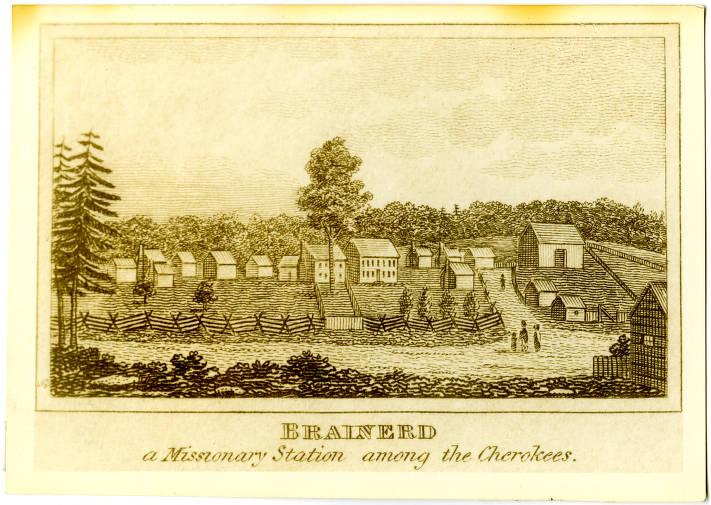
Newer posts →

Subscribe

  • Entries (RSS)
  • Comments (RSS)

Archives

  • February 2026
  • January 2026
  • December 2025
  • November 2025
  • October 2025
  • September 2025
  • August 2025
  • July 2025
  • June 2025
  • May 2025
  • April 2025
  • March 2025
  • February 2025
  • January 2025
  • December 2024

Categories

  • Local History

Meta

  • Create account
  • Log in

Website Built with WordPress.com.

  • Subscribe Subscribed
    • New Seneca Turkey's Town
    • Already have a WordPress.com account? Log in now.
    • New Seneca Turkey's Town
    • Subscribe Subscribed
    • Sign up
    • Log in
    • Report this content
    • View site in Reader
    • Manage subscriptions
    • Collapse this bar
 

Loading Comments...