
Tags
Centre Alabama, cherokee-indians, Chief Pathkiller, native-americans, New Seneca, northeast-alabama-history, Pathkiller Ferry, Pathkiller Grave, trail-of-tears, turkeytown
In the last post, we proved that Chief Pathkiller lived in Turkey’s Town. He had a ferry on the Coosa River. We saw that a fort was built around his residence. His wife Peggy would keep this ferry. His children would live on the property on both sides of the Coosa River. All of this is in Etowah County, Alabama, Near Gaston School on US 411 North. It confirms the original location of Turkey’s Town.
New Improvement
This post explains Chief Pathkiller move. “One mile south of present day Centre.” We learn of a new wife and an illegal sale of part of his estate. Additionally, let’s look at the dispute between the Garrett Family and John Ridge. John Ridge acquired most of Chief Pathkiller’s estate at the Centre, Alabama location. Uncovering the History of Turkeytown, Pathkiller’s Ferry.
The affidavit of James Lasley. “The grandfather of this claimant Anna Pathkiller being the person who made the first improvement and kept it and held it legally as his according to the Law and usage til about the year 1815 ”
What happens? Did Peggy send him packing? Did he abandon the family? What was going on in history at this time?
Influx of White People
Chief Pathkiller became the “King” or Principle Chief in 1811 after Black Fox’s death. The Creek war ended in 1814. During that time, “Friendly Creek” was living at Chief Pathkiller’s cabin. A “fort” was built around it. A treaty ratification took place at Turkey’s Town in October 1816. The US Army, under the command of Maj Gen. Andrew Jackson, came to sign this treaty. (The 1816 Turkey Town Treaty is a post later.) The US government signed treaties in 1817 and 1819.
The Creek War brought the US Army, that was made up of Tennessee Volunteers. There were mixed families in the Cherokee people. They have married white people. But now, it must have felt like an invasion of strangers taking everything. Friendly Creeks living in the front yard. The yard had been fortified. Two years later, more soldiers. Andrew Jackson came with an escort for the treaty signed in 1816. The 1816 treaty strongly talks about moving the whole nation West of the Mississippi River. Is this more than Peggy wanted?
Oo-loo-cha, the New Wife
It is the custom of the Cherokee people that the female controls the marriage. Peggy might have dissolved the marriage. We do not have a clue as to what happened. We do know that the separation happened between 1815 and the Treaty of 1819. His daughter Nelly told James Lasley about 1815. (See Lasley’s statement above.) Hammer, the son of Oo-loo-cha, stated 1819, see below.
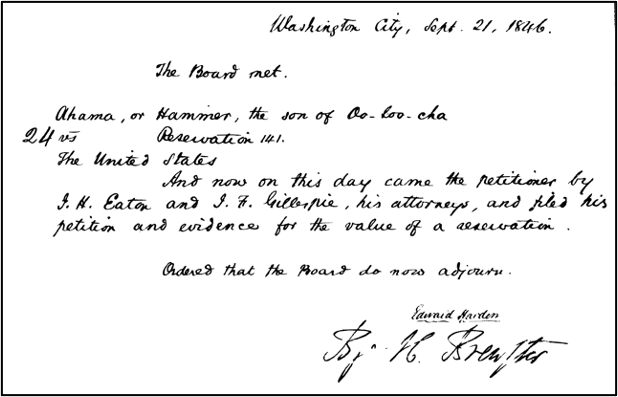
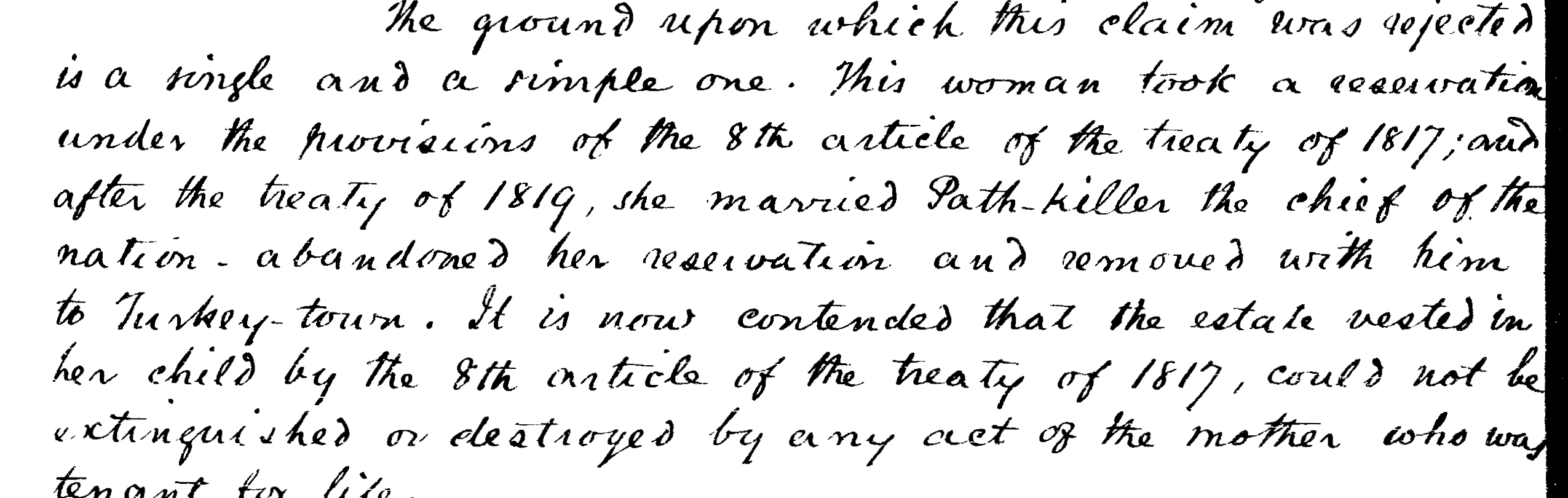
“after the treaty of 1819, she married Path-killer the chief of the nation, abandoned her reservation and removed with him to Turkey-town.”
The above two selections of Hammer’s 1846 claim are based on his mother’s reservation. Chief Pathkiller married Oo-loo-cha just after the 1819 treaty.1 Hammer’s father is Fawn Killer, and he died before 1819.
The claim by Hammer is on the estate or improvements last held by Pathkiller. This is the ferry and property at Terrapin Creek today’s Centre, Alabama. Hammer sold part of this estate to a white man named Robert Brown.
Michael Wren discovered a file box on Pathkiller. This was in the collection of Penelope Allen Johnson. It was located at the University of Tennessee in Knoxville. There were several folders about a dispute in the Cherokee District Court at Chattooga. This court was located just Northeast of today’s Gaylesville, Alabama. By Cherokee law, to settle disputes between the people, it was done in the Cherokee district court.
Tah-ka-ha-kee & Crying Snake vs Robt Brown
Plaintiffs witness May 26th 1830
Ahnoah Deposeth and saith that she was living in the neighborhood of Gunters Landing when her uncle the Bears Meat told her that the Pathkiller wanted her the Deponent to come and live where the Pathkiller was clearing a place on the Couse River on the West Bank at Pathkillers Ferry so called; the Pathkiller told her that he would get some young men to build some houses, and bout one year after the Pathkiler brought the Hammer there with his mother the Pathkillers wife.
How long did the Pathkiller settle at the ferry? Ans; He lived there until he died. Did he ever move opposite? Ans; No Did he die where he was clearing? Ans; He died at the house. Which side of the river did the Pathkiller die? Ans On the East side2
We learn a lot from this court case. This notation from the witness Ahnoah tells us she is the granddaughter of Pathkiller. She was living near Gunter’s Landing or Creek Path. She calls Bear Meat her uncle. This indicates that her mother is Bear Meat’s sister. Proven by Cherokee custom. Bear Meat is the son of Pathkiller by an unknown wife.3
Chief Pathkiller had a house built for her. She stated he died in his house on the east side of the River. This was at his (New) Ferry.
The two people bring this case to court are Tah-ka-ha-kee and Crying Snake. Tah-ka-ha-kee is the son of Pathkiller by an unknown wife. Is he the brother of Bear Meat? Crying Snake is the son of Nancy, Chief Pathkiller and Peggy’s daughter. Crying Snake produced a note. Principal Chief John Ross stated in this note that Pathkiller had willed the improvements at this location to Crying Snake. Neither one of them had a copy of the will.
This is to certify that the Path Killer some short time prior to the death of my Grand Father was at my house where I lived near the Look Out Mountain, and got me to write a will for him respecting his ferry and possessions on the Coosa River which as well as my memory serves me was a follows – That after his Death his Grand Son Crying Snake should inherit his ferry and possession and that in case he the said Crying Snake should think it proper to receive Ahamah and associate him in interest with him that it should be discretionary with himself, so to do but that the Crying Snake should stand foremost and do as may appear best to himself – Given under my hand at the Head of Coosa this 16th day of Feby 1830. /s/ John Ross
Chattooga court house, Cherokee Nation, May 25th 1830
I do hereby certify the Def____ the l_____ as ea____ in t_____ to my hand Robert Field, Clk CC4
This case settled in Crying Snake’s favor.
RECORD BOOK OF THE CHEROKEE SUPREME COURT October Term 1830
[PAGE 72]
| Crying Snake Vs Robert Brown | }}} | Treppes to try the right to a certain field at Pathkillers Ferry on the West side of the river. |
The Court find for the plaintiff, Crying Snake, the field in dispute.
| Witnesses attendance | M. McIntosh | 14 days | $10.50 |
| John Ratliff | 17 days | 12.75 | |
| Anohy | 16 | 12.00 | |
| James Lasley | 15 | 11.25 | |
| Quakey | 3 | 2.25 | |
| Qakey | 2 | 1.50 | |
| Kenah | 6 | 4.50 | |
| Kah-lo-ne-sky | 3 | 2.25 |
Friday 27th (October 1826) The Court met according to adjournment. Present &C5
Pathkiller started a new improvement, according to the court case. This improvement held a ferry and a farm on both sides of the Coosa River at Terrapin Creek. He lived on the east side and had a house built for his granddaughter Ahnoah. She stated in testimony that she was married to Hammer at one time. She said that her grandfather Chief Pathkiller died in his house on the east side of the river. Cherokee custom, he would be buried on-site at his death. So, Chief Pathkiler is buried at this location. He had a new wife named Oo-loo-cha.
John Ridge and the Ferry
“Alabama Collection Camps, Forts, Emigrating Depots and Travel Routes Used During the Cherokee Removal of 1838-1839,” Chapter 8, Michael Wren wrote;
After Pathkiller’s death, controlling interest in the ferry was acquired by John Ridge while some members of Pathkiller’s family continued to hold a minority interest. John Ridge employed a white man named William Childers to operate the ferry. It is likely that William Childers was the source of the name Childersville.6
In 1832, St Clair County authorized Emanuel M. Zimmerman to establish a ferry on the Coosa River. 7 Zimmerman assigned that right to John H. Garrett. Garrett used that right to dispossess Ridge and Company their ferry on the Coosa River.8 (The footnote contains lots of additional information.)
In a letter Benjamin Curry to Governor Gayle of AL dated January 21, 1835., William Childers and John Ridge complained about Garrett building on the property.
“General John H Garrett came with an armed force and is now building a dewilling house in the yard of one of Ridges’s tenets between the Indian dwelling and his little patch separated by a distance not under sixty feet.“9
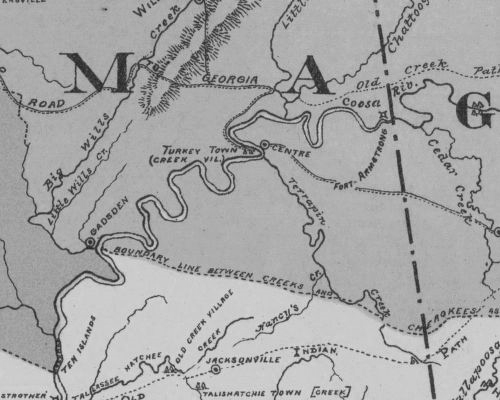
The Garrett family confiscating this property created great confusion as to the location of Turkey’s Town. Along with the above map, the historians became confused on where Turkey’s Town was located. This was not part of Turkey’s Town until after 1819 and Chief Pathkiller establishing a new ferry and resident.
John Ridge would surrender this property under the 1835 New Echota Treaty.
John H Garrett and his wife Mary would patent purchase this property.10 This is the site that Charles C. Royce and James Mooney would site as Turkey’s Town. The Garrett family tradition states they were on this property in 1816. William H Garrett was the oldest son of John H Garrett and Mary Hall Garrett. He stated this in a bio for the state of Alabama. He said he was born “22 February 1819 near Hamburg, Edgefield County, South Carolina.” John H Garrett is on the 1830 St Clair County, Alabama Census. In St Clair County court records he is listed as a Justice of the Peace. He will become a Major in the Alabama Militia by 1835. He died in 1841 while serving the Alabama Legislature in Tuscaloosa, Alabama. The Garrett family still owns this property today.
Conclusion/Confusion
Confusion. A lot of info in the past three posts. Review them. Chief Pathkiller had two ferries. His first ferry is the location of today’s Fitts Ferry in Etowah County, Ala. He separated from his wife, Peggy, and left those improvements to her and the children. He married a new wife named Ooo-loo-cha. He began a new improvement and ferry, which is now today’s Garrett’s Ferry in Centre, Alabama. He did not move or start the new improvements until after 1819 in what is now Centre, Alabama.
Four posts to tell you where the original village of New Seneca, Turkey’s Town is located. The original village is in Etowah County, Alabama. See the maps below.
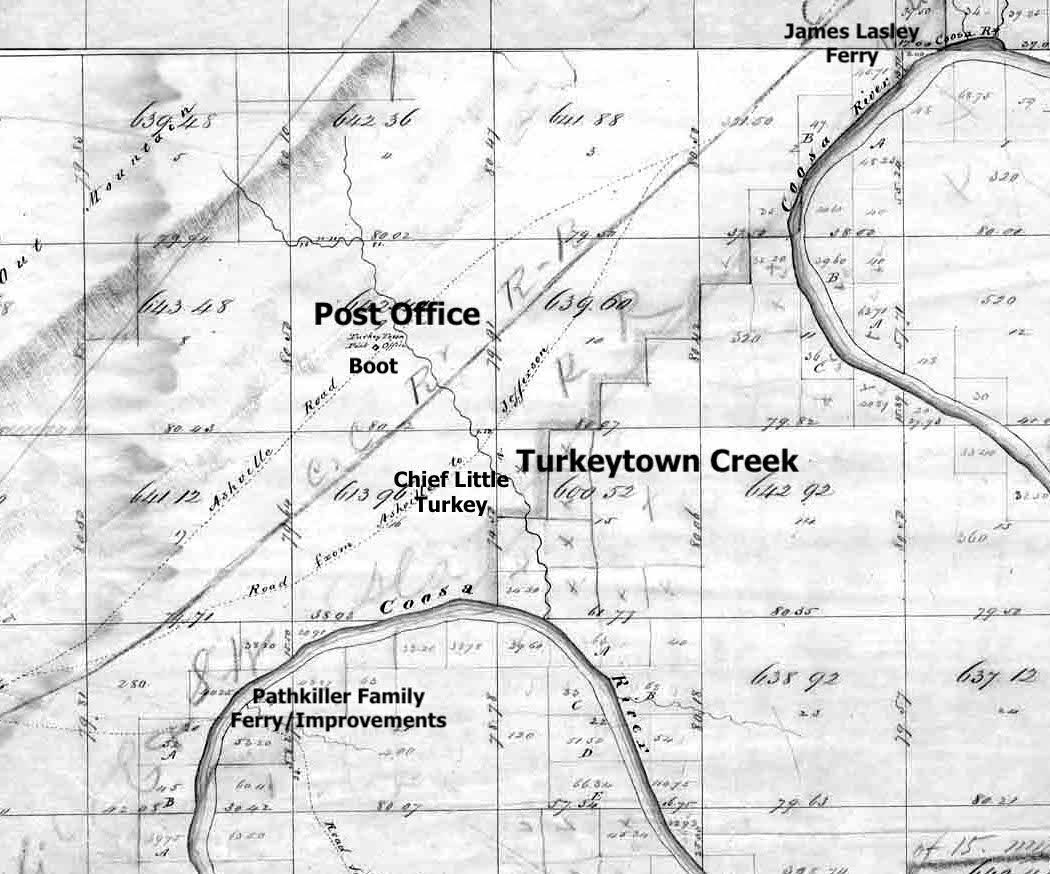
Here is a modern-day map of the same area from Google Maps. Labeling by Jeffrey Sauls.
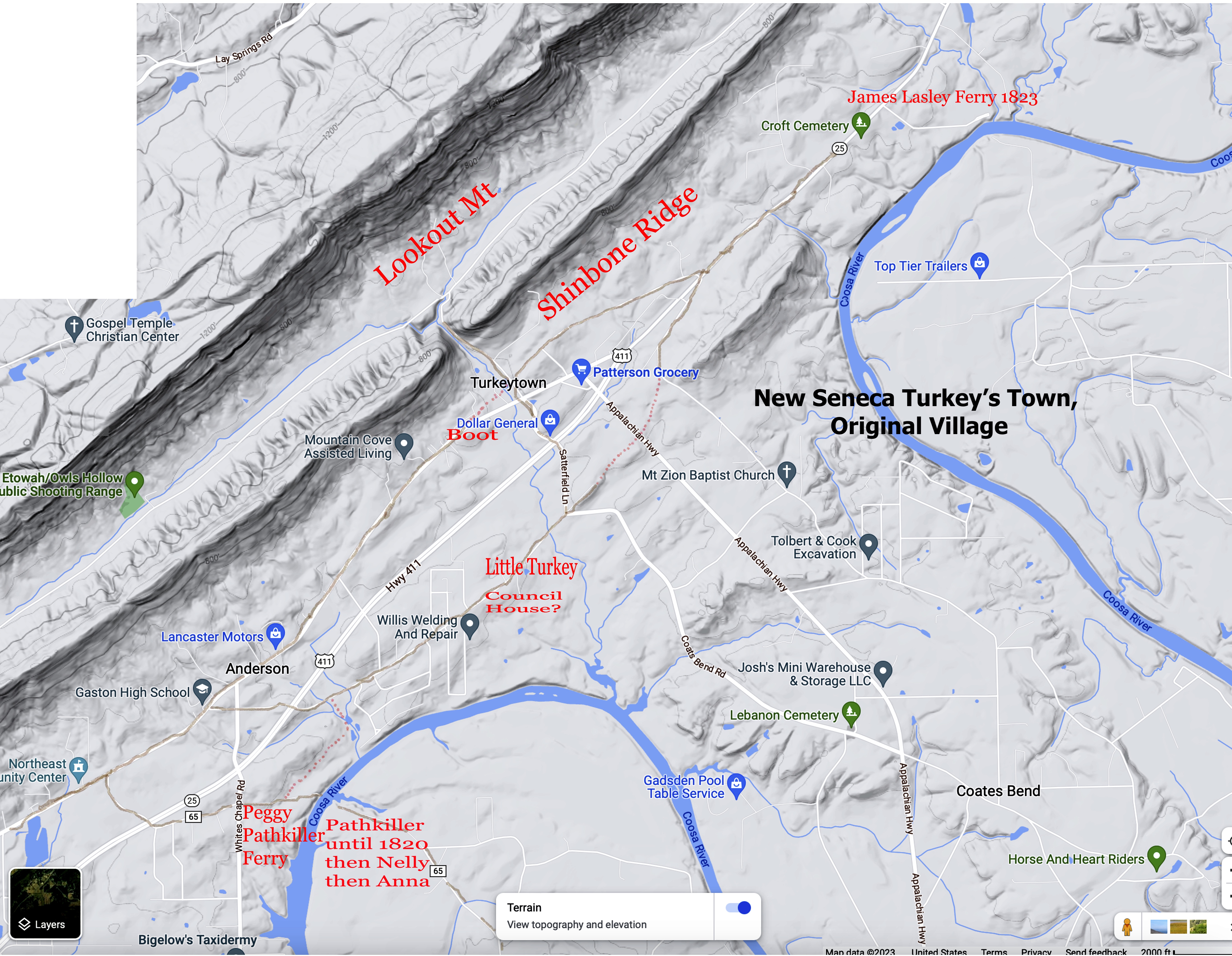
By the time of the Trail of Tears, 1839, Turkey’s Town began just below Gadsden. Will’s Creek empties into the Coosa River there. It would stretch to Centre, Alabama. The Trail of Tears will have its own post, and I will explain this 25 miles of Turkey’s Town.
Uncovering the History of Turkeytown, Establishment, A Timeline, the Next Post. When did Chief Little Turkey move to this location?
- The treaty of 1819 reaffirmed the treaty of 1817. It was signed 27 February 1819. https://treaties.okstate.edu/treaties/treaty-with-the-cherokee-1819-0177 ↩︎
- Penelope Allen Johnson Collection, University Tennessee Knoxville, Series V, Box 1, FOLDER 201 ↩︎
- Bearmeat served in the Creek War 1813-14 and was a scout for General Cocke. Cocke wrote a letter commending Bearmeat as he is referred to as “the son of the old Path Killer.” Hargrett Rare Book and Manuscript Library, The University of Georgia Libraries, Telamon Cuyler Collection, Box: 77, Folder: 30, Document: 02. Major Robert Searcy in a letter to Gen. John Coffee commends Bearmeat as well; “the son of the Path Killer king & principle Chief of their nation”. Fold3 Ancestry.com, Correspondence and Miscellaneous Records; page 271-274, Records of the Cherokee Indians Agency in Tennessee 1801-1835, Record Group 75, National Archive ↩︎
- Tennessee Cherokee Collection, Box 4, Folder 3. Microfilm Collection 815, Reel 1, frames 1020-1021. Tennessee State Library and Archives, Nashville TN. ↩︎
- Cherokee Supreme Court Record Book page 72, Tennessee Cherokee Collection, Box 3, Folder 10, Tennessee State Library and Archives, Nashville TN. ↩︎
- COOSA RIVER #6 Township 10 South, Range 9 East, Section 28, Pathkiller’s Ferry / Ridge’s Ferry / Childers’ Ferry / Garrett’s Ferry page 242, Chapter 8 Topography of the Removal Routes Ferry Crossings on Major Rivers and Tributaries, By Michael Wren, Alabama Collection Camps, Forts, Emigrating Depots and Travel Routes Used During the Cherokee Removal of 1838-1839, https://www.nps.gov/trte/learn/historyculture/upload/Alabama-Collections-Camps-Forts-Depots-and-Routes-508.pdf ↩︎
- St. Clair County AL County Court Minute Book (1828-1834) page 173-174 “Ordered by the Court that Emanuel M. Zimerman be authorized to Establish a ferry on the Coosa River at what is now known by the name of Pathkillers ferry where Childers now lives…” on page 180 is states “that Emanuel M. Zimmerman be authorized to Establish a keep a ferry on Coosa river below Heners Island and above Childers ferry and below Mulkeys fery…” The Alabama Legislature on January 12, 1832 authorized Garrett to “open a road” near his farm on the Coosa River and directed the Circuit Court of St. Clair County to grant Garrett a license to keep a ferry. ↩︎
- Letter to John Ridge March 13, 1835 from William Childers about Garrett and his efforts at taking the ferry and Ridges forward of the letter to the Secretary of War on March 13, 1835. Benjamin Currey’s letter to CC Clay dated January 20, 1835 and the Letter of Benjamin Curry to Governor Gayle of AL dated January 21, 1835. National Archives Microfilm Publication M234, roll 76, frames 476-483; Letters Received by the Office of Indian Affairs, 1824-1881; Records of the Bureau of Indian Affairs, Record Group 75; National Archives – Southeast Region, Morrow, GA. The Childers letter mentions that “Garret is here on the other side of the River has got Large double houses bilt and has taken them old houses that Pathkiller ust to Lie in and made kitchens of them”. The legal and military wrangling between Ridge and Garrett over control of this ferry is documented in
Fourth Board Claim #2 (Heirs of John Ridge vs. the United States); Claims Papers, 1846-1847, of the Fourth Board of Cherokee Commissioners, Entry 250; Records of the Bureau of Indian Affairs, Record Group 75; National Archives Building, Washington DC. See also Minute Docket 1 pages 4, 56-62; Minutes of the Fourth Board of Cherokee Commissioners, Entry 249; Records of
the Bureau of Indian Affairs, Record Group 75; National Archives Building, Washington, DC. The early Court Records of Cherokee County Alabama were all lost in a series of courthouse fires. The Fourth Board Claim file contains a copy of the court record. Legal Notice was printed in The Jacksonville Republican, Jacksonville AL, Issue of November 2, 1837, Volume 1, No 42, pg 3, column 4. “Cherokee County, Circuit Court, October Term 1837, John H. Garrett vs. John Ridge and William
Childress. In Chancery.” {Note the Legal advertisement ran until January 1838.} See also Letter dated August 12, 1837 from John Wool to General Dunlap in American State Papers, Military Affairs Volume 7, page 551. See also US Serial Set, Series 315, 25th Congress – 2nd Session, Senate Document 120, pp 26, 357-358, 728-729. ↩︎ - Ibid ↩︎
- Bureau of Land Management, General Land Office Records, Eastern States Office, Springfield, VA. Pre-emption Certificate 6,698 for John H. Garrett of Cherokee County, Alabama, was issued June 1 1845 for the northeast part and the fraction “A” of fractional Section 28 in Township 10 of Range 9 East. Pre-emption Certificate #6,694 for Mary Garrett of Cherokee County was issued on June 1, 1845 for the southwest part of the northeast quarter of fractional Section 28 in Township 10 of Range 9 East. Pre-emption Certificate #6,699 for Mary Garrett as assignee of Charles S. Legatt was issued June 1, 1845 for the southeast quarter of fractional Section 28 in Township 10 of Range 9 East, all in the District of Lands subject to Sale at Lebanon Alabama.
http://www.glorecords.blm.gov/PatentSearch/ ↩︎ - Survey of Township 11 South of Range 7 East, of the Huntsville (AL) Meridian, Section 9. Plat certified April 20, 1840, by James W. Weakley, Surveyor General of the public lands in Alabama. Samuel Bigham, Deputy Surveyor.http://www.glorecords.blm.gov/SurveySearch/ ↩︎
- U. S. Appointments of Postmasters 1832-1971, ancestry.com ↩︎
Trust in the Lord with all your heart, and do not rely on your own understanding;
in all your ways know him, and he will make your paths straight. Proverbs 3; 5-6 CSV
 New Seneca Turkey's Town