
Tags
cherokee, cherokee-indians, history, native-americans, New Seneca, northeast-alabama-history, seneca, trail-of-tears, turkeytown
Intro
Uncovering the history of Turkeytown. My goal is to give a voice to the Cherokee people who live in New Seneca, Turkey’s Town. I aim to clear up misunderstandings about when and where Turkeytown was located. I want to create a timeline of the settlement by Chief Little Turkey. I will examine the significance of this village. We will look at the impact on the Cherokee Nation, the United States, and the state of Alabama. I will introduce you to the connections between the Cherokee people and modern-day communities. These communities and cities were directly formed out of Turkey’s Town.
Mr. R. S. Cotterill states in the Preface of his book, The Southern Indians; “The Southern Indians . . .the records of their history are records by whites and are marred by prejudices and misunderstandings . . . The writer finishes his task with no boast that his portrayal has been precise or his account complete. He hopes he has moved at least a little toward the goal of depicting Indian history as it was.” I, too, do not claim to be precise or complete. Instead, I aim to be as correct as the records allow. The voices of the Cherokee need not be silent. The records they have left behind tell their story. I will try to piece together their records to tell this story.
Historians have debated Turkey’s Town location and when it was settled for almost 100 years. Searching every document or record with references to Turkey’s Town is impossible. As more information is digitized and placed on the internet, it becomes available in libraries and archives. Thus, one must search through as much as possible.
I am very grateful to Michael Wren for his support in my research. He is a Board Member of the National Trail of Tears. He shared documents he had found in the National Archives, the University of Tennessee at Knoxville, and other sites. These invaluable documents and others that I have found become the base for piecing the story together. It allows the voice of the Cherokee to speak. It allows the people who interacted with them to talk. It allows for a more precise story.
In this post, we will look at the real name of the town. New Seneca Turkey’s Town was named by Chief Little Turkey.
When a name is not a name
Gun’-di’-gaduhun’yi (abbreviated Gun’digadu’hun)- “Turkey’s settlement” (gu’nu’, turkey), so called from the chief, Turkey or the Little Turkey, upon the west bank of Coosa river, opposite present-day Centre, in Cherokee county, Alabama.” (Myths of The Cherokee and Sacred Formulas of the Cherokees, James Mooney the 19th and 7th Annual reports B. A. E. published in 1900 and reproduced 1982, page 521, Glossary of Cherokee Words). Mr. Mooney appears to be the standard for the location and name of Turkey’s Town. He is quoted by many websites and many historians. He presents a good argument. Who is he?
From Wikipedia, the free encyclopedia.
James Mooney (February 10, 1861 – December 22, 1921) was an American ethnographer who lived for several years among the Cherokee. Known as “The Indian Man”, he conducted major studies of Southeastern Indians, as well as of tribes on the Great Plains.[2] He did ethnographic studies of the Ghost Dance, a spiritual movement among various Native American culture groups, after Sitting Bull‘s death in 1890. His works on the Cherokee include The Sacred Formulas of the Cherokees (1891), and Myths of the Cherokee (1900). All were published by the US Bureau of American Ethnology, within the Smithsonian Institution.
What do the Cherokee people say? What did they call the place?
The Cherokee people who lived in Turkey’s Town tell the history differently. We will start uncovering the history of Turkeytown by looking at the name as told by the Cherokee.
The treaty of 1830 established the “Indian Removal Act.” The 1835 treaty resulted in Trail of Tears, the forced removal of the Cherokee people. The Cherokee people filed claims for payment with the United States for what they left behind. They are referred to as Validation/Spoliation Claims. You can find the 1838 and 1842 claims at the National Trail of Tears web site.
In some of the 1842 validation/spoliation claims, the names Dah-noo-wey-ye, Tah-noo-wey-ye, and Nah-te-kay-ye is used for Turkey Town. These names are interchangeable, and the word translates to “Turkey’s Place.” (Reference, the late Hastings Shade, Cherokee Talker/teacher, Oklahoma. Interview with Michael Wren. https://en.wikipedia.org/wiki/Hastings_Shade?wprov=sfti1) An example of this is in this 1842 claim by Susannah. It is located on the National Trail of Tears Association’s website. This is the link; https://totclaims.com/directory-1842_claims/east_residence/dah-noo-wey-ye-or-turkey-town-chattooga-dist/
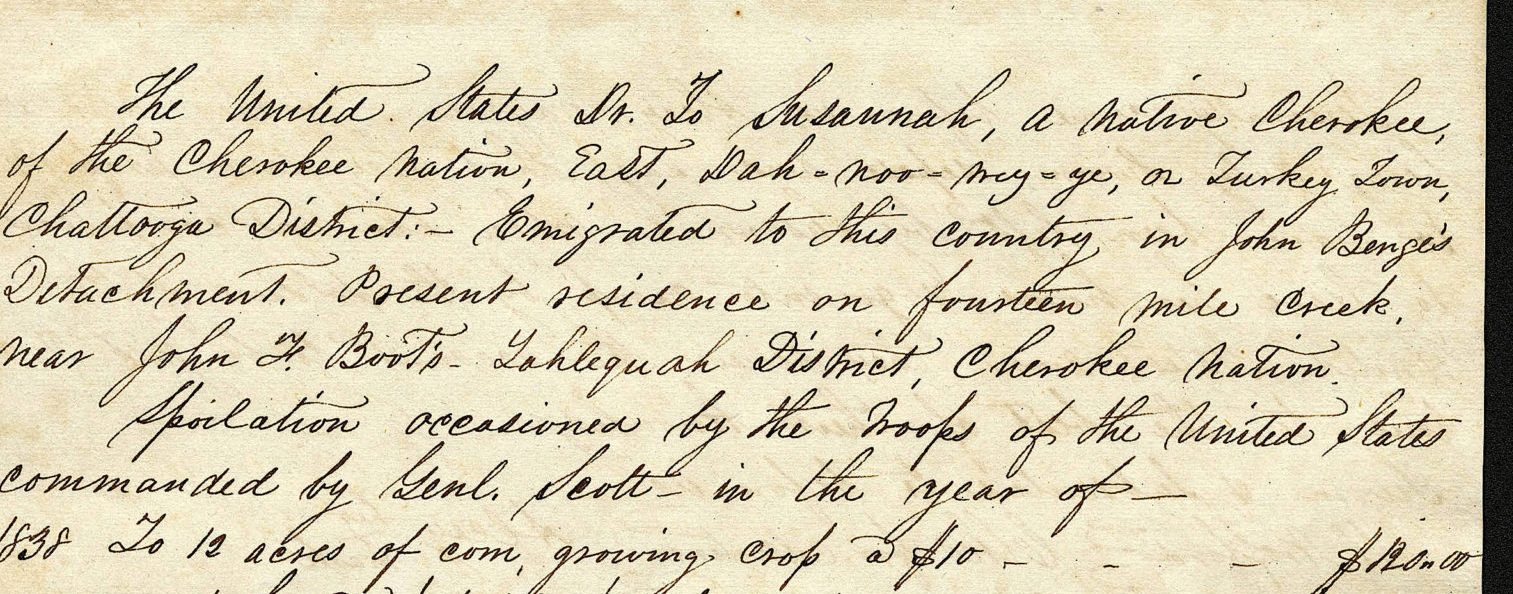
As we see, Turkey Town is the name used by the Cherokee people. Many historians have stated that the village/town was named for “Chief Little Turkey.” This is true, but Turkey Town is a reference, not the name. The name Turkeytown is not the name of the village. Turkey’s Town is a reference used by the US Government, the Spanish, and other Indigenous People. This reference would become the name. When a name is not a name. Chief Little Turkey called his new town, New Seneca.

“At a general meeting held at the Turkeys Town or otherwise called New Sinekaw in the Cherokee Nation Present the Chicomagies Chiefs March 10th 1789“
A letter written for Chiefs, Little Turkey, Hanging Maw, and Dragging Canoe. The letter is intended for Governor Samuel Johnson in 1789 (Governor of North Carolina). The letter seeks arrangements for another peace treaty. The new treaty is to be akin to the 1785 Hopewell treaty, or we should adhere to that treaty. The Hopewell Treaty was signed by the Cherokee Nation and the United States in November 1785. That signing took place at the Hopewell Plantation. Modern-day, this plantation house is on the property of Clemson University in Clemson, South Carolina. The above clip is from a copy of the letter transcribed for Chiefs Little Turkey, Hanging Maw, and Dragging Canoe. The document NCU16 is in the Papers of the War Department 1784-1800. Roy Rosenzweig Center for History and New Media, George Mason University, wardepartmentpapers.org.
If there is a “New Seneca,” then there must be an “Old Seneca.” The Cherokee town of Seneca is across the Keohwee River from the Hopewell Plantation. Present-day this is Seneca, South Carolina. This Old Seneca was the home of Chief Little Turkey. When Chief Little Turkey was the “Beloved Headman of the whole Nation,” he called for a grand council meeting. This meeting took place at Estanaula on Tuesday, 26th June 1792. Below is a statement from Little Nephew, a warrior from the Running Water Town, at this meeting.
“I put on my belt and tied up my things, to start from here to Seneca. I desired them to think of that place, the Little Turkey’s old Town, and the coals of fire which are yet to be seen there;”
Little Turkey named his new town after his old town. The transcription of the Grand Council meeting is available. It is found in the Library of Congress: American State Papers: Indian Affairs: Volume 1: Pages 271-273. Below is a copy of the opening statement.
“Present, the Little Turkey, great beloved man of the whole nation; the Badger, the beloved man of the Southern division; the Hanging Maw, beloved man of the Northern division; the Boot, the Black Fox, the Cabin, Path Killer, head-men of Turkey’s town.”
The above opening statement mentions that the headmen of Turkey’s Town are in attendance. These headmen are the only ones named referring to a town. They are significant to the Cherokee Nation and New Seneca, Turkey’s Town. Blackfox and Path Killer will become Principal Chiefs of the Nation. We will explore these men in their own posts.
“The Little Turkey’s old town.” Seneca is shown on the map below.
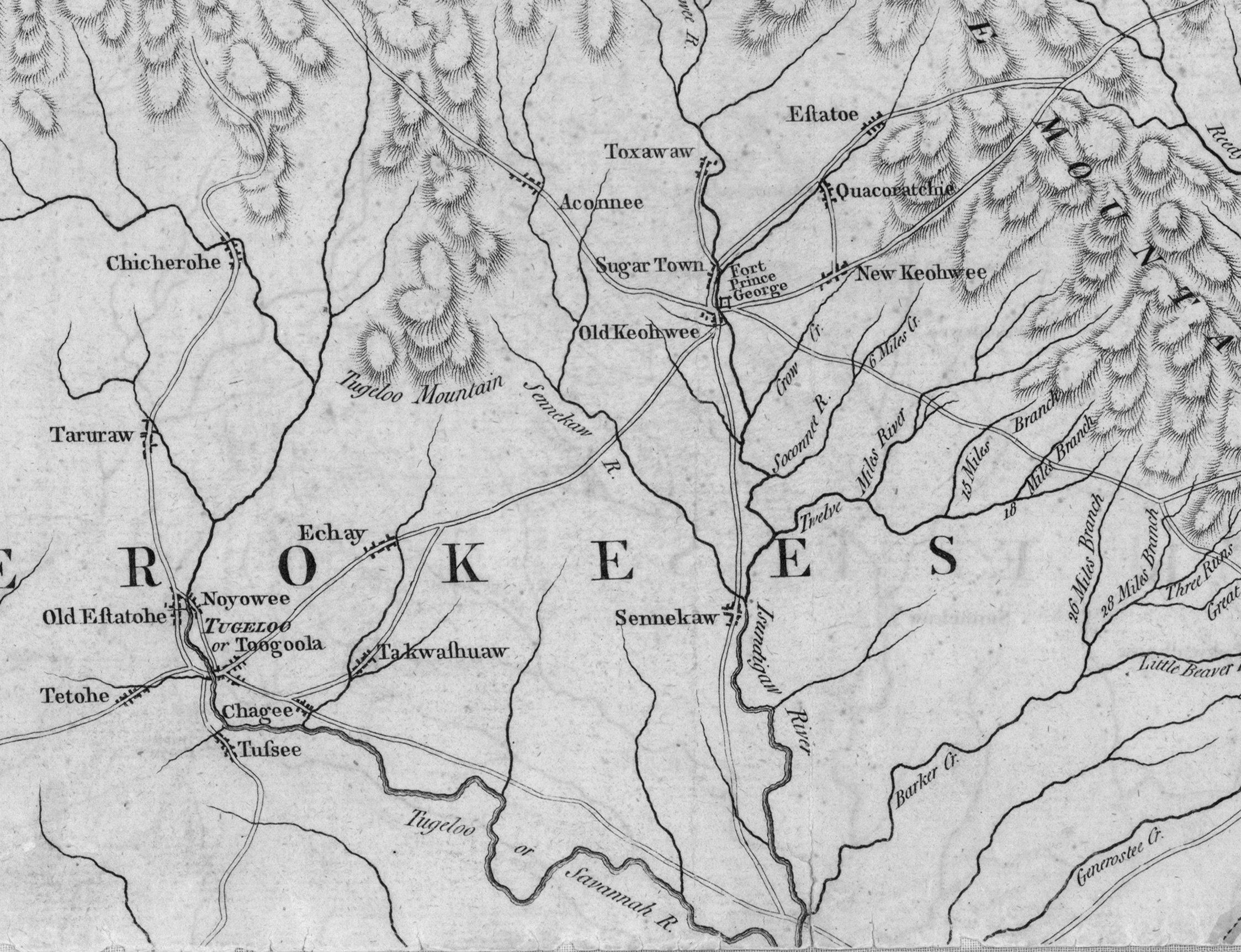
The 1771 map above shows Seneca, spelled Sennekaw. A portion of “Mouzon’s Map 1771; Mouzon, H. and Robert Sayer and John Bennett, (1775) An Accurate map of North and South Carolina with their Indian frontiers, shewing in a district manner all the mountains, rivers, swamps, bays, creeks, harbours, sandbanks, and soundings on the coast; with the roads and Indians paths as well as the boundaries, or provincial lines, the several towns and other divisions of lands in both provinces, London, printed for Robt. Sayer and J. Bennett” from the Library of Congress. hpps://www.loc.gov/item/74692510/
The Map is showing what would be the present-day Georgia/South Carolina border. Seneca and Clemson, South Carolina, are in the area shown on the map as Sennekaw and Old Keohwee. (A special note, Chief Little Turkey’s wife is from Keohwee. To be explained later in its own post.)
Another confirmation on the name comes from John McDonald, Chief John Ross’ maternal grandfather, stated. “By the loyal part of the Nation, I mean those that continued friendly to the English during the late American War and who have since thrown themselves, under the protection of his Cotholick Majesty—they compose the lower part of the nation, and comprehends nine towns including Villages, viz. Turnip Mountain town, TurkiesTown, or New Seneca—Wills Town—Lookout Mountain—Chickamoga, but now the Running Water, Necojackie, Long Island—Craw & Wassatie the last five are Situated on the Cherokee or Tennnessie River. . .“ (Letter of John McDonald to Henery White, Governor & Commander in Chief in Pensacola West Florida, August 17, 1794. Google Books, eBook. Annual Report of the American Historical Association for the year 1945 in four volumes. Volume IV, Spain in the Mississippi Valley, 1765-1794. Edited by Lawrence Kinnaird, Part III Problems of Frontier Defense 1765-1794, page 336.)
John McDonald and the family moved to Turkey’s Town about 1788, as his son-in-law Daniel Ross stated. During their time living in Turkey’s Town, John Ross was born. John Ross would become the “Principle Chief” of the Nation in 1827.
There are other documents as dictated by Chief Little Turkey from New Seneca. Example web link; https://webarchive.loc.gov/all/20211105005929/https://memory.loc.gov/cgi-bin/ampage?collId=llsp&fileName=007/llsp007.db&recNum=4
Conclusion.
The name of this village is New Seneca. It was referred to as Turkey’s Town.
The name New Seneca evolved into Turkey’s Town, Turkey Town, and then modern-day Turkeytown. When a name is not a name, we start this journey. Uncovering the History of Turkeytown or Dah-noo-wey-ye.
Next time, we will look at where Turkeytown is located. James Mooney stated it is one mile South of Centre, Alabama, on the West bank of the Coosa River. Historians have stated the town is underwater near Cedar Bluff, Alabama. Others the town may be in Etowah County, Alabama, at Turkeytown Creek.
Where is the physical location? We need to hear the Cherokee people. What do they say?
Next post 21 January 2025. Uncovering the History of Turkeytown, Traditional Location.
Trust in the Lord with all your heart, and do not rely on your own understanding;
in all your ways know him, and he will make your paths straight. Proverbs 3; 5-6 CSV
 New Seneca Turkey's Town